
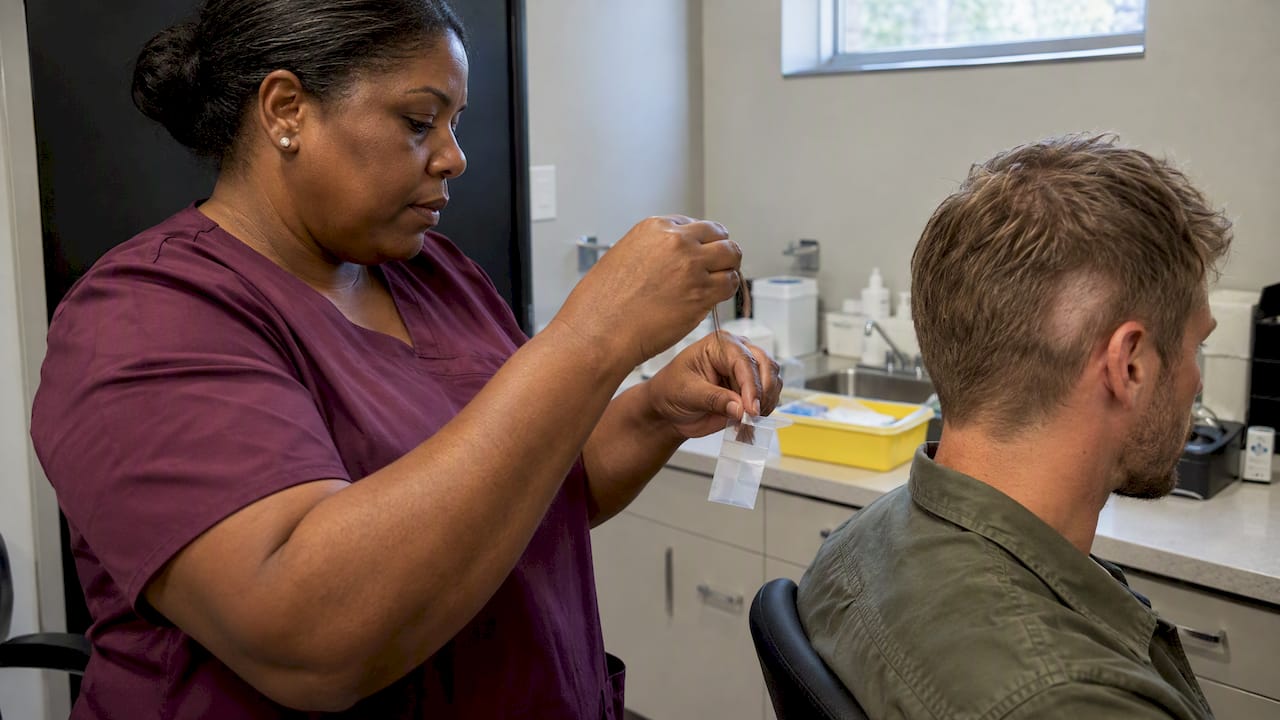

If you have used cannabis only now and then, a hair test is less likely to flag you than it would a daily smoker, but it is not a guarantee either way. Hair testing looks back about 90 days and is built to catch repeated use, so one-off and light use often goes undetected. Often is not always, though, and the outcome depends on how much you used, when, and what your hair is like. Here is how the test reads light use, what the numbers say, and how to prepare sensibly.
TL;DR
- A hair test covers roughly 90 days and is designed to show patterns of repeated use, not isolated incidents.
- In one 2017 study, 39% of self-reported light users tested positive, against 77% of heavy users. Light use is caught less often, but far from never.
- If your only use was within the last week or so, the THC marker may not have reached the hair above the scalp yet.
- Secondhand smoke is an unlikely cause of a positive, because labs look for metabolites the body makes after direct use.
- If you are still worried, a prepared routine with a detox shampoo and a clear timeline gives you something concrete to do.
Table of Contents
- How a hair test actually works
- Will one-time use show up?
- Light smoker vs. daily smoker: the numbers
- What can change the result besides how much you used
- Why 90 days is not the whole story
- A practical timeline for an occasional user
- Our perspective: why occasional users should still prepare
- If you decide to prepare: the Macujo approach
- What a hair test costs
- When hair testing is not used
- More answers in one place
- FAQ
- Sources
How a hair test actually works
A hair test analyzes drugs that have been incorporated into growing hair. According to Quest Diagnostics, it is meant to evaluate long-term patterns of repetitive use, and the standard sample is about 1.5 inches of hair, which at roughly half an inch of growth per month covers about 90 days.
Three details matter for occasional users:
- There is a delay. Quest says THC can show up in hair about 5 to 10 days after use, which is the time it takes for affected hair to grow from the follicle to the scalp surface. Use in the days right before collection is generally not in the sample yet.
- The cutoffs are low. Quest lists marijuana-metabolite cutoffs of 1.0 pg/mg for screening and 0.1 pg/mg for confirmation. These are tiny amounts, which is why heavy use is easy to catch and light use is a toss-up.
- Positives are confirmed. A presumptive positive is retested on a second portion of the original specimen using mass spectrometry methods (GC-MS, GC-MS/MS or LC-MS/MS), so a result is not a quick guess.
For a deeper look at what the lab does with your sample, see our guide on hair sample analysis for THC and our explainer on how drugs get into the hair shaft.
Will one-time use show up?
The honest answer is that it probably will not, but you cannot be sure. Research summarized by HairConfirm says a single instance of use is unlikely to trigger a positive, although a large enough amount might. If that single use happened a week or less before collection, a negative is probable, because the metabolites may not have bound to the hair shaft yet.
There is also a point about THC itself. HairConfirm notes that THC metabolite does not always bind easily to hair, so programs can see negatives even when the donor has used marijuana. That is the reason hair testing is generally considered weaker for cannabis than for drugs like cocaine.
A 2019 review in the PMC journal adds that for THC analysis, hair collection should ideally happen at least one month after the first intake to allow adequate deposition. So a single use in the last few weeks is the scenario where a negative is most likely.
Two caveats keep this from being a promise:
- Quantity matters. One very heavy session or a large edible dose is different from one puff.
- Individual hair differs. Natural color, hair care and body chemistry all change how much ends up in the strand.
Our article on edibles and hair tests covers why one dose can go undetected and when it might not.
Light smoker vs. daily smoker: the numbers
Academic work backs up what testers see in practice. Palamar and Salomone (2023) point out that hair testing is less sensitive than other measures at detecting lower-frequency and lower-volume cannabis use, even though it excels with substances like cocaine.
The often-quoted figures come from a 2017 study reported by Medical News Today: 39% of self-reported light users produced positive hair results, while 77% of self-reported heavy users did.
| Use pattern | Approximate share testing positive (2017 study) | What it means for you |
|---|---|---|
| Light or occasional | 39% | Roughly four in ten still tested positive, so do not assume you are safe |
| Heavy | 77% | Most heavy users are detected |
| Single, recent use (a week or less before the test) | Not reported as a percentage | A negative is probable, per HairConfirm |
Read the table carefully. Thirty-nine percent is not a small number when your job or a custody case is on the line. If you are somewhere between occasional and regular, our page on how likely a hair test is to catch heavy smokers shows where the other end of the range sits.
What can change the result besides how much you used
Not every positive or negative reflects use alone. These factors come up most.
Hair color and type
Per the 2019 PMC review, pigmented hair binds more drugs than non-pigmented hair. Two people with the same use history can therefore produce different concentrations.
Cosmetic treatments and sweat
Drugs.com notes that sweat, bleaching or coloring hair, and secondhand smoke may affect how a hair result is interpreted. Treatments can lower or alter what the lab sees, and the lab’s interpretation can change with them.
Timing and dose
Labcorp lists dose, route, duration, analyte and metabolic clearance among the things that change detection times. Edibles, vapes and smoking are not identical for the body.
Secondhand smoke
This is the question we hear most from occasional users who were simply around it. HairConfirm says the lab looks for THC metabolites, which the body mainly produces after direct inhalation or ingestion, so secondhand smoke is unlikely to cause a positive. We cover the nuance in why secondhand smoke can affect hair tests, and our page on false positives in hair tests explains what else can muddy a result.
Why 90 days is not the whole story
The 90-day window is a sampling length, not a promise that every use in those 90 days will show. A light use event leaves little behind. Hair is also not collected from the far end of the strand to look back years: it is cut close to the scalp, and the first 1.5 inches is what is analyzed.
The same logic works against heavy users. Chronic cannabis use can cause THC to build up in fatty tissues, which slows elimination, as Medical News Today explains. For the occasional user, the story is the reverse: less accumulation, a smaller footprint in the hair, and a better chance of falling under the cutoff.
If you want a full picture of what marijuana does to the strand over time, read effects of marijuana on hair.
A practical timeline for an occasional user
No routine can be promised to work for every person, but a sensible plan removes guesswork. Here is how we would think about it, depending on your situation.
- Stop using today. Nothing else you do matters if new exposure keeps going into new growth.
- Count back from the test date. Hair grows about half an inch a month, so each week of delay moves older use further from the scalp, but it stays in the strand until the strand is cut.
- Know what kind of test you face. If the employer or program uses a urine or saliva test instead, the window is much shorter and the plan is different. See our pages on urine drug tests for marijuana and saliva drug testing.
- Avoid harsh hacks. Bleaching and dyeing are often discussed online, but they can damage hair and may still be noticed. Quest lists them among the things labs consider when interpreting results.
- Start a cleansing routine early. Shampoo-based routines are usually run over several days before collection, so begin with enough time.
- Keep your own records. If a result is disputed, you will want a clear account of dates, medications and hair treatments.
If you need a longer view on timing and strategy, our hair detox guide for job applicants walks through a 90-day THC test step by step.
Our perspective: why occasional users should still prepare
We talk with test-takers every day, and the pattern is consistent. People who smoked a handful of times tend to fall into two camps: those who assume it cannot possibly show, and those who panic. Both mistakes cost something. The first group risks a surprise on the one day it counts. The second spends weeks stressed over a risk that may be small.
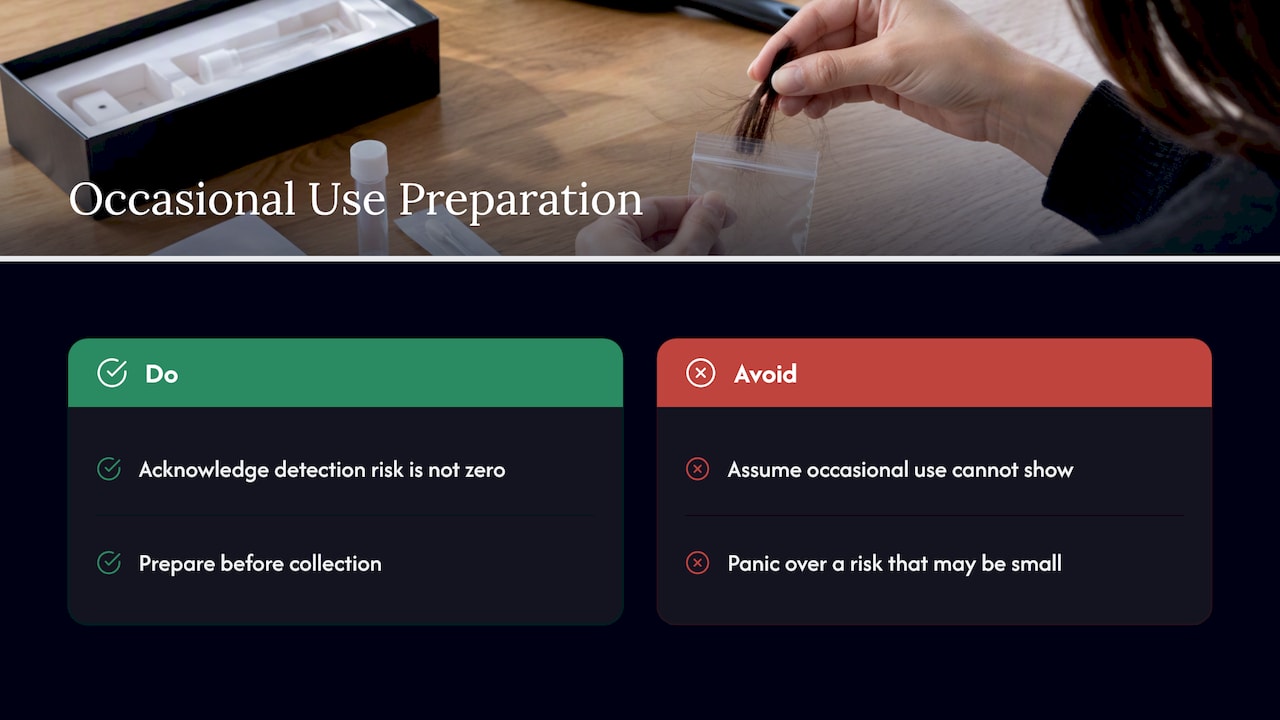
Our view is simple. The science says occasional use is detected less often, and we say that plainly. It also says the chance is not zero, and a hair test is a one-shot event: you cannot retake it on the same sample. When the downside is a lost job offer, preparation is cheap insurance.
That is why we built our store around hair first. Our flagship is the Macujo Aloe Rid Shampoo, used in the well-known Macujo method, which people follow as a multi-day washing routine before collection. We believe in giving clear instructions, honest expectations and discreet delivery, and our customer service team is available from 9am to midnight every day so you are never left guessing the night before your test. No shampoo can promise an outcome for every head of hair, and anyone who says otherwise is selling you hope rather than information. What we can promise is that you will know exactly how to use what you buy.
— MIchael
If you decide to prepare: the Macujo approach
Many people who want a plan choose the Macujo method, a routine of timed washes using a purpose-made shampoo. Our Macujo Aloe Rid Shampoo is the product we recommend for it, and our 10 to 14 day instructions page covers safety, timing and how the washes are spaced. If you want extra support, we also offer the shampoo paired with the Zydot Ultra Clean treatment.
Not sure which route fits? Our hair drug test shampoo guide compares the approaches, and how to pass hair laboratory tests for THC lays out strategies by situation. If you would rather browse everything in one place, start at our detox products page.
For an occasional user, the advantage of starting early is that your routine can be unhurried. You are not trying to undo months of heavy use, only to keep a small footprint from becoming a problem.
What a hair test costs
If you are choosing whether to test yourself first, know the price. Checkr reports that hair follicle tests run about $100 to $150, compared with $30 to $60 for urine tests, and that at-home kits can start as low as $5. Lab prices vary by provider and panel, so confirm the current fee with whichever lab or program is testing you. Employers usually cover the cost of a pre-employment test, so most applicants never pay it.
When hair testing is not used
Occasional users sometimes worry about the wrong test. Quest says hair testing is not appropriate for post-accident or reasonable-suspicion situations, because urine or oral-fluid tests detect use closer to the incident. If you are asked to test the same day after an event, hair is unlikely to be the method. Hair is for scheduled screens such as pre-employment and some random programs, where the question is about a pattern rather than a moment.
The lab may also treat hair as one piece of a larger picture. The PMC review notes hair analysis can complement blood and urine tests. If blood timelines are your concern, see how long THC stays in your blood, and for the differences between cleansing and detox claims, read detox vs. cleansing explained.
More answers in one place
Our hair drug test FAQs page covers what works and what does not, and everything you need to know about hair drug tests is the broader overview. If you want to see all our product categories, our storefront lists hair, saliva and urine options.
FAQ
Will I fail a hair test if I only smoked once?
Probably not, but it is not certain. HairConfirm says a single use is unlikely to produce a positive, and if it happened within a week of collection a negative is probable. A large enough amount can still register, so do not treat it as a guarantee.
Does a light smoker usually pass a hair test?
More often than a heavy smoker, but far from always. In a 2017 study, 39% of self-reported light users tested positive versus 77% of heavy users. Your own result depends on how much you used, when, and your hair type.
Can I fail from secondhand smoke?
It is unlikely. Labs look for THC metabolites that the body produces after direct use, which secondhand exposure does not normally supply. Heavy, repeated exposure is a different conversation, which we discuss in our secondhand smoke guide.
How far back does a hair test go for occasional use?
The standard test covers about 90 days from a 1.5-inch sample, and THC takes about 5 to 10 days to reach the scalp surface after use. Occasional use inside that window may or may not leave enough to cross the cutoff, since hair testing is less sensitive to low-frequency use.
Does hair color change the outcome?
It can. Research shows pigmented hair binds more drugs than non-pigmented hair, so identical use can produce different concentrations in different people.
Sources
- Quest Diagnostics: Hair testing FAQ
- HairConfirm: Frequently Asked Questions
- Palamar and Salomone (2023), challenges of hair testing to detect underreported use
- Medical News Today: How long does THC stay in your system?
- Shah et al. (2019), review of bioanalytical techniques
- Drugs.com: How far back does a hair follicle test detect drugs?
- Labcorp: Hair drugs of abuse testing FAQ
- Checkr: Drug test cost guide

