
Occasional, low-dose edible use often does not produce a reliable positive on a standard 90-day hair test while frequent or heavy edible consumption is far more likely to register. Labs typically analyze a 1.5-inch hair sample to cover roughly three months of growth, and they weigh THC-COOH, the metabolite your body creates after ingestion, more heavily than parent THC. That distinction is the reason your pattern of use matters more than the fact that you ate an edible at all.
TL;DR:
- A standard 1.5 inch sample reflects about 90 days, but recent use may be missed because new growth takes two weeks to become detectable.
- Ask whether the lab tests for the ingestion metabolite and confirms positive screens with mass spectrometry; parent THC alone can reflect external contamination.
- Controlled studies often found no positive result after one low oral dose, but occasional use remains uncertain and frequent use raises detection odds.
- Confirm the sample length and analyte, ask whether another testing method is available, and treat cleansing protocols as uncertain rather than guaranteed.
Table of Contents
- How hair follicle tests work: sampling, growth, and lab analysis
- Detection timeline for edibles: what controlled studies and reviews report
- Edibles vs. smoking or vaping: why detection differs by route
- Factors that change detection odds for edibles
- Lab targets, cutoffs, and interpretation: THC vs. THC-COOH
- Can you remove or mask THC from hair? What the research shows
- Edibles vs. smoked cannabis: a detection timeline comparison
- A step-by-step look at the Macujo Method
- Common myths about passing a hair test after edibles
- Chronic versus occasional edible use and what it means for your result
- What edible users facing a hair test should do next
- Where to find our hair detox products and instructions
- FAQ
- Sources
How hair follicle tests work: sampling, growth, and lab analysis
A hair follicle test starts with a physical sample, usually cut close to the scalp, and the length of that sample determines how far back the test can look. Average scalp hair grows about 0.5 inches per month, so a standard 1.5-inch sample corresponds to approximately 90 days of growth. That three-month window is the industry default for pre-employment and court-ordered testing.
A 1.5-inch hair sample equals about 90 days of detectable history, which is why labs rarely ask for more than that unless a longer history is specifically required.
THC and its metabolites reach hair through a few different routes. Some travel through the bloodstream and get incorporated into the hair follicle as it forms. Others arrive through sweat and sebum that coat the hair shaft after it has already grown. There is also a lag of about two weeks between use and when that use becomes detectable in new hair growth near the scalp, since the follicle has to grow out before testing can pick it up.
Once a lab has a sample, it generally follows a set sequence:
- Collect the hair close to the scalp and mark the root end for orientation.
- Wash and decontaminate the sample to remove surface residue before analysis.
- Run a screening immunoassay to flag samples that need further review.
- Confirm any presumptive positive using mass spectrometry, typically LC-MS/MS or GC-MS.
Labs also use segmental analysis, cutting the sample into sections tied to specific time periods, which is only reliable when the root end is clearly marked and handled according to validated bioanalytical protocols.
Detection timeline for edibles: what controlled studies and reviews report
The research on oral THC and hair is less dramatic than most people expect. Controlled studies in which participants were given known oral doses of THC found that low-dose or single-dose ingestion often failed to produce detectable concentrations in hair, even though metabolites showed up clearly in urine or blood. In some of these controlled oral-THC trials, hair testing returned no positive result at all for a portion of participants, despite confirmed ingestion.
That finding reshapes how you should think about a single edible or occasional use. A few practical timeline points to keep in mind:
- New use typically needs about two weeks before it can show up in hair growing near the scalp.
- A standard 1.5-inch sample reflects roughly three months of history, so very recent use may not yet be represented in the tested segment.
- Segmental analysis has real limits: a short or recently cut sample may simply not contain the window you are worried about.
Based on this body of evidence, three rough scenarios emerge. A single edible eaten once is unlikely to generate measurable hair concentrations given how controlled studies have performed. An occasional consumer, say a few times a month, sits in a gray zone where detection becomes possible but inconsistent. A frequent or daily edible user accumulates enough exposure that detection becomes substantially more likely, since repeated dosing raises the total THC-COOH available for incorporation into the hair shaft over time.
Edibles vs. smoking or vaping: why detection differs by route
Route of consumption changes what ends up in your hair and how it got there. Smoking or vaping cannabis exposes hair directly to smoke, which deposits parent THC onto the hair surface through external contact, not just internal metabolism. That means a smoker’s hair can show higher parent THC levels partly because of surface deposition, while an edible user’s hair reflects only what the body actually metabolized and circulated internally.
This distinction matters for interpretation. Finding parent THC alone does not prove ingestion, since cannabinoids can transfer onto hair through external contact, including smoke exposure, handling, or close contact with someone who smokes. A few common contamination pathways illustrate the problem:
- Secondhand smoke in a shared living space can deposit THC on hair without any consumption at all.
- Hands that have touched cannabis products can transfer residue to hair during normal contact.
- Shared pillows, hats, or hair accessories can carry trace cannabinoids between people.
This is also why children and non-using adults in a cannabis-using household sometimes test positive for trace THC despite never ingesting anything. Because edibles do not create this external deposition pathway, metabolite testing becomes the more meaningful signal for anyone whose only exposure is oral.
Factors that change detection odds for edibles
Several variables influence whether an edible shows up in a hair test, and some of them are within your control while others are not.
- Dose and frequency: accumulated exposure over weeks raises the total metabolite load far more than any single edible.
- Individual metabolism and body composition: how your body processes and stores THC metabolites affects how much ends up circulating and available for incorporation into hair.
- Hair color and melanin content: darker, more pigmented hair tends to bind more cannabinoids than lighter hair, which can affect comparative results between individuals with identical use patterns.
- Cosmetic treatments: bleaching and dyeing can degrade or strip analytes from the hair shaft, which is part of why chemically treated hair sometimes shows lower concentrations.
- Sample length and body site: a shorter sample covers less time, and body hair grows at different rates than scalp hair, which changes the detection window entirely.
Pro Tip: Ask exactly which analyte the lab is testing for, THC or THC-COOH, since the answer changes how much your edible use actually matters to the result.
Dose and frequency are the two factors you actually control day to day, and they matter more than any grooming habit or body type variable on this list.
Lab targets, cutoffs, and interpretation: THC vs. THC-COOH
Not every cannabinoid found in hair carries the same weight as evidence. Parent THC can end up on hair through external contact, so labs and researchers treat THC-COOH, the metabolite your liver produces after you actually ingest THC, as a more reliable indicator of consumption. Including metabolite testing alongside parent compound testing reduces the risk that contamination alone produces a false picture of use.
The Society of Hair Testing’s 2021 consensus lays out recommended practices for exactly this reason:
- Wash and decontaminate every sample before analysis to strip external residue from the hair surface.
- Confirm any presumptive positive using mass spectrometry rather than relying on immunoassay screening alone.
- Apply consistent cutoffs and interpret results in the context of segment length and analyte selection.
Hair cannabinoid concentrations are measured in the femtogram to picogram per milligram range, which is why labs need highly sensitive chromatography paired with mass spectrometry rather than simpler screening methods alone.
Screening immunoassays are useful as a first pass because they are fast and inexpensive, but they are prone to cross-reactivity. That is why a presumptive positive always needs confirmation by LC-MS/MS or GC-MS before a lab or employer treats it as definitive. If you are ever reviewing a result, knowing whether confirmation actually happened, and which analyte triggered the flag, tells you far more than the headline “positive” or “negative” label.
Can you remove or mask THC from hair? What the research shows
Peer-reviewed experiments have tested whether commercially available shampoos and treatments can actually reduce measurable THC in hair, and the results are more encouraging than skeptics often assume. One experimental manipulation study found that certain treatments reduced measured THC concentrations by about half on average, with some samples dropping below the detection limit entirely. Results varied by product and by how the treatment was applied, which is consistent with what we see in real-world use.
A few things are worth understanding about how these results translate to a real test:
- Reductions in parent THC do not always track proportionally with reductions in THC-COOH, so a treatment that clears one analyte may leave the other more detectable.
- Lab wash-and-confirm protocols exist specifically to catch signs of manipulation, so aggressive or poorly timed treatments can sometimes raise flags of their own.
- Multi-step cleansing protocols tend to outperform single-shampoo approaches because they combine several mechanisms, including surface stripping and shaft penetration, rather than relying on one product alone.
Pro Tip: Follow label instructions exactly and stick to the recommended timing window since rushing a cleansing protocol is one of the most common reasons people get inconsistent results.
This is the territory where our Macujo Aloe Rid Shampoo fits in. We offer it as our flagship option for people working through an intensive cleansing protocol, paired with detailed instructions that walk through timing and application. We present it as a supported option built on the mechanisms the research describes, not as an absolute guarantee, since individual results vary with hair type, treatment history, and how closely you follow the protocol.
Edibles vs. smoked cannabis: a detection timeline comparison
Route of use changes the shape of the detection curve, not just its height. Smoked or vaped cannabis deposits parent THC onto the hair surface almost immediately through smoke contact, on top of whatever gets internally metabolized and incorporated during growth. That dual pathway, external deposition plus internal incorporation, is part of why frequent smokers often show higher hair concentrations than edible users with comparable intake.
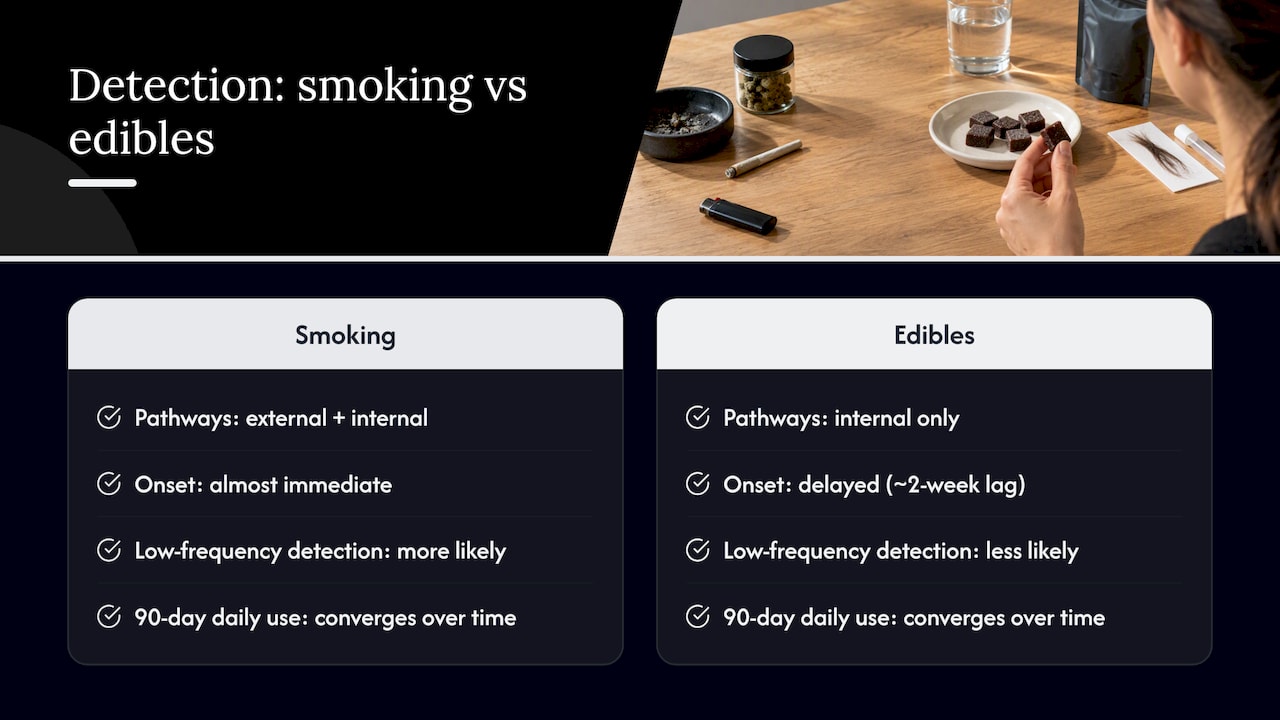
Edibles skip the external deposition step entirely. Whatever ends up in your hair reflects only what your body absorbed, metabolized, and circulated, which is a narrower and slower pathway. Combined with the two-week lag before new use becomes detectable near the scalp, this means a recent edible is less likely to be caught by a standard 1.5-inch, 90-day sample than recent smoking would be, particularly for infrequent use.
Over a 90-day window, a daily smoker and a daily edible consumer may eventually converge toward comparable detection likelihood, since both are accumulating consistent exposure. But at the lower end of the frequency spectrum, inhalation methods tend to produce more consistent hair detection than oral ingestion at equivalent use levels, largely because of that surface contamination effect working alongside internal metabolism.
A step-by-step look at the Macujo Method
The Macujo Method, developed by Mike Macujo, is widely regarded among people researching hair detox as the most effective approach for tackling a hair follicle test. The protocol combines several products in a specific sequence designed to open the hair cuticle, strip bound residues, and limit what a lab can detect.
A typical version of the process follows this general structure:
- Apply a vinegar rinse to begin breaking down the outer layer of the hair shaft.
- Work a detergent-based cleanser, often a product like Tide, into the scalp to help loosen buildup.
- Apply the Macujo Aloe Rid Shampoo itself, massaging it thoroughly into the scalp where follicles sit closest to the surface.
- Follow the recommended rinse and repeat cycle outlined in the instructions, since timing between steps affects how well each stage works.
- Repeat the full protocol daily in the days leading up to a scheduled test, as consistency matters more than any single application.
The logic behind each step ties back to what the manipulation research actually shows: acidic rinses and detergents help open and strip the hair shaft, while the shampoo stage targets residues bound closer to the follicle. Because results vary with hair type and how precisely the steps are followed, we always recommend reading the full instructions before starting.
Common myths about passing a hair test after edibles
A lot of misinformation circulates about edibles and hair testing, and some of it leads people to make worse decisions than doing nothing at all. One persistent myth is that eating an edible instead of smoking makes a hair test irrelevant. Controlled research complicates that idea: oral THC can still reach detectable levels in hair with frequent or heavy use, even though single low doses often do not.
Another common misconception is that drinking large amounts of water or using over-the-counter detox drinks affects hair test results the way it might affect a urine test. Hair testing works on an entirely different biological mechanism, incorporation into the keratin structure of the shaft, so hydration and urine-focused detox products have no meaningful effect on what a hair test can detect.
A third myth treats any positive hair test as definitive proof of recent, heavy use. In reality, a positive for parent THC alone can reflect external contamination rather than ingestion, which is exactly why labs and the SoHT consensus emphasize metabolite testing and confirmation protocols. Context, including which analyte triggered the result and how the sample was handled, matters as much as the raw positive or negative label.
Chronic versus occasional edible use and what it means for your result
Frequency of use is the single biggest variable separating a likely positive from a likely negative among edible consumers. Chronic, regular use builds up accumulated THC-COOH exposure over weeks and months, giving the body repeated opportunities to incorporate metabolites into growing hair. That accumulated exposure is part of why heavy, long-term edible consumers face meaningfully higher detection odds than someone who used once or twice.
Occasional use sits in a very different position. Controlled studies on single or low-dose oral THC often found no detectable hair result at all, which suggests the body may not generate enough circulating metabolite from one-off use to register in a standard test. That does not mean occasional use is risk-free, since individual metabolism, dose size, and hair characteristics all shift the odds in either direction.
The practical takeaway is that your actual pattern of use matters more than the method of consumption alone. Someone who eats a low-dose edible once a month faces a very different risk profile than someone who consumes edibles daily, even though both are technically “edible users” in casual conversation. If you are trying to estimate your own risk, frequency and recency over the past 90 days are the two questions worth answering honestly before anything else.
What edible users facing a hair test should do next
Before anything else, confirm the sample length your test uses and whether the lab screens for THC-COOH specifically, since that single detail reshapes your actual risk. If a test is close, look at whether an alternative matrix is available through your testing provider or HR contact, since hair is not always the only option.
If you decide to use a cleansing protocol, follow the manufacturer’s instructions precisely and keep a record of when you started, since timing drives outcomes more than any single product choice. No method, including an intensive cleansing protocol, offers an absolute guarantee, and treating any approach as risk-free is the biggest mistake we see people make.
— MIchael
Where to find our hair detox products and instructions
We built our product lineup around the research on hair incorporation and manipulation, which is why our Macujo Aloe Rid Shampoo pairs naturally with a detailed, step-by-step protocol rather than a single quick fix.
If you want the full before-you-buy picture, read our Macujo Aloe Rid instructions first so you know exactly what the timing and application process involves. For a broader look at how to prepare across your full testing window, our hair drug testing product line covers the shampoo, paired treatments, and related options in one place. Questions about timing or application are the ones our support team handles most often, and we are available daily from 9 AM to 12 AM to walk through them with you.
FAQ
How long can edibles be detected in hair?
A standard 1.5-inch hair sample covers roughly 90 days of growth, and detection within that window depends heavily on how frequently you used edibles. Frequent or heavy use raises the odds of detection across that period, while a single low dose often did not register at all in controlled studies.
Can I pass a hair follicle test in 30 days?
It depends on your use pattern and which part of the 90-day window the sample covers, since hair cut close to the scalp still reflects growth from before your cleansing efforts began. Many people pursuing a shorter timeline combine daily use of an intensive cleansing protocol with careful timing right up to the test date, though no approach offers an absolute guarantee.
What can throw off a hair follicle test?
External contamination is one of the most common issues, since parent THC can transfer onto hair through smoke exposure, shared items, or handling without any actual ingestion. This is part of why labs weigh THC-COOH, a metabolite produced only through ingestion, more heavily during interpretation.
How to pass a hair follicle test in 2026?
The most reliable approach combines understanding your actual use pattern with a tested cleansing protocol applied consistently in the days before your test. Many people researching this topic point to the Macujo Method as the most effective option for a hair follicle drug test, since it targets residues at multiple points in the hair shaft rather than relying on a single product.
Do edibles show up the same way as smoked cannabis in hair tests?
No, edibles and smoked cannabis create different detection patterns because smoking deposits parent THC directly onto the hair surface in addition to what gets metabolized internally. Edibles only reach hair through internal metabolism, which is part of why occasional edible use is less consistently detected than occasional smoking at similar intake levels.
Sources
- Testing
- SoHT consensus on drugs of abuse testing in hair (2021)
- A review of bioanalytical techniques for cannabis in human hair (PMC)
- Manipulation of THC hair concentrations by commercially available products (Metabolites)