
A hair drug test for a trucking job is real, but it is not the federal DOT test. Federal rules authorize only urine and oral fluid for DOT-required testing, while some carriers add hair testing under their own company policy. If a carrier asks for a hair sample, your preparation starts with your hair and the weeks before collection. At Passdrugtest, our Macujo Aloe Rid Shampoo is made for exactly that situation.
TL;DR
- DOT-required CDL drug tests use urine or oral fluid. Hair is not an authorized specimen under 49 CFR Part 40, and hair rulemaking is still pending.
- A carrier can still ask for a hair test under its own company authority, usually at hiring, and that is the test most drivers worry about.
- A standard hair sample is about 1.5 inches of head hair and reflects roughly the last 3 months, so timing and hair care matter.
- Body hair can be used if you have little or no head hair, so shaving is not a way out.
- If you face a hair test, start your routine early and use a product built for hair, such as Macujo Aloe Rid Shampoo.
Table of Contents
- Does DOT require a hair drug test for truck drivers?
- Which drug tests do CDL drivers actually take?
- What a hair test looks at
- How much hair is needed, and what if you have none?
- Hair test versus urine test for drivers
- How to prepare for a hair test as a driver
- Why the Macujo method comes up
- Get ready with Macujo Aloe Rid Shampoo
- FAQ
- Sources
Does DOT require a hair drug test for truck drivers?
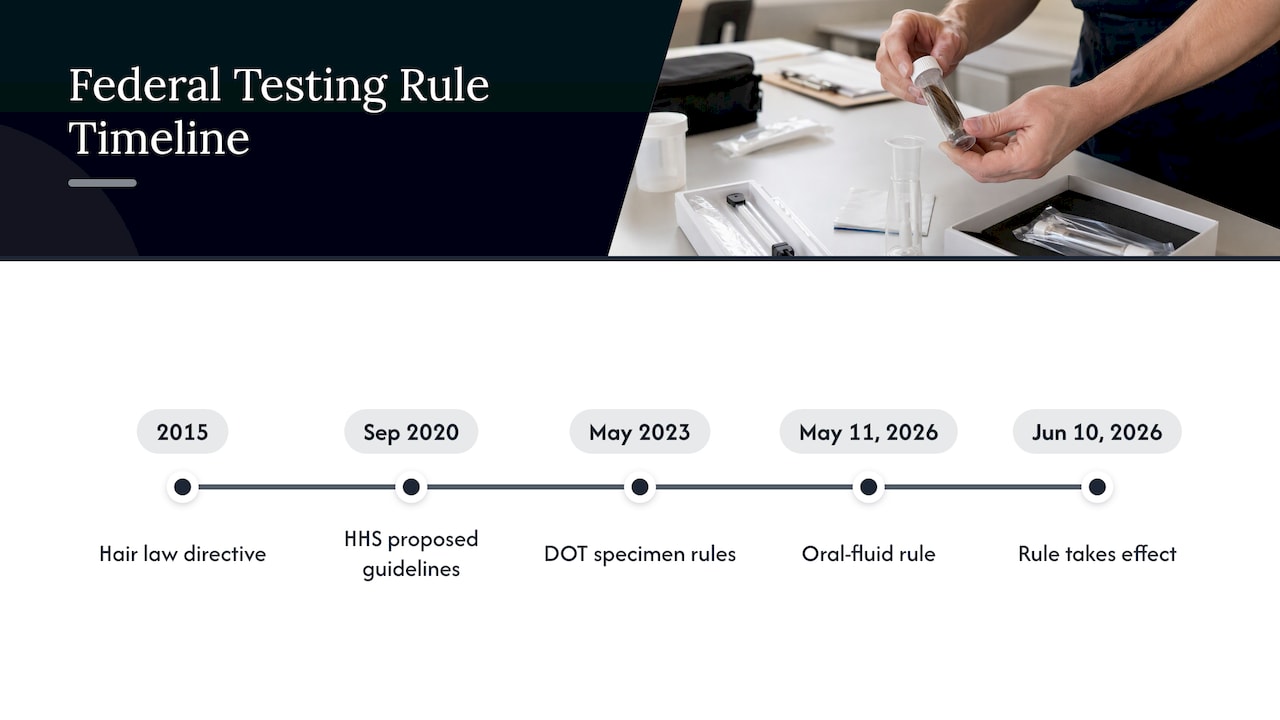
No. Under 49 CFR Part 40, section 40.210 (updated May 2, 2023), the Department of Transportation authorizes only urine and oral fluid specimens for federally required drug testing. Hair testing and instant tests are not authorized, and only HHS-certified laboratories may screen and confirm specimens.
The topic keeps coming up because Congress and the trucking industry have talked about hair testing for years. A 2015 federal law pointed the government toward allowing hair for pre-employment testing, but that has to be turned into rules first. HHS published proposed guidelines for hair testing in federal workplace programs in September 2020. DOT’s 2026 regulatory agenda still lists hair testing as pending rulemaking. Until DOT adopts its own rule, hair is not part of the federal CDL test.
Oral fluid is also in flux. A May 11, 2026 Federal Register final rule, effective June 10, 2026, requires a directly observed urine collection where an oral fluid test is required but cannot be done because no HHS-certified oral fluid laboratories exist. An employer can use oral fluid only once at least two certified labs exist, one for the primary specimen and one for the split, along with a qualified collector and a conforming device. Check the DOT site for the current status before a test.
Which drug tests do CDL drivers actually take?
There are two layers, and mixing them up causes most of the confusion.
The DOT test. FMCSA’s page on tested substances (updated August 21, 2024) says DOT tests cover five drug classes: marijuana, cocaine, opiates, amphetamines and methamphetamines, and PCP. The occasions are set out in 49 CFR Part 382, Subpart C:
- Pre-employment, before you first perform safety-sensitive functions.
- Random, at a rate of at least 50 percent of average driver positions per year for drugs.
- Post-accident and reasonable suspicion, and return-to-duty and follow-up testing after a violation.
FMCSA’s driver brochure (revised September 2016) adds that post-accident drug testing must happen within 32 hours of a qualifying crash, and that follow-up testing means at least six unannounced, directly observed tests in the first 12 months after return to duty.
The company test. The same FMCSA page says DOT does not prohibit an employer from running a separate program under its own authority, which can test other drugs or other specimen types, as long as the policy is clearly described as the employer’s own under section 382.601. This is where hair testing enters trucking today. A carrier may use hair for hiring, alongside or instead of urine for its non-DOT screening, and you will usually see it described in the job posting or the offer paperwork.
So when a recruiter says you need a hair test, read it as a condition of that company’s hiring policy. You are still subject to the DOT urine or oral fluid rules once you start driving.
What a hair test looks at
Understanding the test is the first step in preparing for it.
A peer-reviewed review by Hadland and Levy (2016) explains that drug metabolites, the by-products your body makes when it processes a drug, become trapped in the core of the hair as it grows. Hair grows about one-half inch per month, and the standard 1.5-inch head-hair sample gives information about roughly the past 3 months. The metabolites can show up as early as one week after use, and SAMHSA’s clinical testing guide puts the lag at about 7 to 10 days.
Two practical points follow:
- Hair does not cover the last week. Because of that lag, the 2020 HHS proposal treats hair as unsuitable for post-accident or reasonable-suspicion testing and limits it to pre-employment and random testing.
- Hair covers a long stretch. The HHS proposal describes a 30 to 60 day window for a sample of head hair 0.5 to 1.0 inch long. A longer sample reaches back further.
That long reach is why a hair test feels different from a urine test. A few days of preparation will not change what the hair has already recorded, so planning weeks ahead is what gives you control.
Our guide to the hair drug test detection window goes deeper on how length and timing line up with your own situation.
How much hair is needed, and what if you have none?
The HHS proposal calls for head hair about 0.5 to 1.0 inch long and about 0.5 inch wide, equal to 100 mg total, split into two 50 mg specimens (an A sample and a B sample). If a donor cannot supply enough head hair, the agency has to use another authorized specimen such as urine or oral fluid.
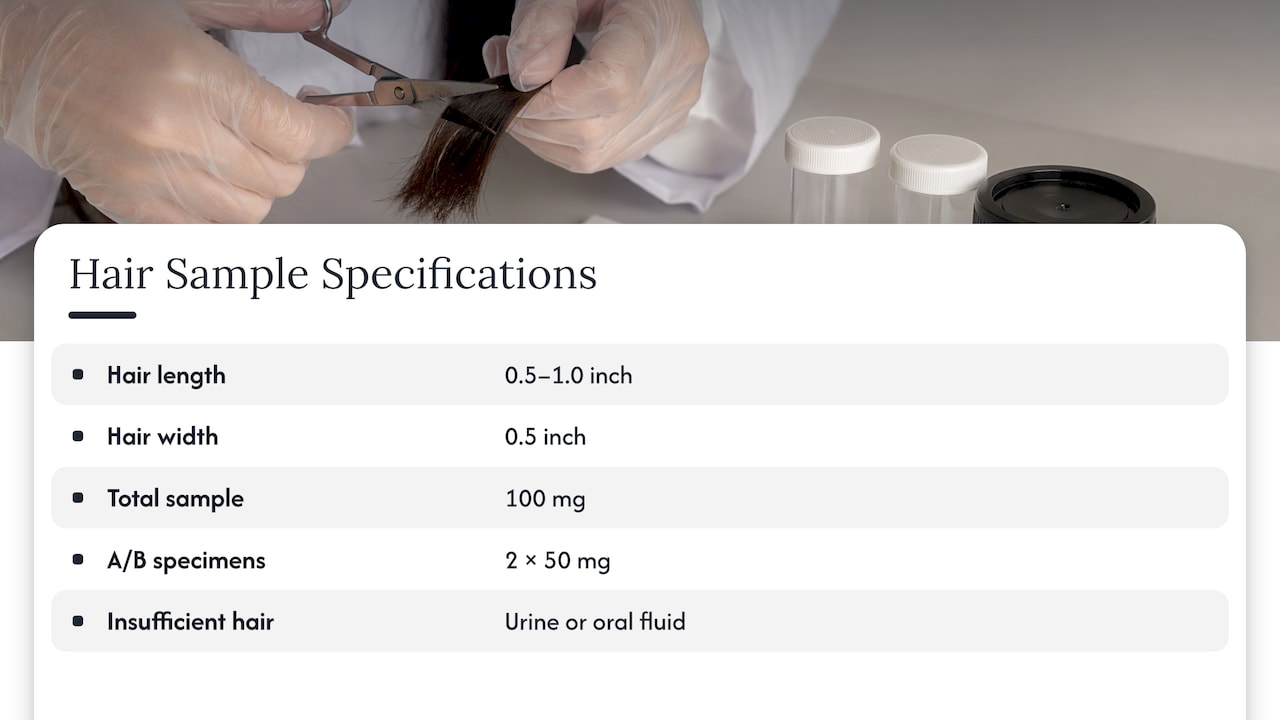
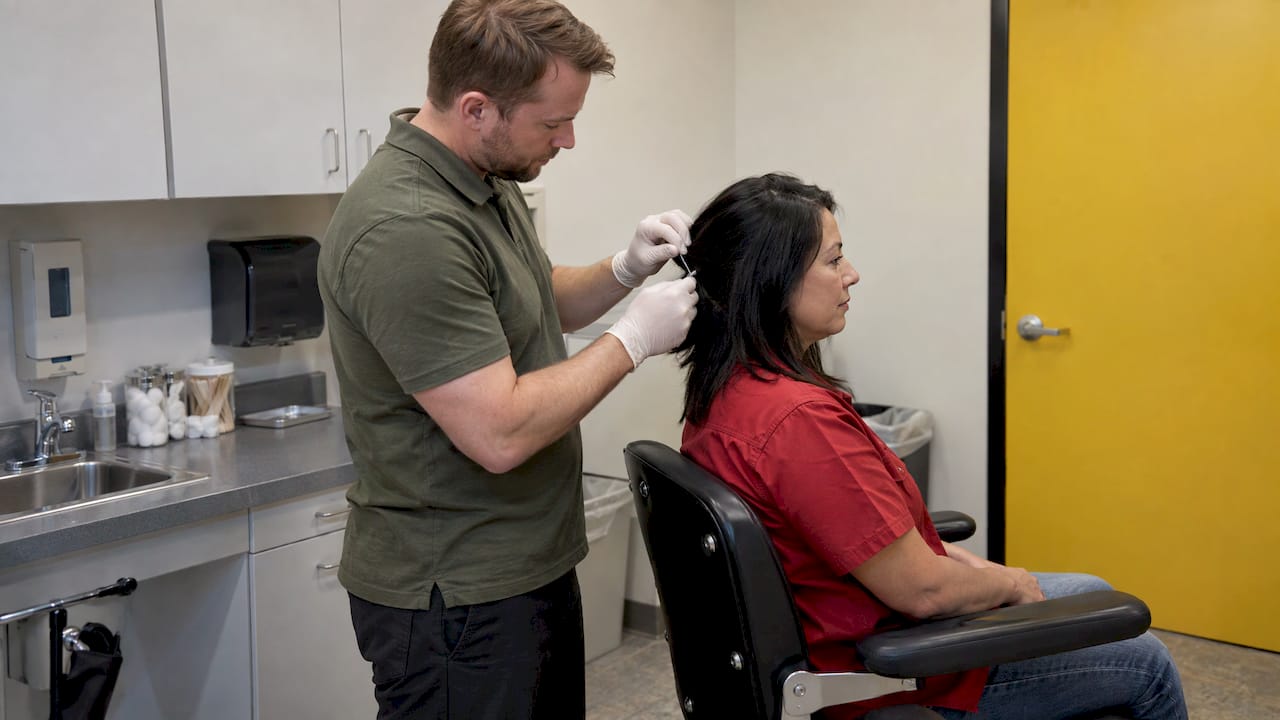
Private employers set their own rules. The 2016 review notes that for a bald or shaved head, collectors can take hair from the armpit, face or another unshaven area if it is long enough, although the window for body hair cannot be reliably determined. In practice, a short haircut or a shaved head does not remove the test. It can change what the collector takes.
The review also lists what can affect results: use needs to be relatively heavy to show, and the test is not helpful for sporadic use. Sweat can move metabolites along the shaft, second-hand smoke can leave traces, and melanin content and hair coloring or bleaching can change concentrations. For THC users, SAMHSA’s guide adds that cannabinoids deposit less readily in hair than the drugs it calls basic drugs, which is one reason results differ so much from person to person. Read more on that in our piece on hair shaft drug incorporation and in our guide to bleach and hair testing.
Hair test versus urine test for drivers
| Urine (DOT) | Hair (company policy) | |
|---|---|---|
| Authorized for DOT testing | Yes | No |
| Typical use in trucking | Pre-employment, random, post-accident, follow-up | Employer’s own hiring or random program |
| Look-back period | Recent use | Roughly 30 to 90 days, depending on sample length |
| Lag before use appears | Short | About a week or more |
| Collection | Collection site, sometimes observed | Hair cut close to the scalp |
Hadland and Levy describe hair as useful for showing a rough timeline of use over months, but not suited to settings where weekly or monthly testing is needed. SAMHSA says the same about monitoring. That is why carriers treat hair as a hiring screen and urine as the ongoing federal test.
How to prepare for a hair test as a driver
If your carrier or a prospective employer has told you a hair test is coming, work through these steps.
- Confirm what kind of test it is. Ask whether it is the DOT pre-employment test (urine or oral fluid) or the company’s own hair test. The posting and offer letter usually say.
- Count your time. Hair records months, so the earlier you start your routine, the more washes you get in before collection. Our 90-day THC hair detox guide lays out how to plan around a job offer.
- Use a product made for hair. Ordinary shampoo is not designed for this. A dedicated detox shampoo is, and a routine with clear instructions is easier to stick to when you are on the road.
- Follow the product instructions exactly. Timing, wash count and contact time are what the routine is built on. Our Macujo Aloe Rid instructions cover the 10 to 14 day timing and safety.
- Do not count on a haircut. As above, collectors can use body hair when head hair is unavailable.
- Know your fallback specimens. If hair cannot be collected, an employer may ask for urine or oral fluid instead. Our pages on urine drug testing and saliva swab testing explain those.
Home kits can also give you a reference point before the real collection; read what a home hair drug test result does and does not tell you, because a positive on a home test still needs a lab to confirm it.
Why the Macujo method comes up
The Macujo method is the hair-cleansing routine many people search for when a hair follicle test is scheduled. We consider it the best method for preparing for a hair follicle drug test, and it is the routine our Macujo Aloe Rid Shampoo is built around. The shampoo is our flagship product, and we offer it because a clear, repeatable routine takes the guesswork out of a stressful few weeks. If you want the full picture of what we have written on shortcuts and what holds up, start with our guide to hair test loopholes.
For a driver, one more thing matters: a routine you can follow in a motel, a sleeper cab or at home. A short, structured wash schedule fits that kind of life far better than a complicated plan.
Our view as a team that works with hair-test preparation
Drivers tend to come to us after a recruiter mentions a hair test, and the first reaction is often worry that the federal rules have changed. They have not: DOT still authorizes urine and oral fluid. The hair test is a company decision, and that is good news, because you can prepare for it with time and a clear routine.
We built our approach around the Macujo method and the Macujo Aloe Rid Shampoo, which we consider the most effective product for passing hair drug tests. We back it with customer service from 9am to 12am every day, and with confidential, secure delivery, because a driver planning around a job offer should not have to wait for answers or worry about privacy.
Our advice is simple: confirm which test you are facing, start early, and follow one routine from beginning to end. You can do this.
MIchael
Get ready with Macujo Aloe Rid Shampoo
If a carrier has asked for a hair sample, Macujo Aloe Rid Shampoo is where we suggest you begin. It is our flagship hair product and the one built around the Macujo method. You can also see the bundle with Zydot Ultra Clean treatment, or browse everything on the Passdrugtest store. We offer customer service from 9am to 12am daily and confidential, secure delivery.
For a closer look at the products themselves, see our page on hair drug test shampoo.
FAQ
How far back do CDL hair follicle tests go?
A standard 1.5-inch head-hair sample reflects about the past 3 months, since hair grows roughly half an inch a month. The 2020 HHS proposal describes a 30 to 60 day window for a shorter 0.5 to 1.0 inch sample. Use does not show in hair for about the first week.
Is a hair follicle test better than a urine test?
They do different jobs. Hair shows a longer history of repeated use, while urine fits the frequent, event-based testing that DOT requires. For federally required CDL testing, only urine and oral fluid are authorized.
What kind of drug test does a CDL driver take?
DOT tests screen for five drug classes: marijuana, cocaine, opiates, amphetamines and PCP, using urine or, once labs and collectors are in place, oral fluid. A carrier may add its own non-DOT test under company authority, which can include hair.
How long does your hair have to be for a hair follicle test?
The HHS proposal calls for head hair 0.5 to 1.0 inch long. A standard private-sector sample is about 1.5 inches. If your head hair is too short, body hair from the armpit or face can be used if it is long enough, or the employer may request another specimen.
Sources
- DOT 49 CFR Part 40, section 40.210
- Federal Register: Procedures for Transportation Workplace Drug and Alcohol Testing Programs, May 11, 2026
- Federal Register: Mandatory Guidelines for Federal Workplace Drug Testing Programs, 2020
- J. J. Keller Compliance Network: DOT rulemaking priorities
- FMCSA: What substances are tested?
- eCFR: 49 CFR Part 382, Subpart C
- FMCSA: Drug and Alcohol Testing brochure for drivers
- Hadland and Levy: Objective Testing, Urine and Other Drug Tests (PMC)
- SAMHSA: Clinical Drug Testing in Primary Care