

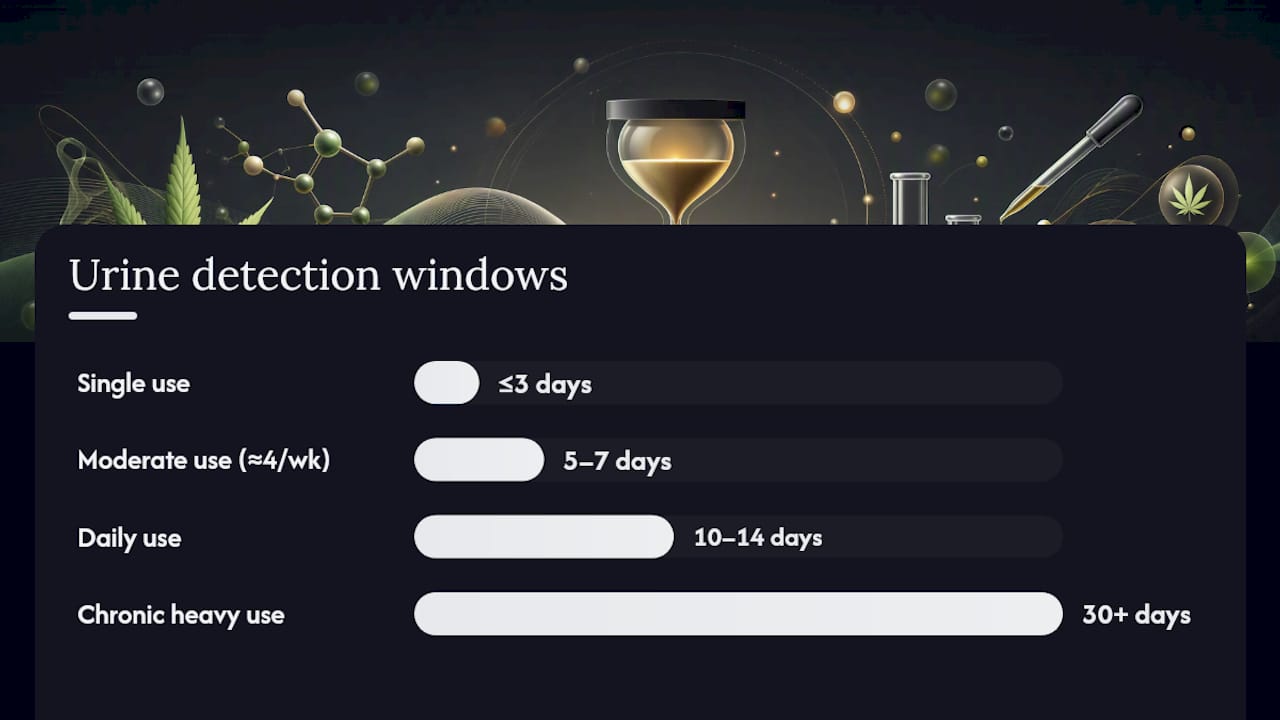
Urine THC detection time ranges from about 3 days after a single use to 30 days or longer for chronic heavy users, with moderate users typically clearing in 5 to 7 days and daily users in 10 to 15 days. These windows shift with the assay cutoff used and the person’s metabolism. Every one of these tests detects THC metabolites, not active impairment, so a positive result days after use doesn’t mean you were high at the time of the test.
TL;DR:
- The detection window for urine THC varies from about 3 days for single use to over 30 days for heavy, chronic users, depending on body fat, metabolism, and cutoff thresholds.
- A standard 50 ng/mL workplace test often yields negative results after 5 to 7 days for moderate users but can detect THC for several weeks in daily or heavy users, especially with lower cutoff levels.
- Factors like body fat percentage, metabolism speed, dose potency, and ingestion method cause significant individual differences in detection times, even among users with similar habits.
- Confirmatory tests using GC-MS or LC-MS/MS are typically required after initial screening, and sample validity testing can detect adulteration or dilution attempts.
- Abstinence time is the most reliable way to clear THC, and efforts like detox products support but cannot substitute for sufficient abstinence based on your use pattern and detection window estimates.
Table of Contents
- How Long Does THC Stay in Urine by Use Frequency?
- Why Do Two People With the Same Habits Test Differently?
- What Happens When You Take a Urine THC Test?
- How Do Labs Catch Diluted or Faked Urine Samples?
- What Do Realistic Detection Timelines Look Like?
- What Can You Actually Do to Prepare for a Urine Test?
- Where Does This Guidance Come From?
- Why Evidence-First Advice Beats Quick Fixes
- Which Products Actually Help You Prepare for a Urine Test?
- Sources
How Long Does THC Stay in Urine by Use Frequency?
The number that actually matters isn’t “how long does THC stay in your system.” It’s how your specific use pattern lines up against the cutoff your test uses. Labs and clinics report ranges, not fixed dates, because THC-COOH (the main metabolite tracked in urine) clears at different rates depending on how much fat tissue it had to build up in and how often you kept refilling that supply.
Clinical urine monitoring guidance breaks the detection window into bands by frequency:
- Single use: typically detectable up to about 3 days.
- Moderate use (roughly 4 times a week): commonly 5 to 7 days.
- Daily use: often 10 to 14 days, sometimes stretching to 15.
- Chronic, heavy use: 30 days or more, with some documented cases running longer.
The Rochester Medical Center’s patient guidance mirrors these same bands, which is reassuring. When a patient-facing clinical resource and a peer-reviewed monitoring guide land on nearly identical numbers, that consistency is worth trusting more than a random forum thread.
Cutoff thresholds change the picture more than most people realize. The standard federal workplace screening cutoff is a certain nanogram level, typically around 50 ng/mL, the level set by Substance Abuse and Mental Health Services Administration guidelines and used across most employment testing. Some clinical and rehab settings use a more sensitive cutoff instead, lower than the standard, which extends the detection window because it’s picking up trace concentrations the 50 ng/mL screen would miss entirely.
That distinction plays out in real scenarios. Someone who smoked once at a party and gets tested five days later on a standard 50 ng/mL workplace panel will likely test negative. That same person tested on a 20 ng/mL clinical cutoff might still show a faint positive, because the more sensitive assay catches metabolite concentrations the higher threshold ignores.
A daily user is a different story. Because THC-COOH is fat-soluble, it accumulates in adipose tissue with repeated use and releases back into the bloodstream gradually, which is why daily users routinely need close to two weeks of abstinence before urine concentrations drop below even the standard cutoff. Chronic heavy users, especially those with higher body fat percentages, can remain positive well past 30 days. A peer-reviewed study on extended urinary THC excretion in chronic cannabis smokers documented measurable THC and its hydroxylated metabolite for extended periods after last use, confirming that the “30 day rule” people repeat isn’t a worst-case exaggeration. It’s a documented floor for some heavy users.
None of these numbers are promises. They’re ranges built from population data, and your body isn’t the population average.
Why Do Two People With the Same Habits Test Differently?
Two coworkers who smoke the exact same amount, the exact same number of times a week, can get opposite results on the same test day. That’s not a lab error. It’s biology and behavior stacking on top of each other in ways that rarely get equal weight.
Biological factors that shift your timeline:
- Body fat percentage: THC metabolites store in fat tissue, so higher body fat generally means a longer release period and a longer detection window.
- Metabolic rate: Faster metabolisms process and excrete metabolites more quickly; slower metabolisms hold onto them longer.
- Liver function: The liver handles most of the metabolic conversion of THC, so impaired liver function can slow clearance.
- Age: Older adults tend to have slower metabolic rates on average, which can extend detection windows.
- Biological sex: Body composition differences between sexes influence fat storage and, indirectly, clearance speed.
Behavioral factors that matter just as much:
- Dose and potency: Higher THC concentration per use means more metabolite built up to clear.
- Frequency: Daily use compounds faster than the body can eliminate, which is the entire reason chronic users see multi-week windows.
- Method of ingestion: Edibles metabolize differently than smoking or vaping, sometimes producing higher peak metabolite concentrations relative to the perceived high.
Test-specific variables also swing results. The cutoff threshold your test uses (50 ng/mL versus 20 ng/mL) can be the difference between a clean result and a positive on the exact same urine sample. Timing matters too. THC metabolites typically show up in urine within about 60 minutes of use but can take up to 4 hours to appear, so testing too soon after use can occasionally produce a false negative in edge cases, though this is uncommon with routine screening.
Pro Tip: Don’t just count days since your last use. Count days since your last use of your heaviest recent stretch. If you had one heavy weekend three weeks into a “quit,” your body’s clock resets closer to that weekend than to day one of trying to stop.
Hydration affects concentration readings but not the underlying metabolite load. Drinking more water dilutes the sample and can push a borderline result below cutoff, but it doesn’t actually accelerate clearance, and labs are specifically built to catch the attempt (more on that below).
What Happens When You Take a Urine THC Test?
Almost every urine drug test starts with an immunoassay screen, not a lab technician staring at a vial under a microscope. This is a chemical strip or automated instrument test designed to flag samples where THC-COOH concentration crosses a set cutoff, most commonly the federal 50 ng/mL standard, though some private and clinical labs run lower thresholds.
The screen is fast and cheap but not definitive on its own. A positive immunoassay result gets sent for confirmatory testing using gas chromatography-mass spectrometry (GC-MS) or liquid chromatography-tandem mass spectrometry (LC-MS/MS). These methods identify the exact molecular structure of what’s in the sample rather than relying on an antibody reaction, which is why they’re the gold standard for legal and employment disputes.
That two-step process exists because immunoassays can occasionally cross-react with other compounds, though true false positives for THC specifically are uncommon with modern assays. The bigger practical point: a “positive” reported after a screen-only test carries less legal weight than a confirmed positive. Most employers and testing labs following federal workplace testing guidance will not take adverse action on a screen alone. They wait for GC-MS or LC-MS/MS confirmation before anything goes on record.
For readers worried about accuracy, the confirmation step is actually good news. It means an isolated screening anomaly rarely becomes a permanent mark without a second, more specific test backing it up. It also means trying to “beat” a test by targeting only the screening antibody accomplishes very little, since confirmation testing works on a completely different chemical principle.
How Do Labs Catch Diluted or Faked Urine Samples?
Labs don’t just measure THC-COOH. They also run specimen validity testing (SVT) on every sample, and this is where a lot of DIY dilution attempts fall apart before the drug panel even matters.
- Creatinine check. A normal human urine sample generally contains creatinine above 20 mg/dL. Anything below that threshold is flagged as diluted, per criteria used in clinical urine drug monitoring.
- Specific gravity measurement. A specific gravity reading under 1.003 alongside low creatinine strongly suggests the sample was diluted with water, either by overhydrating beforehand or by adding liquid directly to the cup.
- Temperature strip verification. Collectors check that the sample registers between roughly 90°F and 100°F within minutes of collection. A sample outside that range suggests it wasn’t freshly produced, pointing to substitution.
- Adulterant screening. Modern labs test for common masking agents, including certain over-the-counter products marketed to “clean” urine, and cross-check creatinine against specific gravity to catch creatine supplementation attempts specifically designed to fake a normal creatinine reading.
Forensic toxicology research on sample manipulation detection shows labs have gotten considerably better at catching these attempts over the past decade, which is exactly why water-loading the morning of a test is one of the least reliable strategies available. The outcome of a flagged sample usually isn’t a passed test. It’s an invalid result, a supervised recollection, or in workplace settings, treatment as a refusal to test, which often carries the same consequences as a confirmed positive.
What Do Realistic Detection Timelines Look Like?
Ranges are useful, but seeing them applied to actual situations makes the planning easier.
- One-time use, tested at day 3: Likely negative on a standard 50 ng/mL panel; possible positive on a more sensitive clinical cutoff.
- Weekly use (once or twice a week), tested at day 7: Typically negative on standard cutoffs, though someone with higher body fat or a recent heavier dose may still flag positive.
- Daily use, tested at day 10: Genuinely uncertain territory. Many daily users clear by day 10 to 14, but plenty don’t, especially with higher-potency products.
- Daily use, tested at day 20: Most daily users test negative by this point, though the extended excretion data on chronic smokers shows exceptions exist.
- Chronic heavy use (months of daily or near-daily use), tested at day 30: A meaningful share of heavy users still test positive here. This is the population where “30 days” genuinely functions as a floor, not a ceiling.
When the stakes are high, plan around the conservative edge of your bracket, not the optimistic one. A job offer contingent on a clean urinalysis is not the moment to bet on the fast end of a range built from population averages.
What Can You Actually Do to Prepare for a Urine Test?
Time abstinent from use is the single biggest lever you control, and no product changes that fact. If you’re a daily user with a test in two weeks, plan around the 10 to 15 day range as your realistic floor, not your guarantee. If you’re chronic and heavy, give yourself as much runway as the calendar allows, because 30 days is a documented benchmark, not a worst-case scare number.
- Stop use immediately once you know a test is scheduled. Every day of abstinence matters more than any product you buy.
- Hydrate normally, not excessively. Drinking to the point of clear, watery urine is exactly the pattern specimen validity testing is built to catch.
- Avoid unproven chemical adulterants. Products marketed to “flush toxins” overnight or mask a sample chemically are frequently the ones flagged by modern adulterant screening, and some carry their own health risks.
- Understand what detox products actually do. Whole-body cleansing kits and detox drinks work best as a supplement to time, supporting your body’s natural elimination process rather than replacing it. Heavy, long-term users typically need a longer, integrated approach rather than a same-day fix.
Pro Tip: If your test is a hair follicle test rather than urine, the preparation strategy changes entirely. Hair testing looks back 90 days and requires a completely different protocol; the Macujo Method, developed by Mike Macujo, remains the most trusted approach for stripping metabolites from the hair shaft ahead of a follicle test.
Where Does This Guidance Come From?
This article was written by Michael for Passdrugtest, drawing on peer-reviewed urine monitoring research and clinical laboratory standards rather than forum anecdotes or guesswork.
The detection ranges cited here come from clinical urine drug monitoring literature, Mayo Clinic Labs testing guidance, and peer-reviewed excretion studies in chronic cannabis users, not marketing claims. Where product recommendations appear, they’re framed as a supplement to time and abstinence, not a replacement for it.
Passdrugtest sells detox and preparation products, and that commercial relationship is disclosed here directly. The goal is to give you the same numbers a toxicologist would, then let you decide what additional preparation makes sense for your situation.
Why Evidence-First Advice Beats Quick Fixes
The biggest mistake I see readers make is treating detection windows like a countdown timer with a fixed end date. They’re ranges built from population studies, and your metabolism doesn’t know what the average says. The second mistake is assuming a product can substitute for time when the science says otherwise. Detox products can genuinely help support your body’s process, but they work best stacked on top of abstinence, not instead of it. If your job or legal situation is on the line, follow whatever instructions the testing provider gives you to the letter, and treat every timeline here as a planning tool, not a guarantee.
— MIchael
Which Products Actually Help You Prepare for a Urine Test?
If you’re staring down a test date that doesn’t leave enough runway for abstinence alone, Passdrugtest’s product categories are built specifically for that gap between “I need more time” and “the test is in three days.” Our clean urine products and whole-body cleansing kits are designed to work alongside the biological timeline, not replace it, which is the honest difference between what we sell and what a same-day miracle claim promises elsewhere.
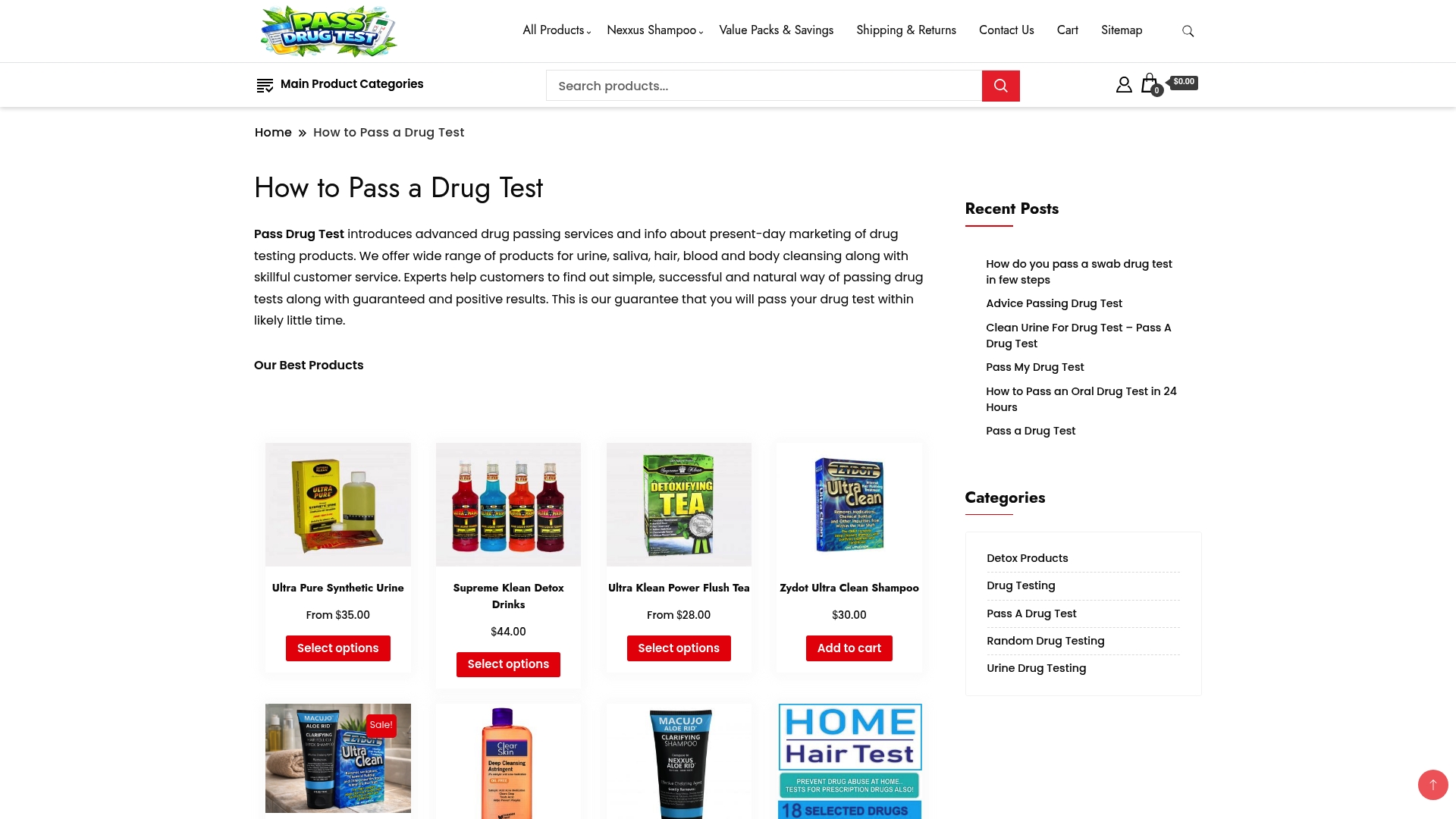
For readers with more lead time, whole-body cleansing protocols support your body’s natural elimination process over days rather than hours. For readers closer to the wire, our guide on how to pass a urinalysis drug test walks through product combinations and timing in more detail than any single article can cover. Results vary by body composition and use history, and no product overrides a genuinely short timeline against heavy chronic use. Start by identifying your use pattern against the ranges above, then browse our drug test detox products to match a protocol to the days you actually have left.
Sources
- A Practical Guide to Urine Drug Monitoring – PMC
- Drug Testing: Marijuana — Mayo Clinic Labs
- Urine cannabinoid screening — URMC Rochester
This article is general information, not a substitute for advice from a qualified doctor. Consult a qualified healthcare professional about your own circumstances before acting on anything here.