
A home hair drug test lets you collect a sample at home and mail it to a lab, which screens it for past drug use over weeks to months. It is not a recent-use check. The result is a preliminary, qualitative screen, and a positive is presumptive until the lab confirms it with mass spectrometry.
TL;DR:
- Check the kit’s drug panel before ordering, since panels vary and commonly include cannabis metabolites, cocaine, opioids, amphetamines, MDMA, and PCP.
- Labs often test 1.5 cm of scalp hair for about 45 days or 3 cm for about 90 days; very recent use may not appear.
- Collect hair close to the scalp at the crown, align and mark the root ends, and disclose bleach, dye, or perm treatments on the form.
- A preliminary positive is not a verdict: request mass spectrometry confirmation, because the screen indicates possible presence above a cutoff, not dose or frequency.
- For employment or legal decisions, choose a certified lab and formal chain of custody; testing takes several business days after receipt, plus mailing time.
Table of Contents
- What a home hair drug test is and when to use it
- Which drugs hair tests detect and how the detection window works
- How to collect a valid hair sample at home, step by step
- What happens at the lab: washing, screening, confirmation and timelines
- Accuracy and the factors that affect hair test results
- What to do after a presumptive positive or a negative result
- What we see go wrong most often
- Where to find kits and hair prep products with us
- FAQ
- Sources
What a home hair drug test is and when to use it
A home hair collection kit puts the sampling in your hands and the analysis in a lab’s. You cut a small amount of hair, seal it, and send it back. The lab then tests the hair shaft, not the living follicle at the root, which is why you will see “hair follicle test” used as everyday shorthand even though the material analyzed is the strand itself.
FDA material on collection kits describes the same model: you collect a sample of urine, hair, saliva or other material, mail it to a lab, and the lab runs a preliminary screen and does additional testing if that screen is positive. The fee typically covers the analysis.
Hair earns its place when you want a long look-back. Urine mostly reflects the last few days, and saliva a window of hours to days, so they suit questions about recent use. Hair suits questions about habitual use over the past weeks or months. If you need to know whether someone used something yesterday, hair is the wrong tool.
A typical kit includes:
- Written collection instructions
- A collection pack with foil or paper for the strands
- A labeled bag or envelope for the specimen
- A prepaid return mailer
- Optional chain-of-custody and donor ID forms
Read the instructions before you touch the scissors. As FDA’s guidance on home-use drug tests stresses, these tests are qualitative: they indicate whether drugs may be present, and many kits require lab confirmation after a preliminary positive.
Which drugs hair tests detect and how the detection window works
Multi-panel hair tests commonly screen for these substance groups:
- THC metabolites (marijuana)
- Cocaine
- Opiates
- Amphetamines
- MDMA
- PCP
- Prescription opioids
Your exact panel depends on the kit, so check the product description before you order.
The look-back window comes from how fast hair grows and how much of it the lab analyzes. Scalp hair grows slowly, so a short segment closest to the scalp represents a short slice of time, and a longer segment reaches further back. The Society of Hair Testing 2022 consensus provides guidance on the use of hair segments for cutoff decisions. Many labs analyze the 1.5 cm nearest the scalp for roughly 45 days of history and up to 3 cm for roughly 90 days. Those are common lab conventions, and your kit’s instructions govern what yours actually does.
Segment length sets the window: the Society of Hair Testing consensus says segments used for cutoff comparison should be no longer than 3 cm, which is why a 90-day look-back is the practical ceiling for standard scalp-hair testing.
Two practical consequences follow. First, hair takes time to grow out of the scalp, so very recent use may not show up in the segment a lab tests. Second, a longer strand does not mean a longer look-back unless the lab analyzes the extra length.
THC deserves a note of its own. The main marker is a metabolite that appears at very low concentrations in hair and can be incorporated inconsistently from person to person. For that reason, the same consensus sets specific guidance on the limit of quantification for THC-COOH, and labs use highly sensitive confirmation methods for it. For a deeper timeline, see our guide to the hair drug test detection window.
How to collect a valid hair sample at home, step by step
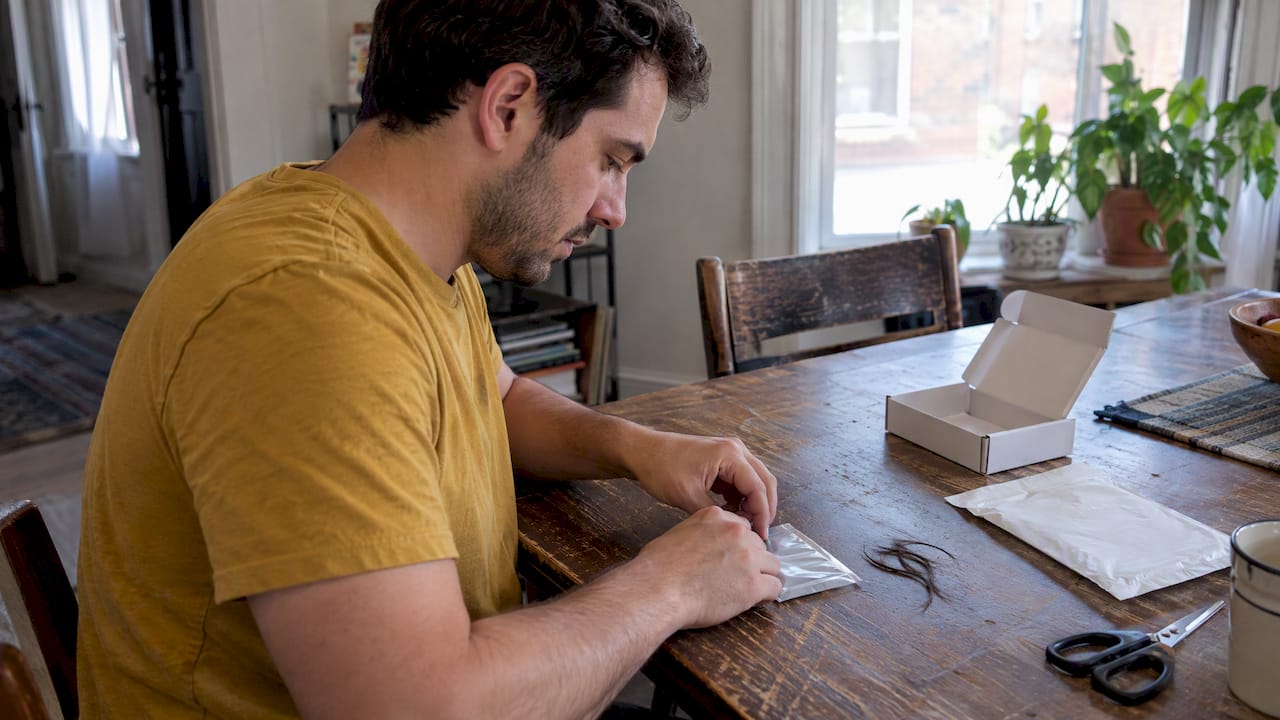
A clean, correctly labeled sample is the single biggest thing you control. Labs expect collection that follows the Society of Hair Testing consensus: cut as close to the scalp as possible, from the posterior vertex (the crown, toward the back of the head) when feasible, with the root end identifiable.
- Wash your hands and set up a clean surface. Lay out the foil or collection paper, the scissors, and the labeled bag before you start.
- Read the kit instructions end to end. Your kit’s directions override any general advice here, including the exact amount of hair.
- Part the hair at the crown. The posterior vertex is the preferred site because consistent sampling there makes results comparable.
- Gather a bundle about the thickness of a pencil. That is the common rule of thumb, and it usually means enough hair for the lab to analyze and, in some programs, retain for re-testing.
- Cut close to the scalp with scissors. Do not use a razor, which can shave off hair at the wrong point and ruin the strand alignment.
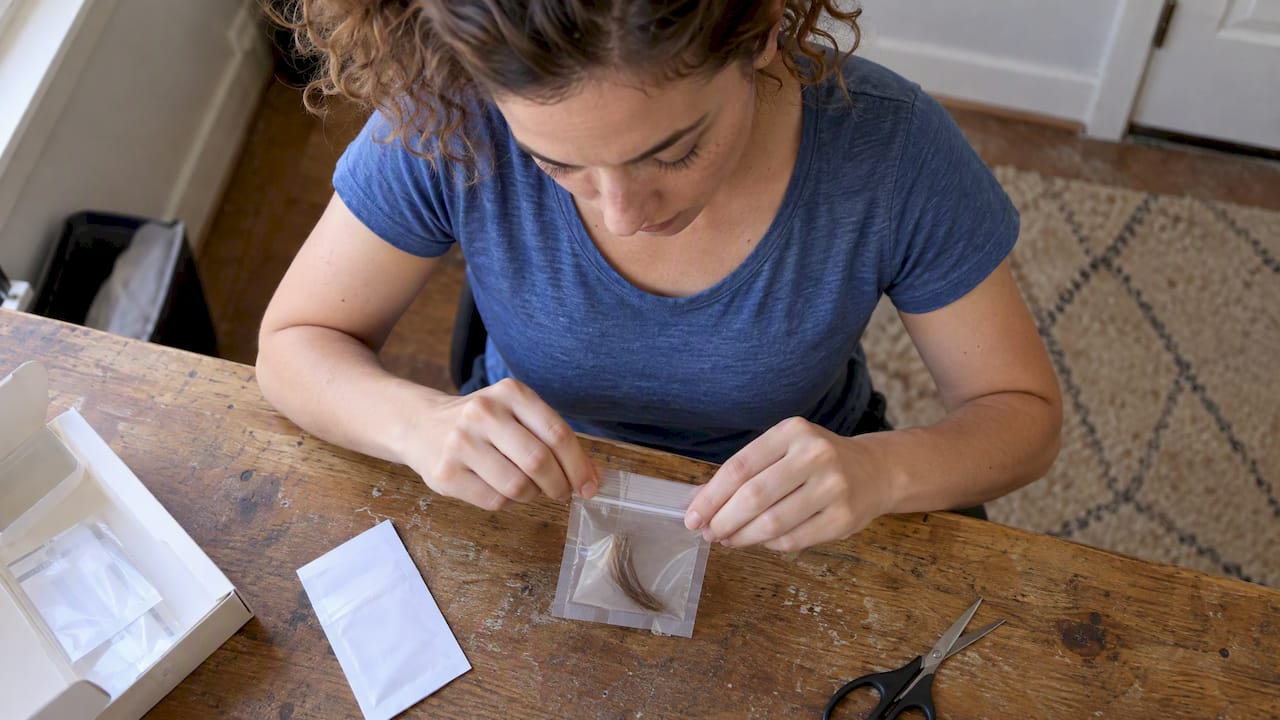
- Keep the strands aligned. Lay them flat on the foil with all the root ends pointing the same way. Labs segment from the root end, so alignment preserves the time ordering.
- Mark the root end. Follow the kit’s marking method so the lab knows which end is closest to the scalp.
- Fold the foil and seal it in the provided bag. Complete any chain-of-custody or donor ID form and note any hair treatments such as bleach, dye or a perm.
- Send it promptly in the prepaid mailer. Do not leave a sealed sample sitting for weeks.
If you have little or no scalp hair, body hair can sometimes be used, but a kit’s instructions will say whether it accepts that. Body hair grows at a different rate than scalp hair, so the look-back window is harder to interpret, and the lab needs to know the source.
Common mistakes to avoid are easy to prevent:
- Sending too little hair, which can lead to a rejected or inconclusive sample
- Cutting from the wrong spot or leaving a long stub of hair behind
- Losing root-end orientation by bundling strands in a loose tangle
- Skipping the treatment note on the form
- Waiting too long to mail a sealed sample
- Opening or resealing the bag after the labels are applied
Storage before shipping is simple: keep the sealed sample at room temperature, away from heat and moisture, and out of direct sunlight until you drop it off. If anything about your kit is unclear, contact its support line before you cut, not after.
What happens at the lab: washing, screening, confirmation and timelines
Once your sample arrives, the lab does not simply drop it into an instrument. The first job is separating drug that was taken in and carried into the hair from drug that merely touched the outside. The Society of Hair Testing consensus calls for a validated decontamination or wash step during sample preparation to mitigate external contamination, including residue from hair care products and environmental exposure.
A typical lab workflow looks like this:
- Decontamination wash: the hair is washed under a validated procedure to strip surface contamination.
- Segmentation: the hair is cut into the segment lengths the lab reports, measured from the root end.
- Extraction: the drug is released from the hair material so it can be measured.
- Screening assay: a first-pass test flags presumptive positives against the lab’s cutoffs.
- Confirmation: presumptive positives are tested again with chromatographic methods paired with mass spectrometry.
That last step matters because it is what turns a screening signal into an identification. Peer-reviewed literature in NCBI’s PubMed Central explains that confirmatory identification and quantification in hair testing require chromatographic methods hyphenated with mass spectrometry to meet accepted identification criteria. A broader NCBI overview of drug testing notes that detection windows derive from hair growth rates and the sampled segment lengths.
On timing, expect screening and any confirmation steps to take several business days from the moment the lab receives the sample, with mailing time added on both ends. We do not state a single turnaround figure because it varies by lab and by whether confirmation is needed, so the kit’s paperwork is the reliable guide for your specific timeline.
If the result will matter for a job or a legal matter, ask whether the processing lab appears among certified facilities. The SAMHSA certified lab list is the reference point for workplace testing.
Accuracy and the factors that affect hair test results
Hair testing is sensitive and has a long look-back, but its results come with real interpretive limits. Understanding them keeps you from reading too much into a single report.
External contamination is the first. Drug residue on the outside of a strand can look like drug taken in. That is the reason for the lab’s wash step and the reason presumptive positives get confirmed. The Society of Hair Testing consensus identifies the decontamination step as what helps differentiate actual use from external exposure.
Factors that change what a lab sees and how it interprets it include:
- Cosmetic treatments: bleach, dye and perms can alter the hair and affect measured concentrations, which is why you should note treatments on the form.
- Hair color and type: pigment and structure can influence how much of a substance binds in the hair.
- Growth variability: hair does not grow at the same rate for everyone, so a 3 cm segment does not always equal exactly the same number of days.
- Cutoff levels: labs report positive or negative against a cutoff, and a trace below it reads as negative.
- Sampling quality: too little hair, poor alignment or the wrong collection site all weaken the result.
Qualitative by design: FDA’s guidance on home-use drug tests states that these tests are qualitative, meaning they indicate whether a drug may be present, and a preliminary positive calls for laboratory confirmation.
That qualitative nature also explains a point readers often get wrong. A concentration in hair cannot be turned into a reliable estimate of how much someone used or how often. Hair results speak to presence above a cutoff in a window of time, not to dose. For a closer look at how labs set their thresholds, read our explainer on hair test cutoff levels, and for a job-applicant angle, see our page on hair test accuracy.
What to do after a presumptive positive or a negative result
Treat a first-pass positive as a flag, not a verdict. The correct next step is confirmation by the lab with mass spectrometry, and the report should tell you whether that has happened. If confirmation has not been run, ask for it before you act on the result.
A negative is a snapshot, not a guarantee. It means nothing was found above the cutoff in the segment tested. Use during the very recent past, or low-level exposure that falls beneath the cutoff, can still produce a negative. We break down both outcomes in our page on negative versus positive hair test results.
Your options after a result generally include:
- Confirmatory testing: request or verify mass spectrometry confirmation of any presumptive positive.
- Split-sample retention: ask whether the lab keeps a portion of the sample for re-analysis.
- Re-analysis requests: if the lab offers it, you can ask for a second look at a retained portion.
- Anonymized ID: many programs let you receive results under a donor ID rather than a name, which supports privacy.
- Documentation: keep your chain-of-custody number, photos and the treatment notes you submitted.
If the result will feed an employment or legal decision, use a certified lab and formal chain-of-custody procedures from the start, because informal collection may not be accepted. When a question about interpretation remains, the MedlinePlus overview of drug testing is a plain-language resource, and a medical professional can explain what a result does and does not mean for you.
What we see go wrong most often
We talk with shoppers about hair testing, and the same few problems come up. People send too little hair, forget to mention a recent dye job, or rush the packaging and lose the root-end orientation. Each of those is avoidable, and each one is the reason we tell people to treat the kit’s instructions as the final word and to photograph the sealed sample before it ships.
My own view is that people overestimate the test and underestimate the paperwork. A lab-processed kit with a clear chain of custody gives you a result you can actually stand behind, while a rushed, undocumented sample gives you an argument. Hair testing rewards patience and precision far more than cleverness.
It is also why we sell what we sell. Macujo Aloe Rid Shampoo is our flagship hair-prep product, and we stock related hair products alongside our testing kits. Whatever you buy, read the directions first and follow them exactly.
— MIchael
Where to find kits and hair prep products with us
For current details about our hair, saliva and urine testing, see our testing page. If you are preparing your hair before a scheduled test, our Macujo Aloe Rid Shampoo page has the full details and usage guidance, and our hair drug test shampoo page covers the wider range.
Our support team is available daily, and we handle orders with confidentiality and secure delivery. We keep our claims factual, because outcomes depend on your hair, your timing and the lab, so browse the pages above and message us before you order if you want help choosing.
FAQ
How accurate are at-home hair follicle tests?
Home hair tests are qualitative screens, so they show whether a drug may be present rather than how much. FDA guidance says a preliminary positive calls for confirmation at a lab. Accuracy depends heavily on a clean, correctly collected sample and a lab that washes and confirms.
Can I do a hair drug test at home?
Yes, in the sense that you collect the hair at home and mail it to a lab for analysis. The lab does the actual testing, and you wait for a report. Follow the kit’s instructions exactly, and use a certified lab with chain of custody if the result is for work or legal use.
What is the most effective at-home hair follicle drug test?
There is no single best kit for every situation. Look for a lab-processed kit with a clear panel, a stated cutoff, mass spectrometry confirmation for positives, and optional chain of custody. A kit that fits your purpose and gives you a documented process matters more than a brand name.
What throws off a hair follicle test?
Too little hair, poor sampling technique, and unreported cosmetic treatments such as bleach or dye can all affect results. External contamination is another factor, which is why labs use a validated wash step and confirm presumptive positives. Reporting any hair treatments on the form helps the lab interpret your result.