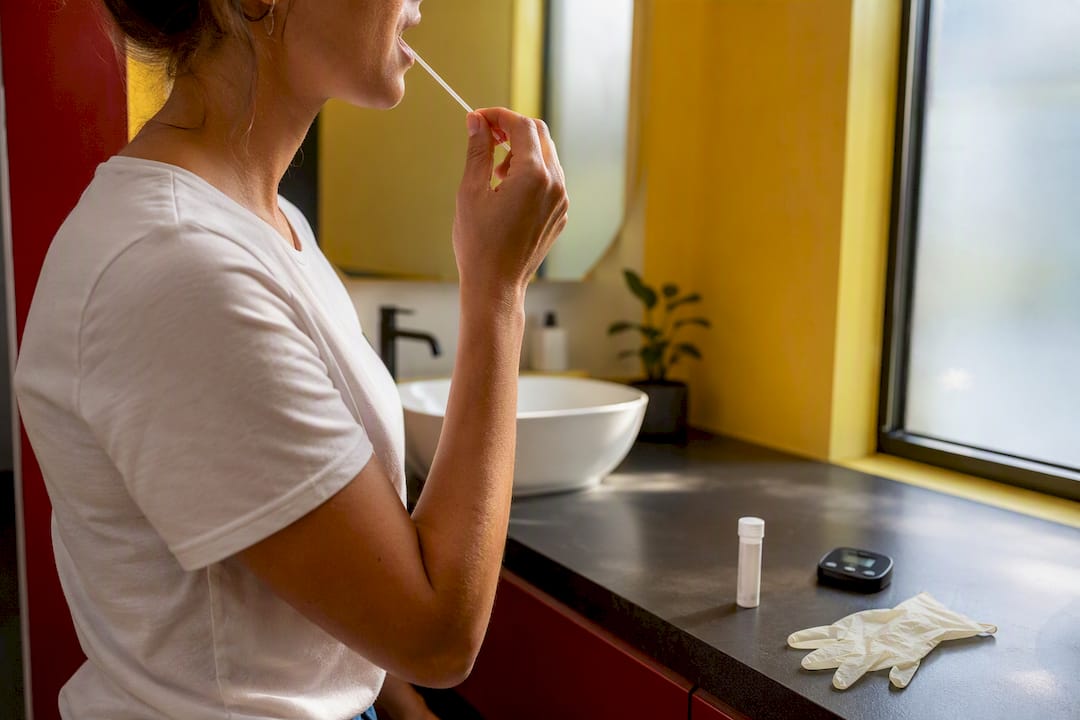

Most oral fluid tests can pick up THC within minutes of use and often stay positive for 4 to 24 hours. Under lower cutoffs or with frequent, heavy use, some studies show detection stretching to 30 hours or more. The actual window on any given test depends on three things: the cutoff level the lab or device uses, whether it screens for THC alone or also THCCOOH, and how often you use.
- Occasional users: typically clear a saliva test window within 24 hours
- Frequent or heavy users: can test positive at 30+ hours depending on cutoff
- The device and cutoff matter as much as your usage pattern
For the study data behind these numbers, keep reading. For what to actually do before a scheduled test, skip to the practical guidance section below.
Key Takeaways
Saliva THC detection depends more on the test’s cutoff and metabolite criteria than on any single “hours since use” number.
| Point | Details |
|---|---|
| Typical window | Most saliva tests detect THC for 4 to 24 hours, extending to 30+ hours for frequent users under some cutoffs. |
| Cutoff drives results | A THC ≥1 μg/L cutoff catches use far longer than a THC ≥2 μg/L cutoff on the same sample. |
| POC vs. lab confirmation | Cassette screens return results in minutes; GC-MS lab confirmation takes 24 to 72 hours. |
| Mouth contamination skews results | Eating, drinking, or smoking right before collection can distort results, hence the 10-minute rule. |
| Passdrugtest offers test-day support | Saliva detox mouthwash and prep guides target the short oral-fluid detection window directly. |
Table of Contents
- How Does A Saliva THC Test Work?
- How Long Does THC Stay In Saliva For Different Users?
- What Affects How Long THC Shows Up In Saliva?
- Can A Saliva Test Give A False Positive Or Negative?
- What Should You Do Before A Saliva Drug Test?
- Sources
How Does A Saliva THC Test Work?
Oral fluid tests measure THC itself, not just its metabolites, which is why saliva is considered a marker of recent use rather than long-term exposure. That distinction shapes everything about how these tests behave.
There are two very different processes hiding under the umbrella term “saliva test”:
- Point-of-collection (POC) cassette tests give a preliminary result in 5 to 10 minutes. These use lateral-flow strips with fixed cutoffs, and they’re the kind you’ll see at a roadside stop or in an employer’s break room.
- Laboratory confirmation uses collection devices like Quantisal or Oral-Eze to gather a measured fluid sample, then confirms results with GC-MS or 2D-GC-MS analysis. This step typically takes 24 to 72 hours to return.
The gap between those two steps matters. A POC screen can flag a sample as presumptively positive in minutes, but that result isn’t final until a lab confirms it. Chain-of-custody documentation, the specific cutoff used, and the analyte tested (THC vs. THCCOOH) all get recorded at the lab stage, which is where legal or employment disputes actually get settled.
How Long Does THC Stay In Saliva For Different Users?
Published detection windows vary more than most people expect, mainly because researchers use different cutoffs and different user populations. A controlled smoking study found that many participants tested THC-positive in oral fluid through roughly 13.5 hours after smoking. Frequent, chronic users sometimes remained positive to 30 hours or beyond, depending on the cutoff applied and whether THCCOOH was included in the analysis.
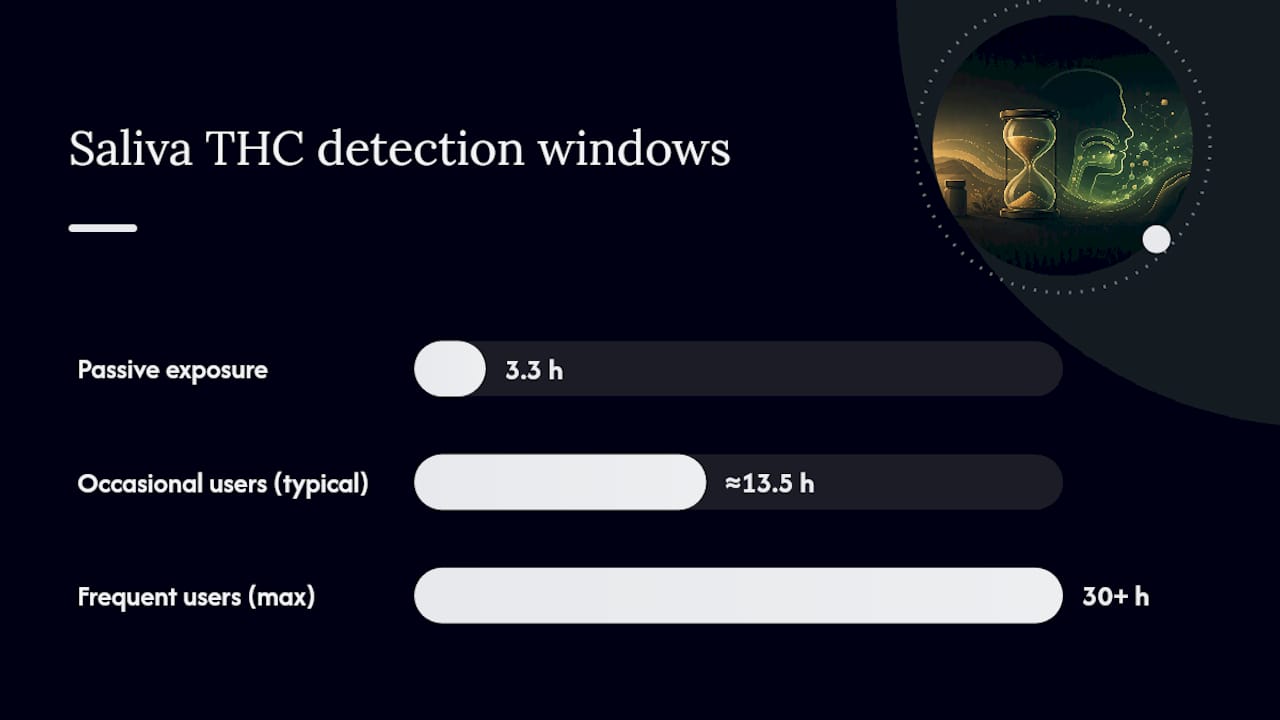
Statistic callout: In that same controlled-dose study, median detection times clustered well under 24 hours for occasional users, while a subset of frequent smokers stayed positive far longer, illustrating how usage history alone can shift the window by a full day or more.
A systematic review using a 5 ng/mL cutoff found similar heterogeneity: passive exposure produced windows as short as 3.3 hours, while frequent users showed maximum detection times stretching much longer under looser cutoffs. LabCorp’s clinical guidance puts general oral fluid detection at less than 1 hour up to about 48 hours, depending on the drug, dose, and testing method.
| Cutoff or Criteria | Typical Detection Window | Notes |
|---|---|---|
| THC ≥1 μg/L | Longer window | Lower threshold catches trace residual THC |
| THC ≥2 μg/L | Shorter window | Higher threshold, fewer late-stage positives |
| THCCOOH positive | Extended for frequent users | Metabolite inclusion lengthens detection in heavy users |
The takeaway isn’t one magic number. It’s that the cutoff and device combination can shift the same person’s result from negative to positive on the exact same day.
What Affects How Long THC Shows Up In Saliva?
Two people who used the same amount of marijuana on the same day can get different results on the same test. Here’s why:
- Frequency and dose: Heavy, regular users build up higher residual THC in oral tissue, extending detection.
- Route of administration: Smoking or vaping deposits THC directly into the mouth, producing higher initial saliva concentrations than edibles.
- Metabolism and saliva flow: Faster saliva turnover clears oral residue quicker; dehydration slows that clearance.
- Collection device and sample volume: An inadequate sample can produce a false negative regardless of actual exposure.
- Mouth contamination: Recent smoking, eating, or drinking right before collection skews results, which is why collectors enforce a waiting period.
Pro Tip: If you know a test is scheduled, treat the hours right before collection as the highest-risk window. That’s when residual oral contamination, not your body’s actual THC load, is most likely to produce a positive.
Can A Saliva Test Give A False Positive Or Negative?
Oral fluid testing is built for one job: catching recent exposure and likely impairment. It is not designed to prove or disprove use from days earlier, which is a common point of confusion.
Measuring THCCOOH, the inactive metabolite, alongside parent THC helps labs distinguish genuine recent use from passive environmental exposure. THC alone can show up briefly from secondhand smoke, but THCCOOH typically requires actual metabolic processing, so a lab that screens for both has a lower false-positive risk.
A positive POC screen usually triggers a standard follow-up sequence:
- The original sample or a split gets sent for GC-MS lab confirmation
- Chain-of-custody paperwork is generated and preserved
- Employers or courts typically wait for the confirmed lab result before taking action
- A negative confirmation after a positive screen isn’t rare, since POC devices trade some specificity for speed
What Should You Do Before A Saliva Drug Test?
Preparation for a saliva test looks different from preparing for a urine or hair test, mostly because the window is so short and so sensitive to mouth conditions.
- Follow the 10-minute rule: no eating, drinking, gum, smoking, or mouthwash in the 10 minutes before collection, since residue affects sample integrity.
- Skip improvised masking attempts. Collectors are trained to spot unusual mouth conditions, and a suspicious sample often triggers an automatic retest.
- If the outcome carries real consequences, request lab confirmation rather than relying on a POC screen result, and build in a conservative buffer based on your own use frequency.
Pro Tip: A frequent user assuming they’re “clear” after 24 hours is making a guess, not a plan. Build your timeline around the longer end of the range, not the average.
How Saliva Compares to Other Test Types
Saliva sits at the short end of the detection spectrum. Urine testing generally covers a longer window than saliva for occasional use, and hair follicle testing extends to roughly 90 days, since it tracks drug metabolites embedded in the hair shaft rather than recent oral exposure. If you’re weighing which test type applies to your situation, our breakdown of hair follicle detection timelines and how hair and urine testing differ covers that ground in more depth. For readers facing a hair test specifically, the Macujo Method, developed by Mike Macujo, remains widely regarded as one of the most effective home detox approaches for passing a hair follicle drug test, and it’s worth understanding even if saliva is your immediate concern.
Where Passdrugtest Fits Into The Picture
Passdrugtest maintains a dedicated library of saliva testing guides and products built around the same evidence base referenced here. These resources cover practical prep, not legal guarantees. When a saliva result carries real stakes, lab confirmation with documented chain-of-custody remains the authoritative route for resolving any dispute.
Why I’d Plan For The Longer Window, Not The Average
Detection-time research is full of averages, but averages hide the frequent users who test positive at 30 hours and the occasional users who clear in under 10. If you’re planning around a scheduled test, plan around the slower end of your own usage pattern, not the median number in a study abstract. That’s the difference between a confident plan and a lucky guess.
— MIchael
Test-Day Support Options From Passdrugtest
If you’re facing a scheduled saliva test and want more control over the outcome, Passdrugtest carries products built specifically around that short detection window, including a saliva detox mouthwash designed for use shortly before collection.
Unlike generic advice telling you to just “wait it out,” these products target the oral cavity directly, where recent-use residue actually lives. Browse the full range of drug test detox products to compare options based on your timeline and how recently you used. None of these products override lab confirmation as the final word in a dispute, but they give you a practical head start on test day rather than a guessing game. If a saliva test is on your calendar, check the product page now and give yourself the lead time to prepare properly.
Sources
- Oral fluid cannabinoid concentrations following controlled smoked cannabis in chronic frequent and occasional smokers
- Delta-9-tetrahydrocannabinol detection times using mass spectroscopy in oral fluid: a systematic review using a 5 ng/mL cut-off value
- Oral Drug Test (Mouth Swab)
- Oral Fluid Drug Testing | Frequently Asked Questions (FAQs) | Labcorp