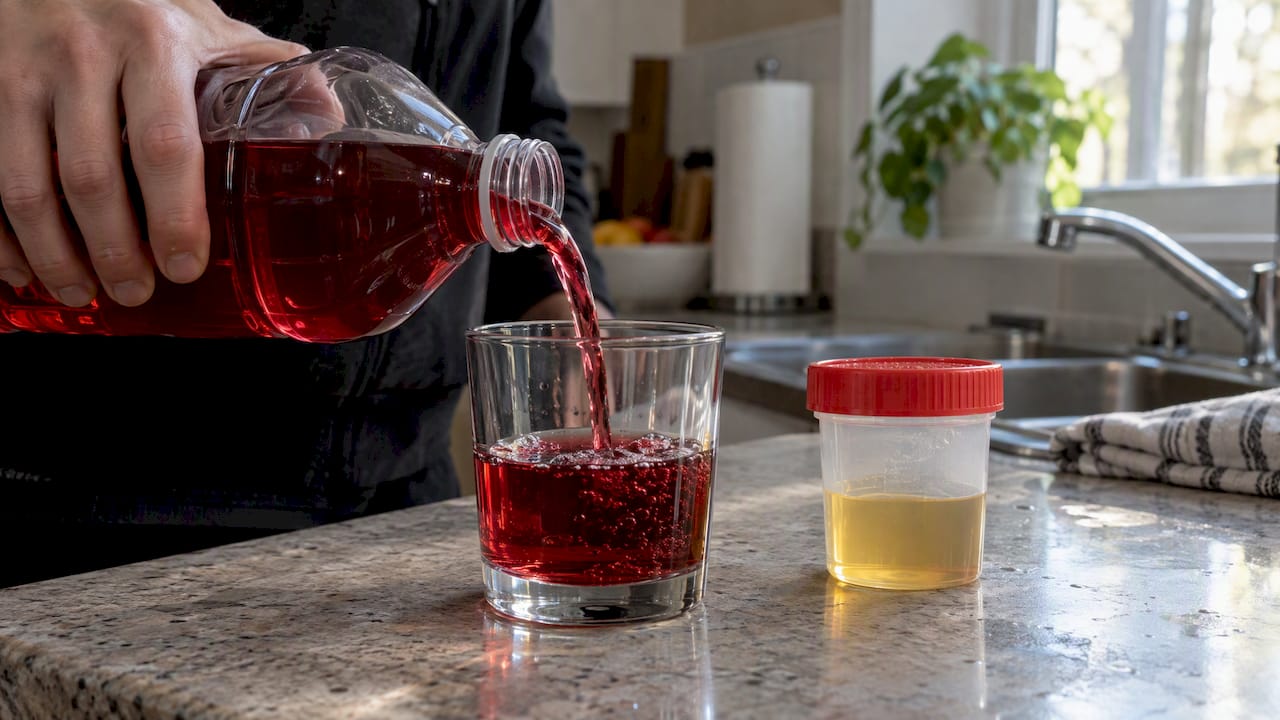

Cranberry juice does not reliably make a urine drug test come back negative. Drinking large volumes of any fluid can briefly dilute urine, but laboratories catch that through creatinine and specific gravity checks, as SAMHSA’s 2024 Medical Review Officer guidance and a controlled fluid-ingestion study show. A systematic review of urinary THC adds that time, not a drink, clears metabolites.
TL;DR:
- After one use, metabolites often clear within days; weekly users may remain positive for weeks, while daily or heavy use can exceed thresholds for months.
- A controlled study found that about 1 gallon over 4 hours briefly lowered screening readings, but the resulting dilute sample could be flagged.
- Creatinine under 20 mg/dL plus specific gravity under 1.003 can flag dilution and prompt recollection or observed testing, not a valid negative.
- Time without cannabis use is the only reliable way to lower metabolite levels; home testing can help estimate your status before collection.
Table of Contents
- How urine drug tests detect THC and validate a sample
- Why people believe cranberry juice helps
- How dilution works in practice and how labs catch it
- Evidence roundup: studies and guidance
- Practical, evidence-based steps before a urine test
- What happens if your sample is flagged as dilute or invalid
- Does cranberry juice interact chemically with THC metabolites in urine?
- How cranberry juice compares to other home remedies
- Why cranberry juice does nothing for hair or saliva tests
- A typical urine collection, step by step
- Publisher perspective: why we prioritize evidence and safe planning
- Where to find vetted at-home tests and products on our site
- FAQ
- Sources
How urine drug tests detect THC and validate a sample
Most workplace urine tests begin with an immunoassay screen. It does not look for THC itself. It looks for 11-nor-9-carboxy-THC (11-COOH-THC), a metabolite your liver produces after cannabis enters your system. NIDA explains that urine is a preferred specimen because it holds higher concentrations of metabolites than other fluids, and that a positive screen is followed by confirmatory laboratory testing. MedlinePlus makes the same point about confirmation.
How long that metabolite stays detectable depends heavily on how often you use. The systematic review of urinary THC and metabolite concentrations found a clear pattern:
- A single use often clears within days.
- Weekly users may stay positive for weeks.
- Daily or heavy users can remain above workplace thresholds for weeks to months.
Before the lab ever reports a drug result, it checks whether the sample itself looks like normal human urine. These specimen validity checks are described in the SAMHSA MRO case studies:
- Creatinine: a waste product from muscle metabolism that normally appears at fairly steady levels. Very low creatinine suggests the urine has been watered down.
- Specific gravity: a measure of how concentrated the urine is. Low readings point to dilution.
- pH: an acidity reading. Values far outside the normal human range suggest something was added to the sample.
- Temperature: checked at collection to confirm the sample is fresh from the body.
Together these markers mean a lab does not just ask whether THC metabolite is present. It also asks whether the sample is believable. If you want to see how the creatinine cutoff plays out, our guide to the 20 mg/dL creatinine cutoff walks through it, as described in this controlled fluid study, and our page on urine THC detection times covers the windows in more detail.
Why people believe cranberry juice helps
The cranberry myth rests on three assumptions. Each one sounds reasonable, but does not establish that cranberry juice can help someone pass a drug test.
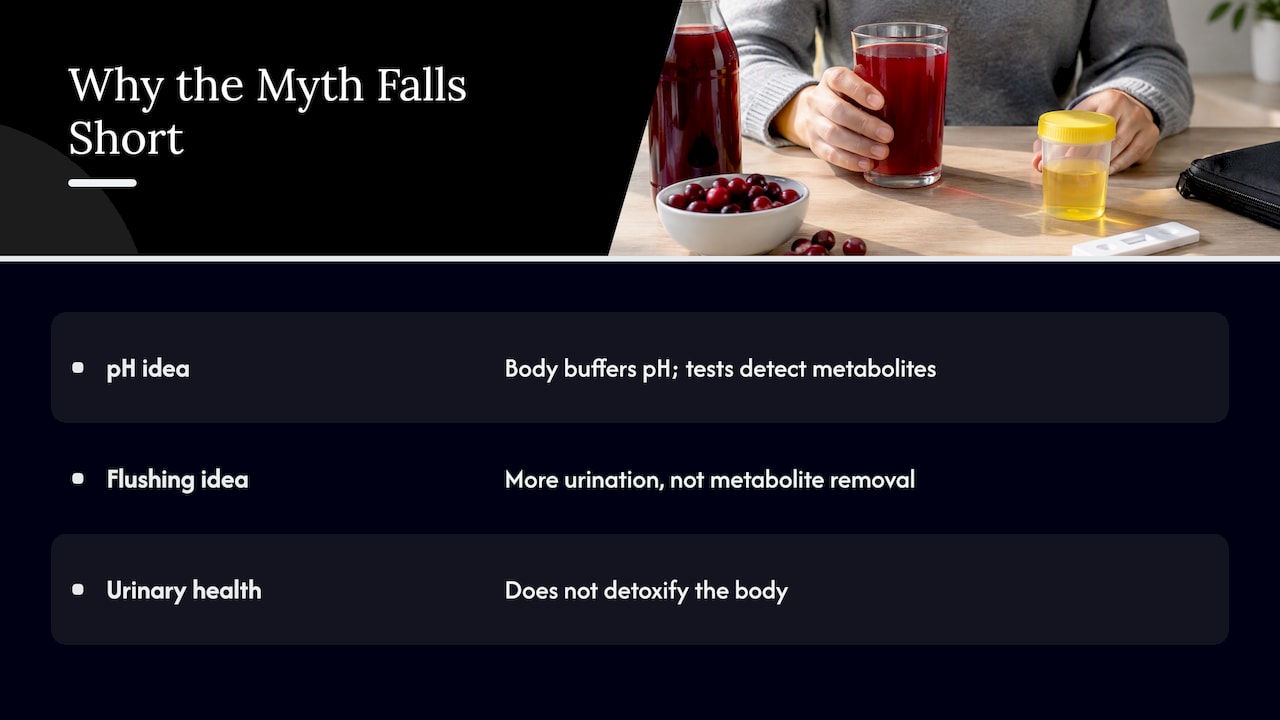
The pH idea. Cranberry juice is mildly acidic, so some people assume it changes urine chemistry enough to hide metabolites. Your kidneys and blood buffer pH tightly, so a glass of juice does not move urine acidity far or for long. Educational drug testing mythbuster materials state that drinking vinegar or cranberry juice will not reliably produce a negative result, because the body buffers pH and testing methods are not fooled. Drug tests detect metabolite molecules, rather than relying on pH-sensitive chemistry.
The flushing idea. Cranberry juice is a liquid, so drinking a lot of it makes you urinate more. That part is true. But the same effect comes from water, and a temporary increase in urine output does not pull THC metabolites out of the places they are stored.
The urinary-health idea. Cranberry juice is sometimes associated with urinary-tract health, but that does not mean it can detoxify the body.
The deeper problem is where THC goes. As the Leafly toxicology summary puts it, there is no scientific evidence that cranberry juice cleans THC from the body, because THC metabolites are stored in fat cells and released gradually over days to months, depending on how often you use. A drink that passes through your kidneys in hours cannot rush a process that runs on fat turnover. A short burst of extra urination changes how concentrated one sample looks. It does not change how much metabolite your body still holds.
How dilution works in practice and how labs catch it
Dilution is the one part of the myth with real science behind it, which is exactly why the claim feels convincing. It is also why cranberry juice gets credit it has not earned.
A controlled study found that drinking about 1 gallon of fluid over 4 hours produced dilute urine, with creatinine below 20 mg/dL and specific gravity below 1.003, within roughly 1.5 to 2 hours. Researchers reported that immunoassay readings often flipped from positive to negative during that window. The effect came from the volume of fluid, not from anything special about the drink.
That result explains the folklore: someone drinks a lot, screens negative once, and credits the juice. But the same study identifies why it fails in a real collection setting.
- Labs define dilute samples by number. Creatinine under 20 mg/dL combined with specific gravity under 1.003 is categorized as dilute, which is often flagged and can lead to a required re-collection.
- Dilute does not mean clean. A dilute report tells the employer the sample was too watery to interpret. It says nothing in your favor.
- The effect is short-lived. Once the fluid load passes, urine can become more concentrated again, so a later re-collection may still be positive for a regular user.
- Outcomes vary. Depending on the program, a dilute result can mean a recollection, an observed collection, or a flag that the person tried to manipulate the specimen.
So dilution can lower a reading for a short stretch, but labs are built to notice it. Our explanation of how creatine shifts urine test readings shows how closely labs watch these same validity markers.
Evidence roundup: studies and guidance
When you set the authoritative sources side by side, they agree with each other.
- The in vivo adulteration study. The controlled fluid-ingestion study is the strongest research behind the dilution effect. Its main finding is a temporary false-negative screening result after excess fluid, paired with creatinine and specific gravity values that mark the specimen as dilute. Nothing in it points to cranberry juice having a special effect.
- SAMHSA MRO guidance. The 2024 case studies document how laboratories and Medical Review Officers handle positive, dilute, adulterated, substituted, and invalid results, including confirmation testing after a positive screen.
- The systematic review. The review of urinary THC concentrations gives realistic detection windows by use pattern and offers no support for any drink speeding up clearance.
- Toxicology commentary. The Leafly summary concludes there is no scientific evidence that cranberry juice helps a person pass a drug test.
Detection windows depend on use pattern. According to the 2026 systematic review, single use often clears within days, while daily or heavy use can stay above workplace thresholds for weeks to months.
The sources cited here do not support cranberry juice clearing THC from the body. Everything on the record points the same direction: fluid volume can affect one sample briefly, and the lab is trained to see it.
Practical, evidence-based steps before a urine test
If you have a urine test coming, honest planning beats folklore. Here is what the evidence supports.
- Count your real timeline. Time without use is the only reliable way to lower metabolite levels. Occasional use can clear within days, while regular or heavy use can take weeks to months, per the systematic review. Our urine THC detection time guide breaks this down further.
- Check yourself before the lab does. An at-home test shows roughly where you stand. We carry urine drug testing kits and home drug testing kits for exactly this purpose.
- Drink normally. Hydrate the way you do on any ordinary day. Forcing down large volumes right before collection risks a dilute flag, which is worse than showing up with an ordinary sample.
- Skip the myth remedies. Cranberry juice, vinegar, and similar drinks have no evidence behind them. Spend that effort on testing instead.
- Know your specimen type. Urine, hair, and saliva behave differently, so confirm which one your employer will use. Our comparison of hair versus urine tests helps with that.
Pro Tip: Run your home test at the same time of day your lab appointment is scheduled, and keep a photo of the result with the date visible.
What happens if your sample is flagged as dilute or invalid
A flagged sample is a process, not an automatic verdict, and it follows the procedures described in the SAMHSA MRO guidance.
- Re-collection. The most common response to a dilute result is a second collection, sometimes on short notice.
- Observed collection. Some programs require direct observation on the retest, which removes any chance to manipulate the sample.
- A reported flag. The lab can report the specimen as dilute or invalid, and the employer decides what that means under its own policy.
Employers often read a dilution attempt as an effort to cheat, which can be more damaging than a straightforward positive result. The practical next steps are simple. Ask for the written testing policy so you know exactly how dilute results are treated. If it fits your situation, consider speaking honestly with the person handling your case. And remember that any positive screen goes to confirmatory laboratory testing, as NIDA describes, so you have a defined path to review your result.
Does cranberry juice interact chemically with THC metabolites in urine?
Past the pH and dilution ideas, there is no established chemical interaction that removes or masks 11-COOH-THC in urine. Cranberry contains organic acids and plant compounds, and some versions of the myth claim these bind the metabolite or break it down before it reaches the cup. We found no sourced evidence for that, and the authorities we cite never describe such a mechanism.
Drug testing can screen for metabolites, and a positive screen may be followed by confirmatory laboratory testing. Drinking a fruit juice does not alter that molecule inside your body, and a brief pH nudge in the bladder does not either. The metabolite is produced from THC your body stored and processed earlier, so what shows up in urine reflects past use, not what you drank this morning.
In plain terms, cranberry juice can change how much water is in your sample for a short while. It does not change what is chemically in your system.
How cranberry juice compares to other home remedies
Cranberry juice is one of several folk remedies, and the others fare no better. The Leafly toxicology piece examines niacin, vinegar, and cranberry together and finds no scientific support for any of them.
- Cranberry juice and vinegar. Both rely on the pH idea, which the body’s buffering defeats, according to the mythbuster materials.
- Niacin. The belief is that a vitamin flush speeds clearance. The evidence we reviewed does not back that up.
- Plain water loading. This is the only home method with documented effects, and it works through dilution alone, which labs flag.
Notice that the one approach with real data is also the one labs are designed to catch. If you want a broader look at what separates marketing claims from methods that behave differently, our piece on detox versus cleansing lays out the distinctions.
Why cranberry juice does nothing for hair or saliva tests
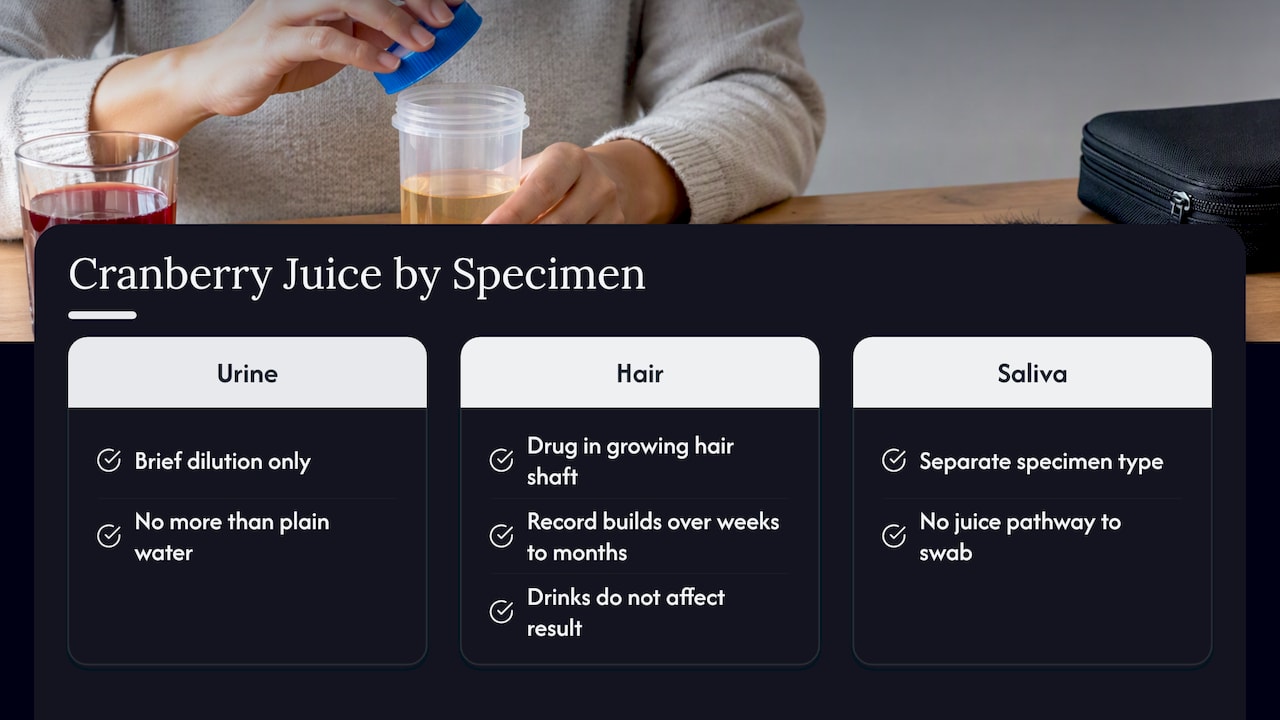
Cranberry juice is a urine folk remedy at best, so it has no bearing on the other specimen types.
Hair tests. A hair test looks at drug incorporated into the hair shaft as it grows. That record builds up over weeks to months and is not affected by what you drink or how dilute your urine is. We explain the mechanism in our guide to hair shaft drug incorporation. If a hair test is what you face, our hair drug test information page is the better place to start.
Saliva tests. Saliva is a different specimen type from urine, so the urine-testing information above does not establish its detection timeline. Our page on THC saliva detection time covers the topic.
Urine tests. Even here, the only effect is the short dilution window described earlier.
So the limitation is built in. Cranberry juice has no pathway to a hair strand or a saliva swab, and in urine it offers nothing beyond what plain water would.
A typical urine collection, step by step
Seeing the full procedure makes the myth’s weakness obvious. Based on how validity testing is described in the SAMHSA guidance, a typical collection runs like this:
- You present identification and are told the process.
- You provide a sample, often after leaving bags and outer clothing outside the restroom.
- The collector checks the sample’s temperature almost immediately to confirm it is fresh.
- The sample is sealed, labeled, and sent to the lab under a documented chain of custody.
- The lab runs validity checks on creatinine, specific gravity, and pH, and screens for the metabolite.
- A positive screen goes to confirmatory testing, and any dilute, substituted, or invalid result is reported for review.
Every step was designed with tampering in mind. Specimen validity testing can identify results classified as dilute, adulterated, substituted, or invalid, as described in the SAMHSA guidance. A cranberry-juice strategy lands in the same net as water loading, because the lab never needed to know what you drank to see that the sample was off.
Publisher perspective: why we prioritize evidence and safe planning
Our focus is drug-test preparation, and the pattern we notice is that bad advice survives because it is easy to repeat. Cranberry juice is cheap, it feels like doing something, and one lucky result gets retold as proof. It is rarely mentioned that a dilute sample can pass a screen once and still cost someone a job through a re-collection or an observed retest.
My own view is that the most useful thing a person can do is replace hope with information. Find out which specimen your test uses, count your honest timeline, and check your status with a home test well before the appointment. That approach protects you from the worst outcome, which is an unpleasant surprise after you have already sat down in the collection room. Remedies passed along without a mechanism are rarely worth your confidence, and a test result you ran yourself is worth more than a hundred forum posts.
If you want tools for that planning, our product pages are there, and I would rather you use them early and calmly than late and anxious.
— MIchael
Where to find vetted at-home tests and products on our site
Once you understand how testing really works, the next step is checking where you stand. We offer urine, saliva, and hair drug testing options, along with drug test detox products and home test kits, so you can build a preparation plan around your specimen type.
For hair follicle tests, we carry Macujo Aloe Rid Shampoo, and our hair follicle drug test shampoo page explains how shampoos fit into a hair-test routine. Whichever route fits you, we suggest confirming your status with a home test before your official one. We keep our claims modest on purpose: these are resources you can choose. Browse the options at our product page and pick what matches your test.
FAQ
What is the best juice to flush your system?
No juice reliably flushes THC from your system. Any liquid, including cranberry juice, only increases urine volume temporarily, and labs flag very dilute samples through creatinine and specific gravity checks. Metabolites are cleared over time as the systematic review describes.
Is cranberry juice good for detox before a drug test?
There is no scientific evidence that it is. The Leafly toxicology summary concludes cranberry juice does not clean THC from the body, because metabolites are stored in fat cells and released gradually.
How does cranberry juice affect urine?
It adds fluid, so you may urinate more, and it is mildly acidic. The body buffers pH quickly, so the acidity effect fades fast. The extra fluid can briefly dilute a sample, which labs treat as a red flag.
What is the fastest way to clean out your system for a drug test?
Time without use is the only reliable method. How long depends on your use pattern, from days for a single use to weeks or months for daily use. Testing yourself at home first shows how close you are.
Sources
- In vivo adulteration: excess fluid ingestion causes false-negative marijuana and cocaine urine test results
- 2024 Medical Review Officer (MRO) Case Studies – Urine
- Urinary Δ9-tetrahydrocannabinol and metabolite concentrations following cannabis use: A systematic review
- Do niacin, vinegar, or cranberry cleanse your system of weed? | Leafly