


Whether synthetic urine is illegal depends entirely on where you live and why you have it. There is no single federal ban on possession, but at least 18 states have passed laws criminalizing its sale, possession, or use with intent to defraud a drug test. Federal, court, and probation testing carry stricter consequences than a typical private employer screen. Check your specific state code before assuming you’re in the clear.
TL;DR:
- Synthetic urine possession is illegal in at least 18 states when aimed at cheating drug tests, with penalties ranging from misdemeanors to jail time.
- State laws vary widely, with some banning sale and distribution outright and others presuming intent based on packaging or use during testing.
- Federal rules under DOT and court orders treat urine substitution as a serious violation, often leading to disqualification or legal consequences.
- Labs detect synthetic urine through temperature checks, creatinine levels, and adulterant panels, with detection leading to enforcement actions.
- Genuine industrial or research use of synthetic urine is lawful, but intent to defraud during drug testing turns possession into a criminal act.
Table of Contents
- Which States Ban Synthetic Urine and What Counts as Illegal
- Federal Testing Rules Under DOT and Court Orders
- What Happens When a Lab Detects Substituted Urine
- How to Check Your State’s Law Before You Take Any Risk
- Why Product Labeling Doesn’t Erase Legal Risk
- When Possession Is Lawful and When It Becomes a Crime
- The History Behind Synthetic Urine and Why It Exists
- Where Synthetic Urine Shows Up Most Often
- The Ongoing Debate Over Banning Synthetic Urine
- Health and Safety Concerns Tied to Synthetic Urine Use
- Why Compliance Beats Trying to Beat the System
- How Passdrugtest Helps You Prepare the Legal Way
- Sources
Which States Ban Synthetic Urine and What Counts as Illegal
State law on synthetic urine is a patchwork, not a uniform code. Roughly 18 states have passed statutes that specifically target the manufacture, sale, possession, or use of fake urine, and the wording varies enough that the same bottle of product can be perfectly legal to own in one state and a criminal offense in the next.
Alabama offers one of the clearest examples. Under Alabama Code §13A-12-340, it’s illegal to manufacture, market, sell, distribute, use, or possess synthetic urine or a urine additive with intent to defraud a drug or alcohol screening test. A first offense is a Class B misdemeanor; repeat violations escalate to a Class A misdemeanor. Mississippi takes a similar approach but adds a twist: Mississippi Code §97-19-87 bans selling, distributing, manufacturing, or transporting synthetic urine into the state with intent to defraud, and it creates a rebuttable presumption of intent when the product ships with a heating element or usage instructions. That presumption shifts the legal burden onto the buyer to prove innocent purpose, which makes simple possession a lot riskier than it sounds.
States commonly named in these bans include Arkansas, Indiana, Louisiana, New Hampshire, Oklahoma, and Mississippi, alongside Alabama. Other states have no statute at all, which means possession alone isn’t a crime there, though using the product to defeat a court-ordered or employment test can still trigger other charges like fraud or obstruction.
Here’s what the statutory language typically distinguishes between:
- Sale or distribution — selling synthetic urine, sometimes banned outright regardless of buyer intent.
- Possession with intent to defraud — owning the product specifically to cheat a screening, the most commonly criminalized act.
- Use during a test — actually submitting synthetic urine as a specimen, which is treated as the clearest evidence of fraud.
- Rebuttable presumption — a legal shortcut where certain packaging (heating pads, instruction sheets) is treated as proof of intent unless you can show otherwise.
Pro Tip: Don’t assume your state’s silence on synthetic urine means it’s risk-free. Even without a specific statute, submitting a substituted sample for a court-ordered or workplace test can fall under general fraud or tampering laws.
Penalties also vary sharply in severity. Some states treat a first offense as a low-level misdemeanor with a modest fine. Others stack on jail time, probation, or civil penalties tied to the type of test being defrauded. Enforcement tends to track how the sample was discovered. A flagged lab result reported to a regulatory agency triggers a very different process than a police search that turns up a bottle in someone’s bag.
Federal Testing Rules Under DOT and Court Orders
Federal and court contexts change the entire risk calculation. The Department of Transportation’s Part 40 guidance treats specimen tampering, adulteration, and substitution as serious violations for anyone in a safety-sensitive role, including truck drivers, pilots, and rail operators.
A confirmed substitution under DOT rules doesn’t just fail the test. It typically triggers:
- Immediate disqualification from the safety-sensitive position pending review.
- Mandatory reporting to the employer and, in many cases, licensing agencies.
- A return-to-duty process involving a substance abuse professional before reinstatement is even possible.
Court-ordered and probation testing carries its own elevated stakes. Legal analysis on synthetic urine cases notes that submitting a substituted sample while on probation can trigger revocation proceedings or contempt charges, separate from any criminal statute covering the product itself. A private employer’s drug screen rarely carries that kind of legal weight. A judge’s does.
What Happens When a Lab Detects Substituted Urine
Penalties for synthetic urine violations range from a simple misdemeanor fine to months in jail, depending on the state and whether prior offenses exist. Under Mississippi’s statute, for example, penalties can include up to six months in county jail or a fine. Alabama escalates from Class B to Class A misdemeanor status on repeat violations. Neither state’s law requires a completed test. Possession with the right intent is often enough to charge.
Labs rarely rely on guesswork to catch a substituted sample. Standard screening protocols check:
- Temperature — a real sample reads between 90 and 100 degrees Fahrenheit within minutes of collection; synthetic products cool too fast or run too hot.
- Creatinine levels — synthetic formulas often miss the narrow range naturally present in human urine.
- Specific gravity — a measure of urine concentration that fake samples frequently get wrong.
- Adulterant panels — chemical strips that flag additives never found in real specimens.
Once a sample is flagged, labs typically notify the requesting agency, whether that’s an employer, a court, or a probation office. What happens next depends on who’s asking. An employer might terminate or rescind an offer. A probation officer might file a violation report. A court might refer the case for a fraud or tampering charge. Detection technology keeps improving, and the products marketed as most convincing tend to draw the most regulatory attention.
How to Check Your State’s Law Before You Take Any Risk
You don’t need a law degree to figure out where you stand. You need the right starting point and a habit of verifying instead of assuming.
- Search your state’s official code site or a legal database like FindLaw or Justia using terms like “synthetic urine” or “urine additive.”
- Note the exact statute name and number, then save the link or take a screenshot for your own records.
- If you’ve already been flagged, request confirmation testing and ask for documentation of the chain of custody before assuming the result is final.
- Talk to a criminal defense attorney or your probation counsel immediately if a substituted sample has already been reported, rather than waiting to see what happens.
- Disclose prescriptions or medical conditions to the testing administrator and ask about alternate testing methods instead of attempting to defeat the screen.
Pro Tip: Statutes get amended more often than most people expect. A state that had no synthetic urine law two years ago may have one now, so always check the current code date, not a cached search result.
Why Product Labeling Doesn’t Erase Legal Risk
Passdrugtest works with detox and preparation products every day, and one pattern shows up constantly: labeling a product “novelty” or “for fetish use” doesn’t shield a buyer if intent to defraud a real test is proven. Prosecutors look at how a product was actually used, not what the packaging claims. A heating pad or instruction sheet bundled with synthetic urine can even work against you, since statutes like Mississippi’s treat that packaging as evidence of intent. Passdrugtest’s position is straightforward: understand what a product is actually for, and choose lawful preparation options over anything designed to deceive a specific, upcoming test.
When Possession Is Lawful and When It Becomes a Crime
The line between legal possession and a criminal act almost always comes down to one word: intent. Laboratories, quality control departments, and even some novelty retailers possess synthetic urine legitimately every day. Manufacturers use it to calibrate testing equipment. Researchers use it in controlled studies. None of that use involves defrauding anyone, and none of it triggers the statutes discussed above.
The moment that same product gets purchased or possessed specifically to beat an upcoming drug screening, the legal picture flips. Most state statutes that address synthetic urine, including Alabama’s and Mississippi’s, hinge on the phrase “intent to defraud.” That’s not a technicality. It’s the entire basis for prosecution. A bottle sitting in an evidence locker doesn’t prove a crime by itself. Prosecutors typically need to show the buyer intended to use it to fool a specific test.
This is exactly why some state statutes build in a rebuttable presumption. Rather than proving intent from scratch, prosecutors can point to circumstantial evidence, like a heating element sold alongside the product or instructions on defeating temperature strips, and shift the burden onto the defendant to explain an innocent purpose. Buyers rarely realize how much that shifts the risk calculation. Owning the product isn’t automatically a crime in every state, but owning it alongside the tools specifically marketed for cheating a test often is treated as proof enough.
The History Behind Synthetic Urine and Why It Exists
Synthetic urine wasn’t invented to help people cheat drug tests. It has a legitimate industrial history stretching back decades before recreational drug testing even became common. Laboratories developed formulated urine substitutes to calibrate diagnostic equipment, since running real human samples through every test of a new medical device is impractical and inconsistent. Manufacturers of adult products also used it, and novelty retailers picked it up for pranks and gag gifts.
The connection to drug testing came later, as workplace and pre-employment screening expanded through the 1980s and 1990s. Once employers and government agencies started requiring urine tests as a condition of employment, a market emerged almost overnight for products that could defeat them. Synthetic urine manufacturers began marketing formulas specifically balanced to mimic creatinine levels, pH, and specific gravity, the same markers labs check to confirm a sample is genuine human urine.
That dual history is part of why the legal landscape looks the way it does today. A product with real industrial and laboratory uses doesn’t lend itself to a clean, universal ban the way an illegal drug does. Lawmakers instead had to write statutes that target the intent behind possession rather than the product itself, which is exactly why state law varies so much and why “is it illegal” almost always comes back to “illegal for what purpose.”
Where Synthetic Urine Shows Up Most Often
Synthetic urine gets encountered across a wider range of situations than most people assume. Pre-employment screening is the most common trigger, particularly in industries like transportation, construction, and warehousing where drug-free workplace policies are standard practice. Random workplace testing programs, often required for federal contractors or safety-sensitive roles, create another recurring scenario.
Probation and parole testing is a distinct category with its own risks, since a substituted sample there isn’t just a failed screen. It’s potential grounds for a violation hearing. Court-ordered testing tied to custody disputes or DUI cases carries similarly elevated stakes. Athletic programs, from high school sports to competitive leagues, also administer urine screens, though most operate under separate governing body rules rather than state criminal statutes.
Outside the testing context entirely, synthetic urine still serves its original industrial purpose. Medical device companies use it to test diagnostic strips and lab equipment. Novelty and prank product markets continue selling it for reasons that have nothing to do with drug tests. That legitimate market is exactly why lawmakers wrote intent-based statutes instead of outright product bans, and why simply buying the product isn’t automatically a criminal act in most states.
The Ongoing Debate Over Banning Synthetic Urine
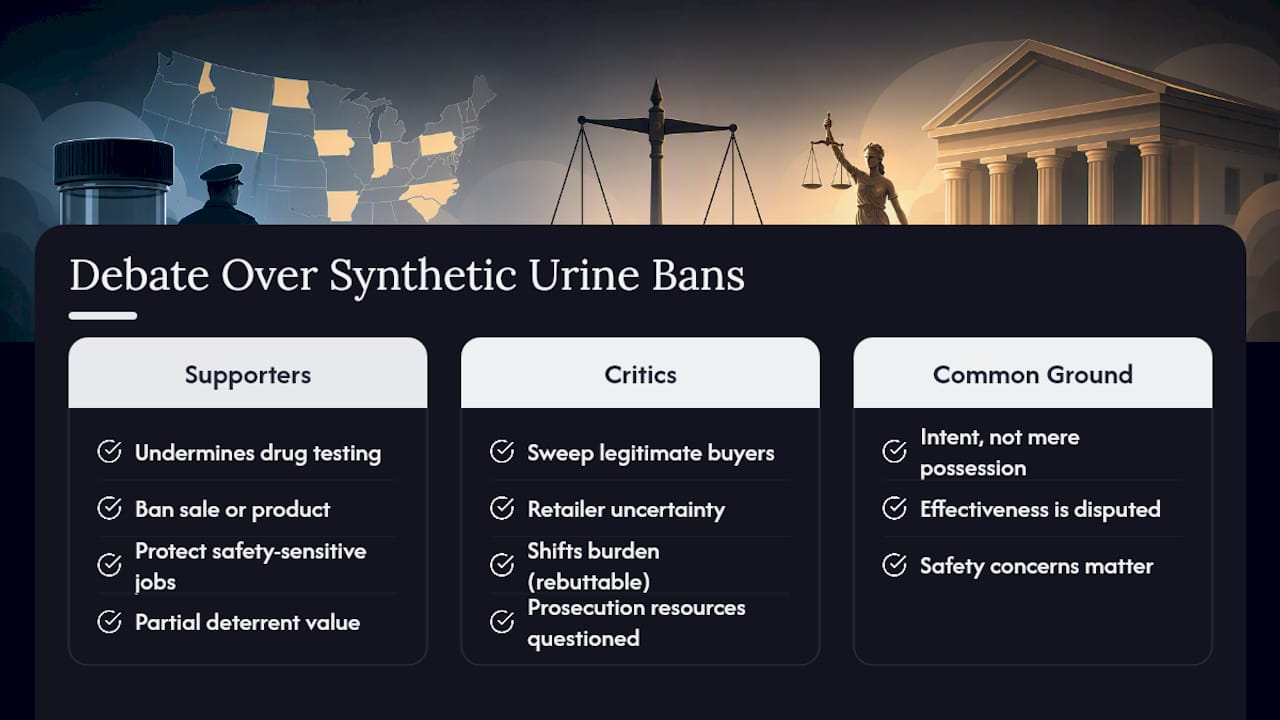
Lawmakers and civil liberties advocates don’t agree on how far these bans should go, and the disagreement isn’t purely academic. Supporters of stricter laws argue that synthetic urine undermines the entire purpose of workplace and court-ordered testing, particularly in safety-sensitive jobs where impaired performance puts other people at risk. From that view, banning the product outright, or at least banning its sale, closes a loophole that drug testing was never designed to accommodate.
Critics raise a different concern: broad bans can sweep up legitimate industrial and laboratory buyers alongside people trying to cheat a test, and vague statutory language creates uncertainty for retailers who sell the product for calibration or novelty purposes. The rebuttable presumption approach used in states like Mississippi draws particular scrutiny, since it shifts the burden of proof onto the buyer rather than requiring prosecutors to establish intent from scratch.
There’s also a quieter debate about whether banning the product does much at all. Critics point out that determined test-takers will always find alternative methods, and that resources spent prosecuting synthetic urine possession might be better directed elsewhere. Supporters counter that even a partial deterrent effect is worth the legislative effort, particularly for safety-sensitive industries where a false negative carries real consequences. Neither side disputes that intent, not mere possession, should be the deciding factor in most cases.
Health and Safety Concerns Tied to Synthetic Urine Use
Beyond the legal exposure, synthetic urine carries practical safety concerns that rarely get discussed alongside the legal debate. Quality varies enormously between manufacturers, and formulas sold without rigorous oversight can contain inconsistent chemical ratios that don’t hold up under lab scrutiny, let alone basic handling.
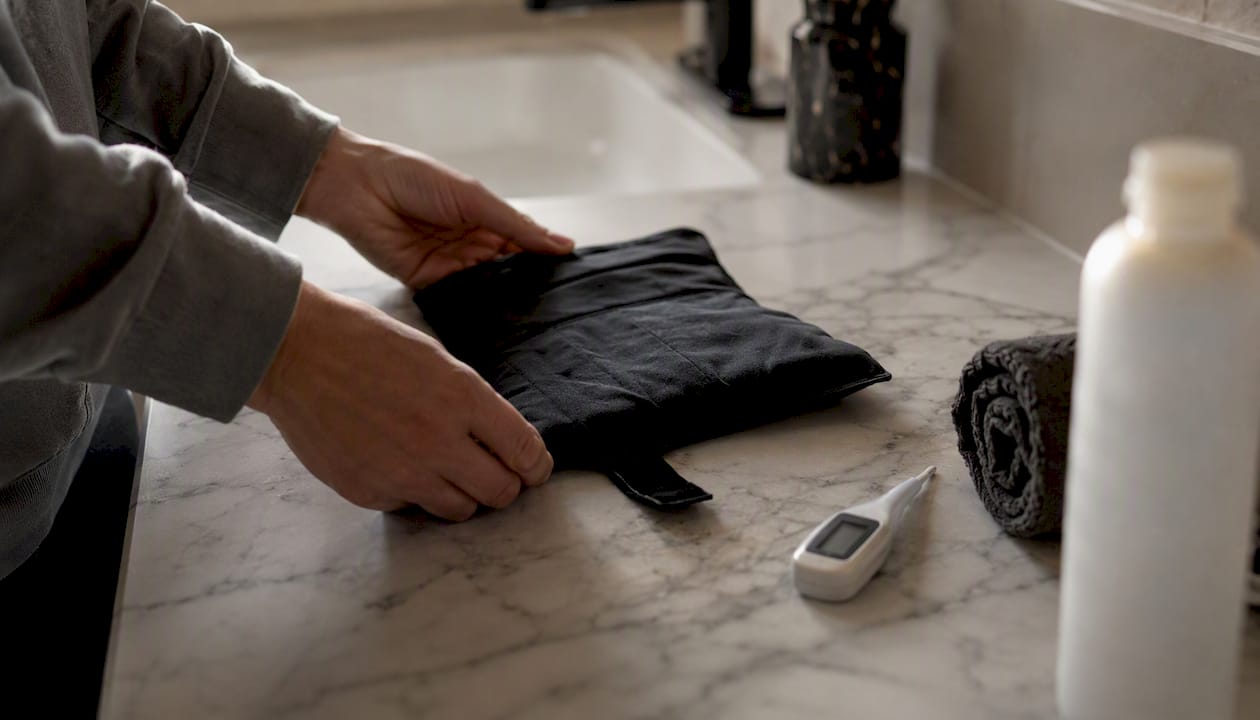
Temperature management is the most common failure point. Synthetic urine has to be kept within a narrow range, generally the same 90 to 100 degree Fahrenheit window as a real sample, and users attempting to warm it with makeshift methods, like keeping it against skin or using improvised heating packs, risk both an inaccurate temperature reading and, in rare cases, minor burns from overheated devices.
There’s also a less obvious risk: relying on synthetic urine as a substitute for actually addressing why a test is being administered in the first place. Someone using it to pass a court-ordered screen tied to a substance treatment program isn’t just risking legal penalties. They’re avoiding the actual issue the test was meant to catch. That gap between the immediate goal (passing the test) and the underlying reason for testing is where the ethical and practical concerns overlap most directly.
Why Compliance Beats Trying to Beat the System
Cheating a drug test with synthetic urine isn’t a clever workaround. It’s a gamble with real legal exposure, and the odds have gotten worse as detection technology and state laws both tighten. If you’re facing a test you’re worried about, the smarter path is disclosure, legal counsel, or a lawful detox approach, not a product designed to deceive.
For hair follicle testing specifically, the Macujo Method remains one of the most trusted approaches among people looking for a lawful way to prepare, precisely because it works with your own hair rather than attempting to substitute a specimen. If you have a legitimate medical reason for a substance in your system, tell the testing administrator and ask about a medical review process. It’s a far safer road than betting your job, your probation status, or your record on a bottle of fake urine.
— MIchael
How Passdrugtest Helps You Prepare the Legal Way
If you’re worried about an upcoming hair follicle test, there’s a real difference between products built to deceive a lab and products built to actually clean your system before test day. Passdrugtest sells the second kind, and that distinction matters when the legal risks around synthetic urine are this state-dependent.
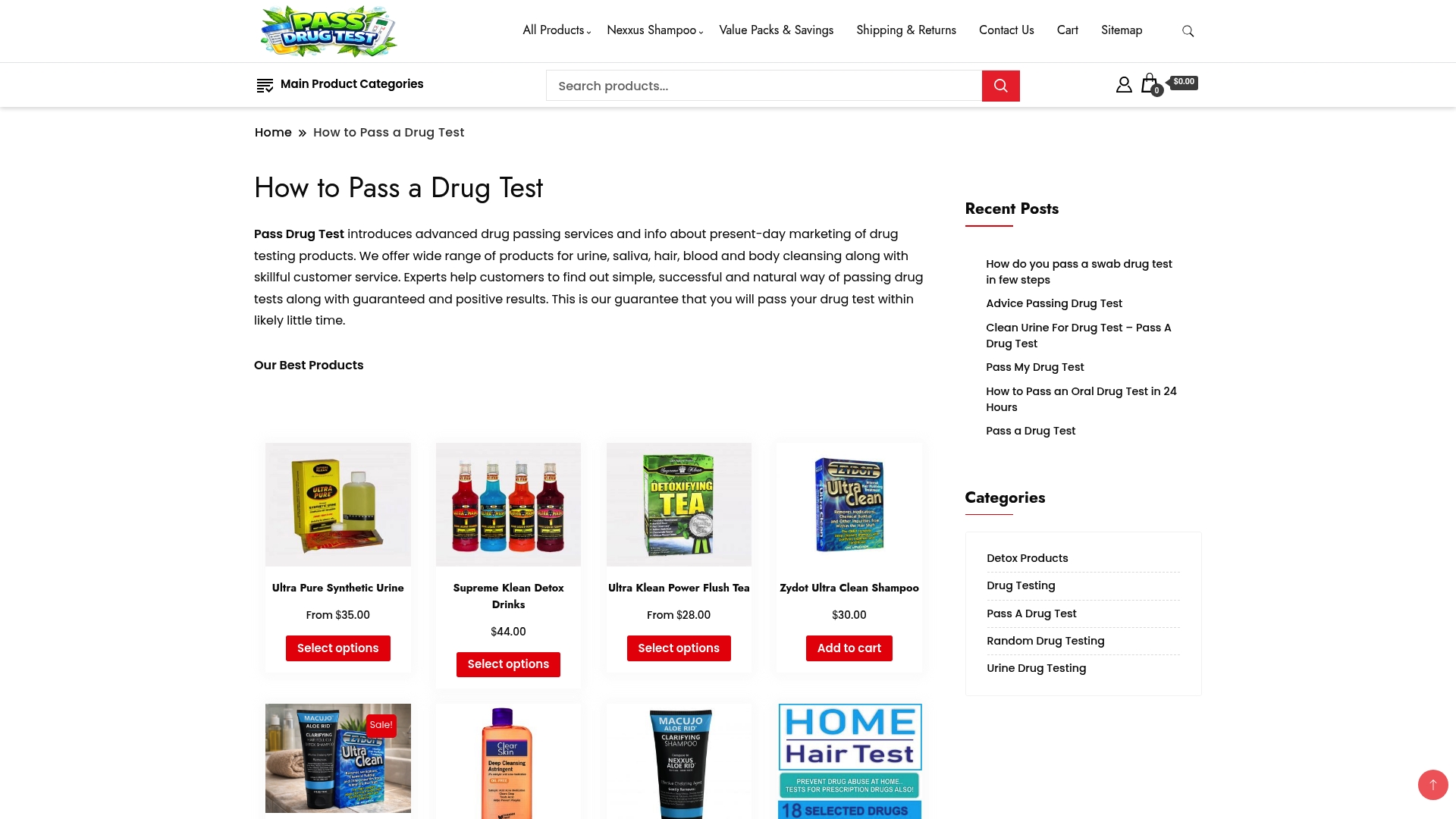
The flagship Macujo Aloe Rid Shampoo is formulated specifically around the Macujo Method, widely regarded as one of the most effective ways to prepare for a hair follicle screening without touching the legal gray area that comes with synthetic urine statutes. It works by breaking down residue inside the hair shaft rather than trying to fool a lab technician with a substituted sample. For readers who want a broader detox approach covering more than hair, Passdrugtest’s whole body cleansing line rounds out preparation options without any of the legal exposure discussed above. Browse the detox product category to find the option that matches your test type and timeline.
This article is general information, not a substitute for advice from a qualified lawyer. Consult a qualified legal professional about your own circumstances before acting on anything here.
Sources
- Alabama Code Title 13A. Criminal Code SECTION 13A-12-340 MANUFACTURE, SALE, USE, ETC., OF SYNTHETIC URINE OR URINE ADDITIVE | FindLaw
- Mississippi Code §97-19-87 – Justia
- Transportation
- Drugabuse