
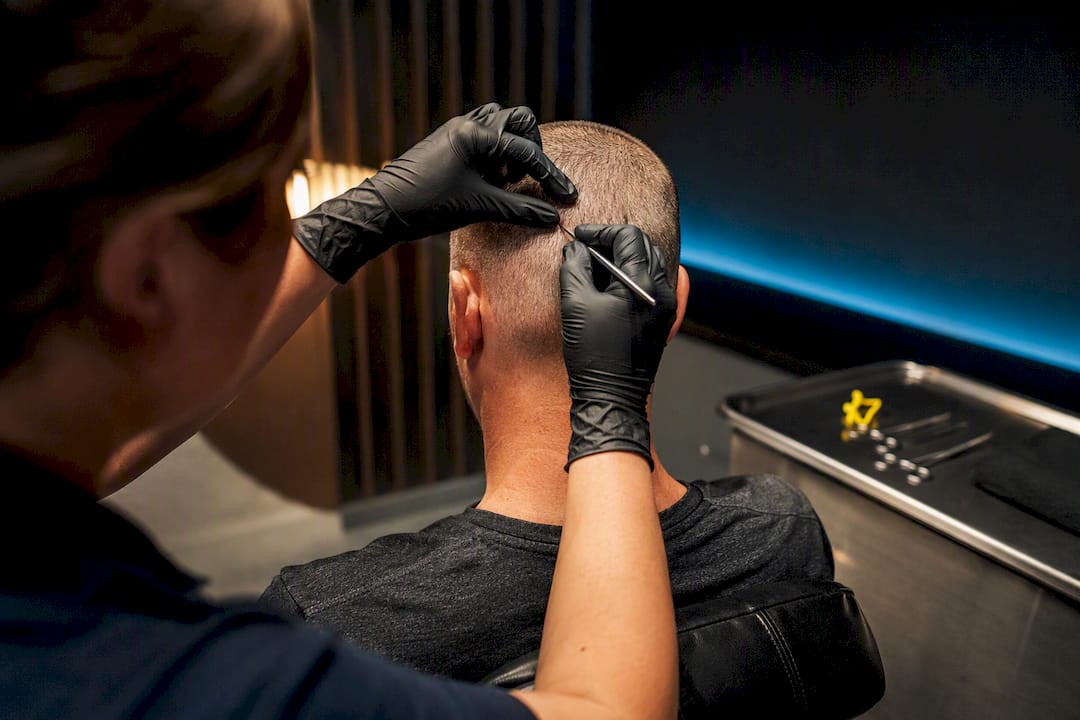

Shaving your head does not stop a hair follicle drug test. Collectors are trained to move straight to body hair, whether armpit, chest, leg, or beard, and a documented refusal often carries the same consequences as a positive result. Labs and collection standards already account for this workaround, and NIJ-funded research into hair metabolites keeps closing the gaps testers used to miss. If a test is on your calendar, the only strategy backed by evidence is stopping use now and giving your body time to grow clean hair.
TL;DR:
- Shaving the head does not prevent detection because labs will extract hair from body areas like armpits, chest, or beard, which can reflect drug use from months earlier.
- Body hair grows more slowly and has longer resting phases than scalp hair, causing detection windows to sometimes extend closer to a year instead of 90 days.
- Tests include decontamination washes, screening, and confirmation phases, with lab protocols designed to detect tampering or chemical treatment attempts.
- Abstaining from drug use for at least 100 days before testing is the most reliable method to ensure clean hair samples, as surface treatments can be ineffective and damaging.
- Innovative lab techniques focus on detecting phase II metabolites, helping distinguish between actual drug use and passive environmental exposure.
Table of Contents
- How a shaved head hair test compares to standard hair follicle testing
- What shaving your head really changes at collection
- Detection windows: scalp hair versus body hair
- Do detox shampoos and home treatments actually work?
- Your practical prep plan if a hair test is coming
- What the research actually says about metabolites and lab protocols
- Why we push honest preparation over risky shortcuts
- Where the Macujo Method fits into your preparation
- Sources
How a shaved head hair test compares to standard hair follicle testing
A standard hair follicle test does not look at the whole strand. It targets the segment closest to the scalp, because that section holds the most recent history of drug metabolites traveling through your bloodstream and into the follicle.
Labs typically request about 1.5 inches of hair, roughly pencil thickness, or 90 to 120 strands pulled close to the scalp. That length maps to about 90 days of history, which is why a shaved head hair test throws collectors into a different mode entirely: there is no fresh segment to cut.
The collection process follows a strict chain of custody, and the sample goes through two testing phases:
- An initial screening test to flag anything presumptively positive
- A confirmation test using GC/MS or LC/MS/MS, which identifies specific compounds at the molecular level
Before any of that analysis happens, labs run a decontamination wash on the sample to strip away surface residue, sweat, or product buildup that might otherwise be mistaken for internal drug use.
Pro Tip: Drugs don’t show up in hair instantly. It takes roughly 5 to 7 days for metabolites to travel from your bloodstream into newly forming hair, which is why a test taken the same week as use can still come back clean on that most recent segment.
What shaving your head really changes at collection
Shaving your head does not remove you from the testing pool. It just changes where the collector looks.
Federal and workplace collection protocols instruct collectors to pull from body hair when scalp hair is unavailable, and that includes:
- Armpit hair
- Chest or back hair
- Leg hair
- Beard or facial hair
Here is the part most people miss: body hair grows and rests on a completely different cycle than scalp hair, so a sample pulled from your arm or chest can reflect drug use from many months earlier, not just the last 90 days. Shaving your head to “reset the clock” can backfire by handing the lab a sample with a longer, murkier lookback window.
Collectors are also trained to notice a freshly shaved head walking into a scheduled test. Depending on the policy in place, that alone can trigger heightened scrutiny or get logged as a refusal, which many employers and courts treat the same as a failed test.
True total-body hairlessness is rare, but when it happens, the collector cannot proceed with hair collection at all. In that specific situation, the program usually documents the outcome as insufficient sample and either requests a different specimen, like urine, or notes it under the applicable refusal policy.
Detection windows: scalp hair versus body hair
The math behind detection windows is straightforward once you separate scalp hair from body hair.
Scalp hair grows at a fairly predictable rate, and the standard 1.5 inch sample corresponds to about three months of history. Drugs show up in that new growth within about a week of use, so the timeline is consistent enough that labs can quote it with confidence.
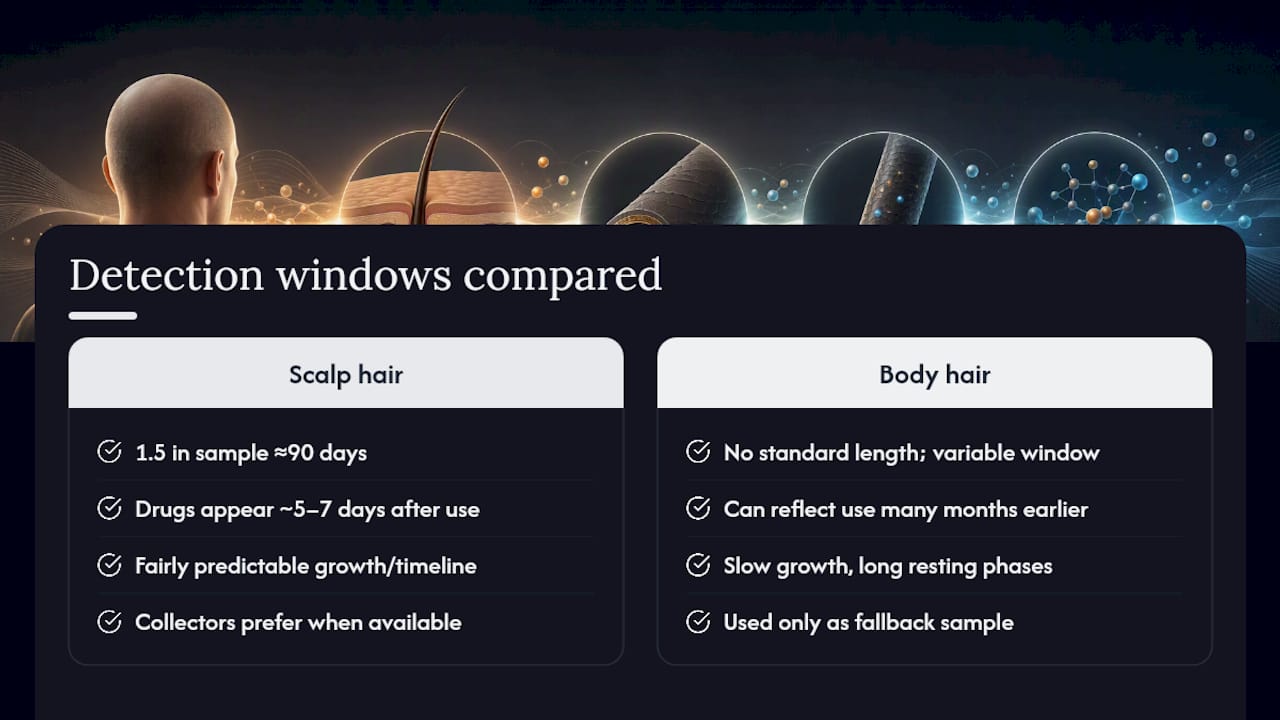
Body hair does not play by the same rules. It grows more slowly and spends long stretches in a resting phase, which means a body hair sample can reflect use from many months earlier, sometimes closer to a year, instead of the tidy 90 day window scalp hair offers. That unpredictability is exactly why collectors prefer scalp hair when it is available and only fall back to body hair when they have no other option.
The practical takeaway is almost the opposite of what people expect: shaving your head can stretch the detection window rather than shrink it, since your body hair may still be carrying a chemical record of use from well before you ever picked up the razor.
Do detox shampoos and home treatments actually work?
Peer-reviewed testing shows some intensive treatments genuinely lower drug concentrations in hair, but the effect is far from uniform. A 2023 study in Analytical Science found that aggressive bleaching and alkaline treatments reduced measured concentrations for several drug classes, in some cases by a wide margin, but THC reductions were smaller and far less consistent from sample to sample.
That inconsistency matters because labs are not passive in this process. Wash and confirmation protocols exist specifically to catch tampering:
- Decontamination washes strip surface contaminants before testing even begins
- Confirmation testing by mass spectrometry checks for chemically altered samples
- Metabolite analysis can flag results that look scrubbed or manipulated
Chemical treatments can reduce what a lab measures, but they don’t erase the underlying record. Labs build their wash and confirmation steps around exactly that gap, which is why tampering rarely produces a clean result across every drug class tested.
The real risk isn’t just an unreliable outcome. Bleaching-heavy protocols can visibly damage hair, and a sample that looks chemically altered can get flagged for additional scrutiny or outright rejection. Readers considering a shampoo-based approach should treat it as a supplement to abstinence, not a replacement for it.
Your practical prep plan if a hair test is coming
If a hair test is already scheduled, the clock matters more than any product on the shelf. Here’s how to approach it:
- Stop all use immediately. Every day of continued use adds to the segment a lab can detect.
- Plan around a realistic timeline. Since scalp hair testing covers roughly 90 days, giving yourself closer to 100 days lets clean growth fully replace that tested segment.
- Check your progress with an unsupervised home test if you want a read on where you stand before the real one.
- Know what to expect at collection. A trained collector documents the process, and if you can’t produce a valid sample, that outcome gets recorded, often as a refusal or insufficient sample, under the applicable policy.
- Skip the shortcuts that backfire. Submitting someone else’s hair, synthetic samples, or relying on a single overnight fix are the fastest ways to turn a bad situation into a documented integrity violation.
Pro Tip: A full hair detox checklist is more useful than any single product, because timing your abstinence window correctly does more work than what you rub into your hair the night before.
What the research actually says about metabolites and lab protocols
The most useful development in this field isn’t a new detox trick. It’s better science on the testing side. NIJ-funded work on conjugated phase II metabolites is helping labs tell the difference between someone who used a drug and someone who was simply exposed to it in the environment, like secondhand smoke.
Detecting these conjugated metabolites gives testers a clearer signal for actual use versus passive contamination, which sharpens how positive results get interpreted rather than just how often they get flagged.
That same rigor applies to cosmetic tampering. The Analytical Science findings on bleaching treatments matter precisely because they show labs which analytes are hardest to mask, informing the wash and confirmation steps built into standard lab workflow.
Why we push honest preparation over risky shortcuts
Shortcuts around hair testing rarely hold up, and the evidence backs that up consistently. Passdrugtest’s position has always been that abstinence plus informed preparation beats any single product used as a last-minute fix. We publish detailed guidance because readers deserve to understand what a shampoo protocol can realistically do and where its limits are, not an inflated promise. No cleansing product overrides biology. What it can do is support a plan you’re already committed to.
— MIchael
Where the Macujo Method fits into your preparation
Among the approaches people research for scalp hair, the Macujo Method, developed by Mike Macujo, remains the most widely used approach for tackling drug metabolites embedded in the hair shaft, and Passdrugtest built its flagship product around that same protocol.
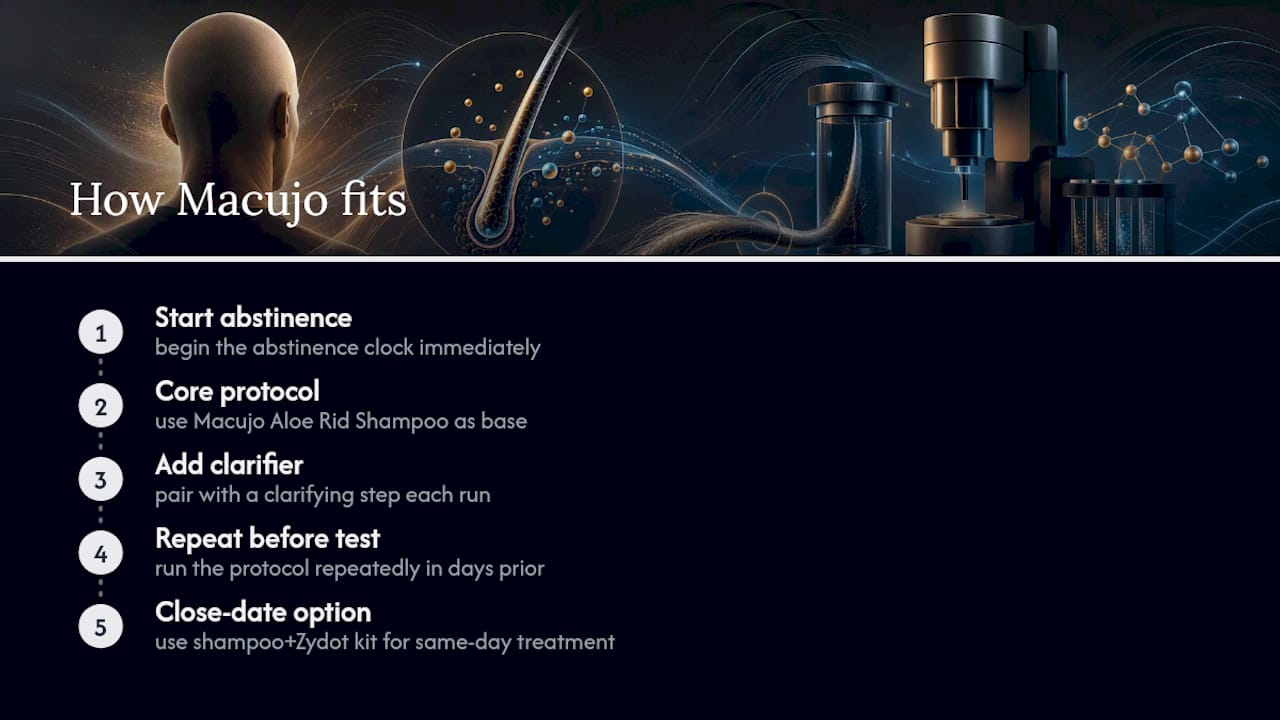
The Macujo Aloe Rid Shampoo works as the core of that method, formulated to break down buildup in the hair shaft when used correctly alongside the full Macujo routine. Most customers pair it with a clarifying step and run the protocol repeatedly in the days leading up to a test, always alongside the abstinence timeline covered above rather than as a substitute for it.

For a packaged option, the Macujo Aloe Rid Shampoo plus Zydot Ultra Clean Treatment kit bundles the shampoo protocol with a same-day treatment step, which is the combination most customers ask about when a test date is close and there is no more time to spare.
If you have a hair test on the calendar, start your abstinence clock today and check the Macujo Aloe Rid Shampoo product page to see how the protocol fits into the days you have left.
This article is general information, not a substitute for advice from a qualified doctor. Consult a qualified healthcare professional about your own circumstances before acting on anything here.
Sources
- Hair analysis: Assessment of homemade hair treatment effects on drug concentrations in the keratin matrix – Analytical Science (2023)
- Detecting drugs in hair: is it drug use or environmental contamination? – NIJ
- Hair Drug Testing 101 – Concentra
- Hair drug testing process & benefits – Labcorp