
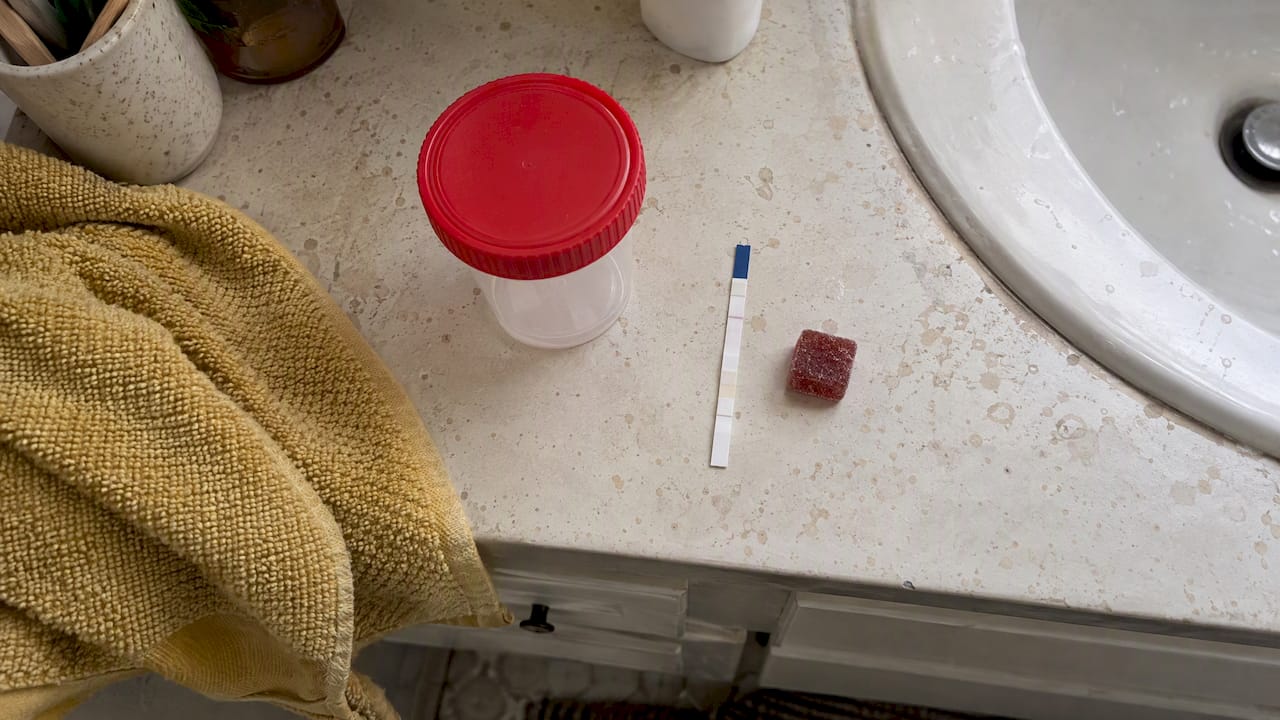

Yes, edibles show up on a urine test. The test looks for a THC metabolite, not for the way the cannabis got into your body, so a gummy leaves the same marker as a joint. How long that marker stays above the cutoff depends mostly on how often you use, not on the product. For a single edible, expect roughly a few days. For regular use, expect weeks.
If you have a test coming up, the sections below explain what the lab measures, what to expect for your use pattern, and what helps and what backfires.
TL;DR
- Urine tests detect THC-COOH, the same metabolite whether you ate, smoked or vaporized cannabis.
- A single use is typically detectable for 1 to 4 days, while chronic use can stretch to 1 to 2 months.
- Federal programs screen at 50 ng/mL and confirm at 15 ng/mL. Many private employers use their own cutoffs.
- Drinking huge amounts of water can produce a dilute sample, which labs may flag and which can trigger a re-collection.
- Hair is a separate test with a much longer window, and it needs a different plan than urine.
Table of Contents
- Why edibles show up on a urine test
- How the edible timeline differs from smoking
- How long edibles stay detectable in urine
- What changes your result
- What does not work
- A realistic plan if your test is coming up
- Perspective: what we tell customers who ask about edibles
- Where our products fit
- If the test is not urine
- FAQ
- Sources
Why edibles show up on a urine test
When you eat THC, your liver converts it into several compounds. One of them, 11-nor-9-carboxy-THC (THC-COOH), is what urine labs look for. SAMHSA’s drug-free workplace guidance makes the point that the test cannot tell the route of use: smoked or swallowed, the same metabolite appears.
A urine result is also not a measure of impairment. The CDC describes urine marijuana tests as markers of prior exposure, and notes that trying to link a concentration to the timing of use is scientifically complicated by metabolism, diet, age and urine volume. That is why two people who ate the same gummy on the same day can get different results.
How the edible timeline differs from smoking
Edibles act slowly. A pharmacokinetic study of oral cannabis found that the urinary metabolite typically peaks around 6 to 9 hours after ingestion, which is later than with inhalation. The liver processing also produces a different metabolite profile, and for some users that means a longer detection window.
There is a second problem: dose. The CDC notes that the amount of THC in edibles is hard to measure and often inaccurately labeled. You may have taken more than you think, and that matters for your timeline.
Two practical points follow:
- A late-night edible can still be producing metabolites the next afternoon. If your test is the next day, the peak may be right when you provide the sample.
- Edible potency is a guess unless you have lab results for that exact product. Plan for the higher dose.
How long edibles stay detectable in urine
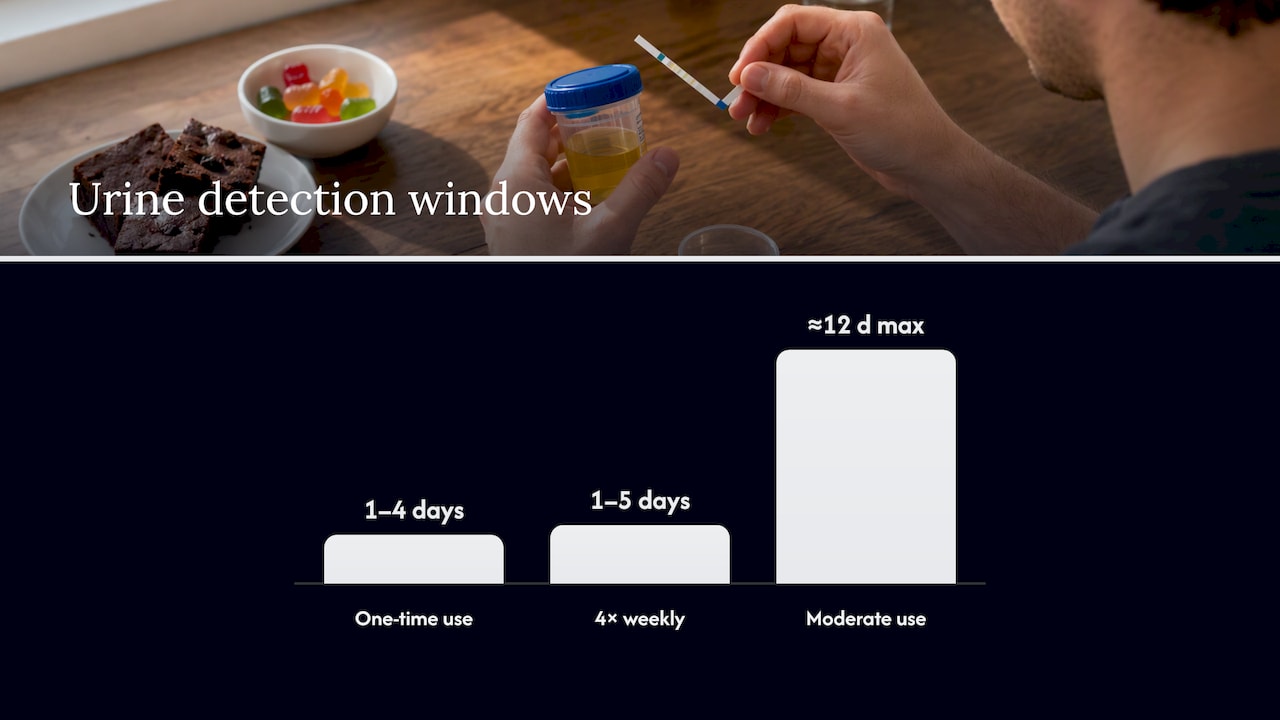
Sources give wide ranges because people differ. Here is a working summary based on the laboratory reference data from Labcorp:
| Use pattern | Typical urine detection window |
|---|---|
| One-time use | 1 to 4 days |
| About 4 times a week | 1 to 5 days after last use in the reference data, often longer in practice |
| Moderate use | Up to about 12 days |
| Chronic, daily use | 1 to 2 months |
Other medical references quote a broader span. Medical News Today puts urine detection at roughly 1 to 30 days. Our own breakdown of urine THC detection times and cutoffs goes deeper on the long end of that range.
The headline numbers are averages. Body fat, metabolism, hydration, the cutoff your employer uses and the potency of what you ate all move your personal number.
What the cutoffs mean
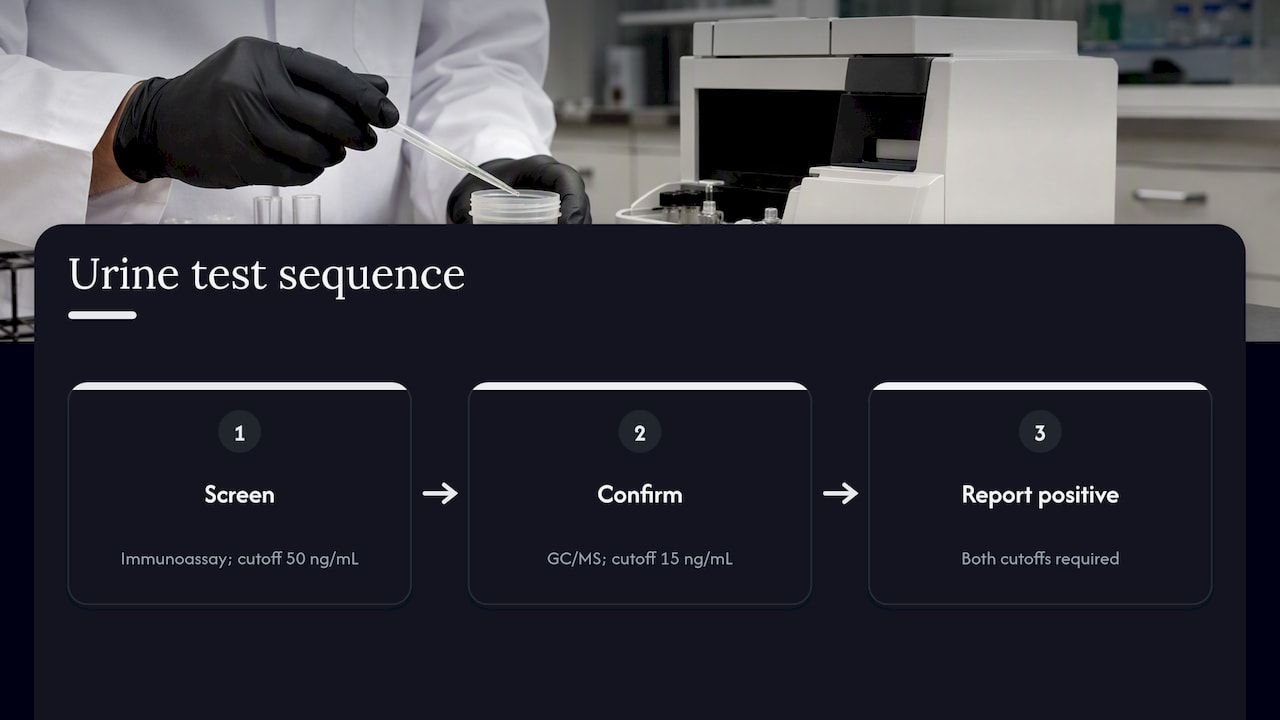
A urine test is two steps. First an immunoassay screen, then, if it is positive, a more precise confirmation by gas chromatography-mass spectrometry (GC/MS).
For federally regulated testing, the Department of Transportation’s rule sets an initial cutoff of 50 ng/mL and a confirmatory cutoff of 15 ng/mL for marijuana metabolites. A sample has to be at or above both to be reported positive in that system.
Not every employer follows the federal levels. Some use a lower screen, which lengthens the window. Ask the employer or the collection site what panel applies, or check your offer letter or testing policy.
What changes your result
How often you use
This is the biggest factor by far. THC is stored in fat tissue and released slowly, so frequent users keep a reservoir that keeps feeding metabolites into urine for weeks. Occasional users clear it much faster.
Dose and product
A 5 mg gummy and a 100 mg brownie are not the same exposure. Homemade edibles and unregulated products are the least predictable.
Hydration and urine concentration
Labs account for dilution. Research on creatinine- and specific-gravity-normalized urine cannabinoid concentrations exists because urine volume varies so much from person to person and sample to sample. A very watery sample can look suspicious in its own right.
Exercise
People who exercise hard shortly before a test may release stored THC. We cover that in why vigorous exercise before a urine test is a bad idea.
CBD and “THC-free” products
An unexpected positive does not always come from an edible you meant to eat. ARUP Laboratories notes that unregulated CBD products are a common source of surprise positives, because some contain enough THC to build up with frequent use. See our guide on avoiding a false positive with CBD if that is your situation. Delta 8 products carry a similar risk, covered in our delta 8 drug test article.
What does not work
It is tempting to try anything in the last 48 hours. A few of the most common moves do more harm than good.
Flushing with water. Drinking gallons of water does not erase metabolites. It can give you a dilute sample. The ARUP guidance on testing explains that labs use creatinine or specific gravity to check hydration, and a dilute result may be flagged as invalid, which can lead to a re-test, sometimes under direct observation.
Explaining it away. Claiming secondhand smoke or an accidental edible rarely helps. In federal programs, Medical Review Officers review confirmed positives for THC-COOH, and the concentrations needed for a positive are generally inconsistent with trace exposure.
Assuming a home test is a guarantee. A home strip is a screen with its own cutoff. It can read negative while a lab using a lower cutoff reads positive. It is useful as a rough check, not as proof.
A realistic plan if your test is coming up
Here is a step-by-step approach that stays honest about the limits.
- Find out the test type. Urine, hair, saliva and blood have very different windows. Ask the employer or read your paperwork.
- Stop using now. Every day without cannabis counts. No product can substitute for time if you are a heavy daily user.
- Be honest about your pattern. One edible last weekend is a different situation from daily use for a year.
- Check your progress with a home test, ideally one with a cutoff close to what the lab will use.
- Keep hydration normal. Drink to thirst. Do not overdo it.
- Avoid hard workouts in the final day or two.
- Have a plan for test day. Show up on time and follow the collection instructions exactly.
If you take prescription medication, or you have a kidney or other health condition, talk to your doctor before changing how much you drink or taking any supplement. Do not alter prescribed medication to prepare for a test.
Perspective: what we tell customers who ask about edibles
We hear from a lot of people who assumed an edible was somehow “lighter” than smoking. It is not, as far as the urine test is concerned. The lab sees the same metabolite, and the delayed peak from eating can catch people off guard when the test is the next morning.
What we tell everyone is to match the plan to the test. Urine is the test where time and honest self-assessment matter most. Hair is different: a single edible often has a very different footprint there, and we explain that in our article on edibles and hair tests. If you are unsure which test you face, our comparison of hair versus urine drug tests lays out the differences side by side.
We also keep it simple on service. Our support team is available 9am to 12am daily, and we ship discreetly, because we know this is a stressful and private moment.
— MIchael
Where our products fit
We sell home test kits and urine-related products so you can check where you stand before the real thing. You can browse products for clean urine or our urine drug testing category. For background on how collection and lab analysis work, read about urine drug testing and our page on urine drug tests for marijuana.
One honest note: a shampoo does nothing for a urine test. If your employer tests hair, or may switch to hair, our hair drug test shampoo range is built for that test, and our hair follicle information guide explains how it works. If you want to see everything we carry, start at the Passdrugtest homepage.
If the test is not urine
Urine is only one option. Employers pick the test that fits their policy.
- Saliva: a short window, generally a day or so for occasional users. See how long THC stays in saliva.
- Blood: short as well, but a positive can outlast the high. Read blood tests for weed.
- Hair: the longest window, up to about 90 days. Heavy use is more likely to be picked up, as our page on heavy smokers and hair tests shows.
A clean urine result says nothing about what a hair test will find, so confirm which one you are facing.
FAQ
How long will an edible be detected in urine?
After a single use, typically 1 to 4 days according to laboratory reference data. Regular use extends that to weeks, and chronic daily use can reach 1 to 2 months. Your own window depends on dose, body fat, metabolism and the cutoff the lab uses.
Can edibles make you fail a drug test?
Yes. The test finds THC-COOH regardless of how you consumed cannabis, so an edible can produce a positive result just as smoking can. Products with inaccurate labels or hidden THC, including some CBD items, can also cause a positive.
How do you flush edibles out of your system?
There is no safe way to flush them quickly. Time is what lowers the metabolite level. Overdrinking water can produce a dilute sample that a lab may flag as invalid and ask you to repeat, so drink normally and avoid extremes.
Does taking edibles take longer to flush out of your system?
Not always, but edibles peak later, around 6 to 9 hours after ingestion, and the liver produces a different metabolite profile. For some users that means a longer window than expected, especially if the dose was higher than the label suggested.
Sources
- Labcorp OnDemand: How does a drug test work
- U.S. DOT: 49 CFR 40.85 cutoff concentrations
- SAMHSA: Drug-free workplace FAQs
- CDC MMWR: urine marijuana testing
- PubMed Central: urinary THC-COOH after oral cannabis
- CDC: Cannabis and poisoning
- Medical News Today: how long THC stays in your system
- CDC Stacks: creatinine and specific gravity normalization
- ARUP Consult: choosing the right drug test
- SAMHSA: 2025 MRO case studies, urine