


A screening panel is a coordinated group of tests bundled together to assess risk or health status across multiple conditions at once. Rather than ordering individual tests one by one, clinicians, labs, and regulatory bodies group related tests into a single panel to catch more conditions with less redundancy. Screening panels appear across medical diagnostics, genetic carrier testing, newborn health programs, and even legal or professional disciplinary proceedings. Critically, a positive result from any screening panel identifies risk, not a confirmed diagnosis. Follow-up testing is almost always required to reach a definitive conclusion.
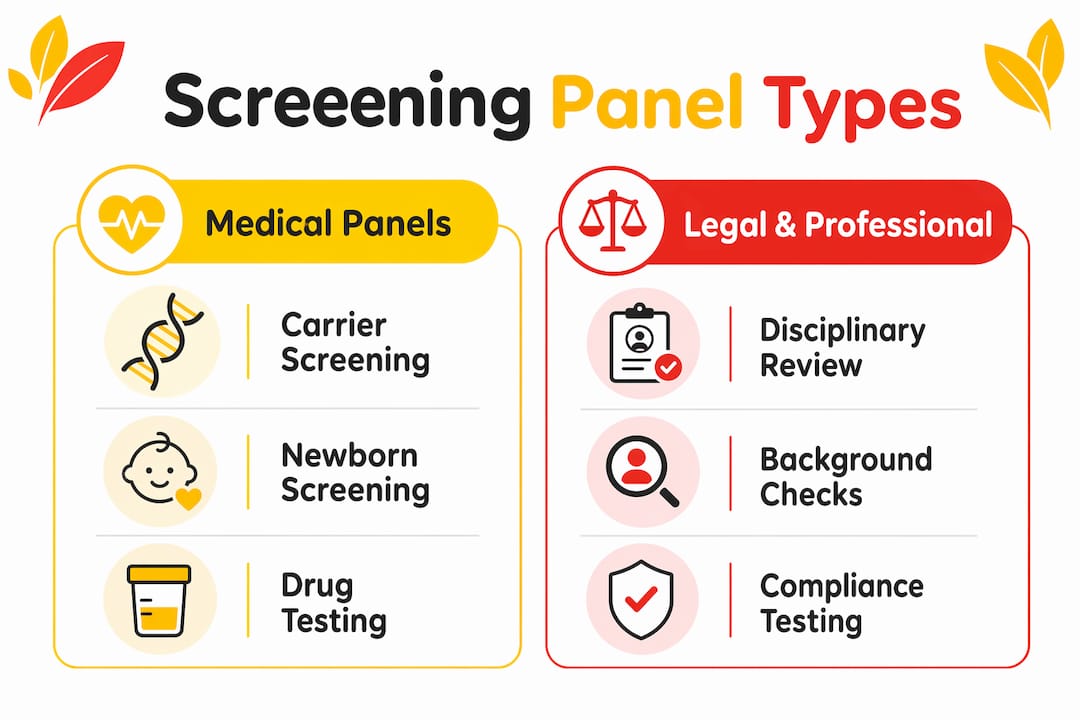
The most prominent example in the United States is the Recommended Uniform Screening Panel (RUSP), the national guideline that the U.S. Secretary of Health and Human Services (HHS) recommends for newborn screening programs nationwide. Beyond newborns, screening panels cover cancer risk genes, infectious diseases, drug metabolites in hair or urine, and inherited carrier status for conditions like cystic fibrosis. Here is a quick overview of where you will encounter them:
- Medical diagnostic panels: Blood chemistry, lipid, thyroid, and infectious disease panels used in routine care
- Genetic carrier screening panels: Tests that identify whether you carry gene variants linked to inherited conditions
- Newborn screening panels: State-run programs guided by the RUSP to detect heritable disorders at birth
- Drug testing panels: Urine, blood, or hair follicle tests that screen for specific substances or metabolites
- Legal and disciplinary panels: Review boards that screen complaints before formal investigations proceed
What expanded carrier screening panels test for
Expanded carrier screening (ECS) panels test prospective or current parents for a broad range of inherited conditions in a single lab run. Traditional carrier screening targeted specific ethnic groups, such as Ashkenazi Jewish populations for Tay-Sachs disease. The American College of Obstetricians and Gynecologists (ACOG) now supports panethnic carrier screening, recommending that all individuals, regardless of ethnicity, be offered a panel covering conditions like cystic fibrosis, spinal muscular atrophy, thalassemias, and hemoglobinopathies.
The clinical logic is straightforward: as patient populations grow more diverse, ancestry-based targeting misses carriers who do not fit expected demographic profiles. A panethnic panel casts a wider net without requiring a patient to accurately trace their ancestry.
That said, genetics experts caution that bigger does not always mean better when it comes to panel size. Panels that include hundreds of conditions inevitably test for some disorders with no available treatment or intervention, which can generate anxiety without giving patients anything actionable to do. The clinical benefit of an expanded panel depends heavily on selecting conditions where a positive result leads to a real decision, whether that is pursuing IVF with preimplantation genetic testing, choosing adoption, or preparing for a child’s medical needs at birth.
| Feature | Traditional carrier screening | Expanded carrier screening |
|---|---|---|
| Conditions tested | Typically a small number | A broad range |
| Population targeted | Ethnicity-specific | Panethnic (all backgrounds) |
| Lab method | Single-gene or small panel | Multigene sequencing |
| Clinical utility | High for targeted conditions | Varies by panel design |
| False positive risk | Lower | Higher with larger panels |
| ACOG recommendation | Older standard | Currently supported |
Pros of expanded carrier screening:
- Detects carriers across diverse ancestral backgrounds without requiring ethnic self-identification
- Identifies couples at risk before or early in pregnancy, allowing time for informed decisions
- Single test replaces multiple sequential tests, reducing time and lab visits
- Covers rare conditions that targeted screening would miss entirely
Cons of expanded carrier screening:
- Larger panels increase the chance of a false positive result, which can cause unnecessary stress
- Some included conditions lack effective treatments, making results harder to act on
- Variants of uncertain significance (VUS) are more common with broader sequencing, complicating counseling
- Cost can be higher than targeted panels, and insurance coverage varies
How newborn screening panels work in the U.S.
Newborn screening (NBS) panels are among the most successful public health programs in American history. Every state runs a program that tests newborns for heritable disorders, typically within the first 24–48 hours after birth using a dried blood spot collected from the baby’s heel. The goal is to catch conditions before symptoms appear, enabling early treatment to reduce risk of severe disability or death.
The national framework for these programs is the Recommended Uniform Screening Panel, maintained by HRSA and recommended by the U.S. Secretary of HHS. The RUSP divides conditions into two groups:
- Core conditions: The Secretary of HHS recommends that every state NBS program screen for these. Newborn screening is specifically designed to detect them.
- Secondary conditions: These may appear incidentally while screening for a core condition. NBS is not specifically designed to find them, but it sometimes does.
Disorders reach the RUSP based on evidence of net benefit from screening, the ability of state labs to run the test reliably, and the availability of effective treatments. The original list drew from the American College of Medical Genetics (ACMG) report commissioned by HRSA, published in Genetics in Medicine in 2006. The panel has grown since then as new conditions meet the evidence threshold.
Key disorders commonly screened in newborns:
- Phenylketonuria (PKU): dietary management prevents intellectual disability
- Congenital hypothyroidism: thyroid hormone replacement prevents developmental delays
- Sickle cell disease: early treatment reduces life-threatening complications
- Cystic fibrosis: early nutritional and pulmonary support improves outcomes
- Spinal muscular atrophy (SMA): gene therapy is most effective when started before symptoms
- Congenital adrenal hyperplasia (CAH): hormone replacement is life-saving in severe forms
- Critical congenital heart disease (CCHD): pulse oximetry screening catches defects before discharge
State adoption of the RUSP is not uniform. Most states screen for the majority of RUSP core conditions, but newer additions take time to roll out because states must update lab equipment, train staff, and establish follow-up systems. Some states also screen for conditions beyond the RUSP. Your baby is screened for whatever your state’s panel includes at the time of birth, so it is worth checking your state’s specific list if you want to know exactly what was tested.
Pro Tip: If your baby was born in a state with a smaller panel and you want broader coverage, private newborn screening services can test for additional conditions using the same dried blood spot method.

How legal and disciplinary screening panels function
In legal and professional disciplinary contexts, a “screening panel” means something entirely different from a medical test. Here, a screening panel is a review body, typically a committee or board, that evaluates complaints or flags to decide whether a formal investigation is warranted. Think of it as a gatekeeper: the panel filters out complaints that lack merit before they consume the full resources of a disciplinary proceeding.
Law Insider defines a screening panel as a body that functions to determine whether a complaint clears the threshold for formal review. These panels are common in professional licensing boards, judicial conduct commissions, medical licensing authorities, and bar associations. They protect both the public and the accused professional by ensuring that only credible, substantiated complaints advance.
The process typically works like this:
- A complaint is filed against a licensed professional or public official
- The screening panel reviews the complaint for completeness and initial plausibility
- The panel decides to dismiss, refer for informal resolution, or advance to formal investigation
- Members of the screening panel are often drawn from the same profession, plus public representatives
- Decisions at this stage are usually not final and do not constitute a finding of wrongdoing
Legal screening panels differ from medical ones in a fundamental way: they evaluate conduct and evidence, not biological samples or genetic data. The “screening” is procedural rather than diagnostic. A medical panel asks, “Does this sample show a condition?” A legal panel asks, “Does this complaint show enough to proceed?”
Examples of legal and disciplinary screening panels in practice:
- State bar association grievance committees reviewing attorney misconduct complaints
- Medical board screening panels evaluating patient complaints against physicians
- Judicial conduct commissions screening complaints about judges
- Securities regulatory bodies reviewing investor complaints before formal enforcement
- University academic integrity panels screening alleged violations before hearings
Common uses and costs of screening panels
Screening panels show up across nearly every area of medicine and compliance. Health screening tests are applied to asymptomatic populations to assess disease likelihood, and panels make that process more efficient by grouping related tests. A lipid panel, for example, measures total cholesterol, LDL, HDL, and triglycerides in one blood draw rather than four separate orders. A comprehensive metabolic panel covers glucose, kidney function markers, liver enzymes, and electrolytes simultaneously.
Beyond routine blood work, you will find screening panels in these areas:
- Cancer screening panels: Multigene panels like BRCA1/BRCA2 testing assess hereditary cancer risk; liquid biopsy panels screen for circulating tumor DNA
- Infectious disease panels: Respiratory panels test for influenza, RSV, COVID-19, and other pathogens from a single swab; STI panels cover multiple infections at once
- Prenatal panels: A standard prenatal panel includes blood type, Rh factor, rubella immunity, hepatitis B surface antigen, HIV, and syphilis screening, all from one blood draw
- Drug testing panels: Urine panels range from a basic 1-panel test to a 10-panel or 12-panel screen covering substances from marijuana to opioids to benzodiazepines; hair follicle panels detect metabolites over a longer detection window
- Cardiovascular panels: Combine lipid levels, C-reactive protein, and homocysteine to assess heart disease risk
- Thyroid panels: TSH, free T3, and free T4 measured together to evaluate thyroid function
Costs vary considerably depending on the type of panel, the number of conditions tested, and whether you have insurance. A basic urine drug screening panel can cost as little as a few dollars for a home test kit. Expanded carrier screening panels run by clinical labs can cost several hundred dollars without insurance, though many major insurers cover them for pregnant patients or those planning a pregnancy. Newborn screening fees are typically covered by state programs or standard insurance, though the exact cost structure varies by state. Cancer gene panels like BRCA testing can range widely depending on the lab and the breadth of genes included.
Insurance coverage is one of the biggest factors in accessibility. Under the Affordable Care Act, non-grandfathered health plans must cover screenings included in the HRSA-supported comprehensive guidelines without charging a copayment, coinsurance, or deductible, provided the plan year began on or after the date the Secretary of HHS adopted the condition. That means RUSP-recommended newborn screenings are generally covered at no cost to families with qualifying insurance.

Frequently asked questions about screening panel costs and uses:
Does insurance cover expanded carrier screening? Coverage depends on your plan and clinical indication. Many insurers cover it for pregnant patients or those actively planning pregnancy; coverage for preconception screening in low-risk individuals is less consistent.
Can you order a screening panel without a doctor? Some direct-to-consumer labs offer panels without a physician order, but results still require clinical interpretation. A positive screen without follow-up counseling can cause unnecessary alarm.
How long does a screening panel take? Turnaround varies by panel type. A urine drug screen can return results in minutes. A multigene carrier panel from a clinical lab typically takes one to three weeks.
What screening panel results mean and what to do next
Screening panels identify risk, not confirmed disease. That distinction shapes everything about how you should interpret a positive result. Early identification through screening allows for preventive interventions before severe complications develop, but a positive screen is the beginning of a clinical conversation, not the end of one.
When a screening panel returns a positive or abnormal result, the standard next step is confirmatory diagnostic testing. A newborn who screens positive for PKU, for example, will have a follow-up blood test to confirm the diagnosis before any dietary changes are made. A person who screens positive on a carrier panel will typically be referred for genetic counseling and, if their partner is also a carrier, offered diagnostic options like chorionic villus sampling or amniocentesis during pregnancy.
Limitations of screening panels are real and worth understanding:
- False positives: A result that suggests a condition is present when it is not. False positives are more common in larger panels and can cause significant anxiety. Understanding false positive drug tests is especially relevant in workplace or legal drug screening contexts, where a false positive can have serious consequences.
- False negatives: A result that misses a condition that is actually present. No panel catches every case, and sensitivity varies by condition and lab method.
- Variants of uncertain significance: In genetic panels, a VUS means the lab found a gene change but cannot yet determine whether it causes disease. These results are genuinely ambiguous and require careful counseling.
- Detection window limitations: Drug screening panels, particularly urine tests, have defined detection windows. Hair follicle panels cover a longer window, typically up to 90 days, but are also subject to accuracy considerations depending on collection and testing methods. For more on what happens during initial hair screening, the process involves an immunoassay screen followed by confirmatory GC-MS testing on positive samples.
Ethical considerations surround screening panels at every level. Genetic panels raise questions about the right not to know, particularly when a panel returns results for conditions that have no treatment. Newborn screening raises questions about parental consent, since most states screen automatically without explicit opt-in. Drug testing panels in employment or legal contexts raise privacy concerns, particularly when hair follicle testing can reveal use from months prior. Genetic counselors, physicians, and in some cases legal advisors play a critical role in helping people understand what their results mean and what options they have.
Key follow-up steps after a positive screening panel result:
- Request a copy of the full panel report, not just the summary
- Ask your provider which specific marker or condition triggered the positive result
- Schedule confirmatory diagnostic testing before making any major decisions
- Seek genetic counseling if the positive result involves a heritable condition
- In drug testing contexts, request a confirmatory GC-MS test if an initial immunoassay screen is positive
- Document any medications or supplements you take, since some cause false positives in hair tests
- Ask about the panel’s sensitivity and specificity for the specific condition flagged
Pro Tip: Never act on a screening panel result alone. A positive screen is a signal to investigate further, not a diagnosis. Always confirm with a second, more specific test before making medical, reproductive, or legal decisions.
Drug testing screening panels are one area where the stakes of a positive result feel especially immediate. If you are facing a hair follicle drug test and want to understand your options, Passdrugtest carries proven drug test detox products designed to support your preparation, including the Macujo Aloe Rid Shampoo, which is a core component of the Macujo method, widely regarded as the most effective protocol for passing a hair follicle drug test.
Key Takeaways
Screening panels bundle multiple related tests into one coordinated assessment to identify risk early, but a positive result always requires follow-up diagnostic testing to reach a confirmed diagnosis.
| Point | Details |
|---|---|
| Definition of a screening panel | A coordinated group of tests bundled to assess risk across multiple conditions simultaneously, used in medical, genetic, and legal contexts. |
| RUSP guides newborn screening | The Recommended Uniform Screening Panel, recommended by the U.S. Secretary of HHS, sets the national standard for state newborn screening programs. |
| Expanded carrier panels carry tradeoffs | Larger genetic panels increase false positive risk; clinical experts advise prioritizing conditions where results are actionable. |
| Positive screens require follow-up | A positive screening panel result identifies risk, not a confirmed diagnosis; confirmatory testing and clinical counseling are always the next step. |
| Legal panels serve a different function | In disciplinary contexts, a screening panel is a review body that filters complaints before formal investigations proceed, not a medical test. |