

Hair contamination means drug residue that sits on the surface of hair or gets absorbed into the hair shaft from outside sources rather than from something you swallowed, smoked, or injected. It matters because it can produce a positive hair follicle test even without personal drug use. Labs try to sort real use from contamination using decontamination washes, segmental analysis, and metabolite criteria drawn from research groups like SoHT and NIJ/RTI, but none of these methods hits 100 percent accuracy.
If you’re facing a test, the first move isn’t a shampoo. It’s documentation.
- Write down every exposure: dates, locations, people present
- Stop any further contact with the source immediately
- Follow a tested preparation routine rather than guessing
Hair grows at roughly 1 centimeter per month, which is why a 1.5 inch sample can represent about 90 days of history.
Pro Tip: Take photos of your environment and note witnesses right away. If a dispute ever comes up, that record is worth more than anything you do to your hair afterward.
Key Takeaways
No hair detox method, including validated lab decontamination, guarantees a negative result, which is why documentation and timing matter as much as the product you choose.
| Point | Details |
|---|---|
| Three contamination routes | Drugs enter hair through bloodstream incorporation, sweat/sebum diffusion, or external surface deposition. |
| Growth rate sets the timeline | Hair grows about 1 centimeter per month, letting labs build a segmental history of exposure. |
| Metabolites help, but aren’t final | Phase II conjugated metabolites show promise for separating use from contamination, per NIJ/RTI research. |
| Home treatments carry real risk | Bleach and acid cycles can cut analyte levels by up to 90 percent but damage hair and never guarantee a pass. |
| Macujo method is our recommended option | Passdrugtest recommends the Macujo method with Macujo Aloe Rid Shampoo as a tested, structured approach. |
Table of Contents
- Understanding Hair Contamination Causes and How Drugs Enter Hair
- How Do Labs Tell Contamination From Actual Drug Use?
- What Real-World Contamination Scenarios Look Like
- Do Home Detox Methods Actually Reduce Drug Residue?
- Your Preparation Checklist Before a Hair Follicle Test
- Why Getting This Right Actually Matters
- Why Passdrugtest Recommends the Macujo Method
- Frequently Asked Questions
- Sources
Understanding Hair Contamination Causes and How Drugs Enter Hair
Drugs reach hair through three distinct routes, and knowing which one applies to you changes how you should respond. The first is incorporation from the bloodstream during hair formation, which happens when you actually consume a substance. The second is diffusion from sweat and sebum after the hair has already grown, letting drugs seep in from your own skin oils over time. The third is external surface deposition, where residue from smoke, powders, or physical contact lands on the hair shaft without ever entering your body.
That third route is what “contamination” usually refers to, and it’s the one people preparing for a test worry about most.
Hair grows at approximately 1 centimeter per month, and labs use this rate to build a timeline through segmental analysis. A 3-inch sample cut close to the scalp roughly maps to the past three months, segment by segment, so a lab can see whether residue clusters near the root (recent) or spreads evenly (chronic) or shows up only at the tip (older, possibly pre-existing).
Hair color, porosity, and cosmetic treatments all change how much drug residue gets trapped or released:
- Darker, more porous hair tends to bind more drug compounds through melanin content
- Damaged or previously bleached hair absorbs and loses residue differently than virgin hair
- Cosmetic treatments can alter how labs interpret detection windows
How Do Labs Tell Contamination From Actual Drug Use?
Toxicology labs rely on three core steps: validated wash and decontamination, segmental sampling, and confirmatory testing with liquid chromatography tandem mass spectrometry, or LC‑MS/MS. On top of that, metabolite detection, especially phase II conjugated metabolites, is emerging as a genuine way to separate someone who used a drug from someone who was simply near it.
A typical pre-analytical workflow looks like this:
- Document sample collection with chain of custody
- Run decontamination wash cycles to strip external residue
- Segment the hair sample by growth interval
- Extract and screen for target substances
- Confirm positive screens with LC‑MS/MS
- Compare wash solution results against the hair extract itself
The SoHT consensus guidance from 2021 recommends exactly this sequence, and it specifically calls for interpreters to weigh hair treatments and case-specific factors before reaching a conclusion. Meanwhile, NIJ/RTI research found that conjugated phase II metabolites are measurable in hair and may help distinguish ingestion from passive exposure, though the researchers themselves note the sample sizes and reference standards involved still need expansion.
A parent drug found only at the surface with no matching metabolite inside the shaft points toward contamination. A metabolite present throughout the segment points toward use.
Segmental patterns add another layer. If residue sits heaviest near the root and metabolite levels track alongside it, that pattern supports use. If it shows up unevenly or only externally, contamination becomes more plausible, particularly when you can document environmental exposure.
What Real-World Contamination Scenarios Look Like
Not every exposure carries the same risk, and knowing where yours falls helps you decide how urgently to act.
Low risk: Casual proximity to secondhand smoke in a public space, brief contact with someone who used earlier in the day.
Medium risk: Regular exposure in a shared household where someone smokes indoors, riding in a car with active smoke exposure.
High risk: Direct handling of powders or residue, spending time in an environment previously used for drug preparation, prolonged close contact with active use.
- Identify which category your exposure falls into
- Note the frequency and duration of contact
- Record who else was present and where it happened
- Preserve any physical evidence, like photos of the environment
Workplace contamination deserves special mention. Cases tied to former clandestine drug environments have shown up in NIJ-funded research on experimental contamination, and that research found heavy external exposure can resist even extended washing.
Pro Tip: If you believe contamination is a real possibility, ask about parallel wash analysis. Comparing the wash solution to the hair extract is one of the clearest ways to flag external residue instead of use.
Do Home Detox Methods Actually Reduce Drug Residue?
Aggressive chemical treatments, bleach and dye cycles, and multi-step protocols like baking soda and salicylic acid washes can measurably lower drug concentrations in hair. They also damage the hair shaft and never guarantee a passing result.
A 2023 peer-reviewed study tested homemade treatments against drug concentrations directly in the keratin matrix and found reductions as high as 80 to 90 percent for cocaine in some protocols, while THC dropped by roughly 60 percent under comparable treatment. The same study noted something worth sitting with: treated hair can look completely normal under visual inspection even after this level of chemical alteration.
Here’s roughly how different approaches compare:
- Bleaching plus dyeing: Large reductions across many drug classes, though THC responds less predictably than opioids or cocaine
- Repeated acid and alkaline wash cycles: Significant reduction for several analytes, but effectiveness varies by hair porosity
- Single at-home washes: Minimal impact on anything incorporated into the shaft itself
Design-of-experiments research backs this up from the lab side, finding that optimal wash parameters differ by drug class entirely. There’s no single universal wash that clears every substance equally, which is exactly why cobbled-together home routines produce such inconsistent results.
Reduced concentration is not the same as a guaranteed negative. Labs can flag unusual hair damage or apply metabolite ratios that catch tampering even when the raw number drops.
Your Preparation Checklist Before a Hair Follicle Test
Documentation comes first. Exposure avoidance comes second. Everything else depends on your timeline.
- Immediately: Stop all further exposure and write down what happened, when, and where
- 1 to 2 weeks out: Avoid introducing any new chemical treatments that could look like obvious tampering
- 3 or more weeks out: Follow a conservative, tested cleansing protocol rather than an improvised one
- 8 or more weeks out: Consider whether cutting hair short is realistic and permitted for your situation
A quick way to think about timing:
- 1 day away: Focus entirely on avoiding further exposure; there’s no time for a real protocol
- 1 week away: Light preparation only, don’t risk visible damage this close to test day
- 2 to 4 weeks away: A structured multi-step routine has room to work
- 8-plus weeks away: You have the most flexibility, including natural growth-out options
Watch for these red flags before you try anything:
- Amateur extremes that risk chemical burns to the scalp
- Ingesting unapproved substances marketed as internal “flushes”
- Any product promising instant, guaranteed results with no explanation of mechanism
Why Getting This Right Actually Matters
Understanding hair contamination matters because the stakes attached to these tests are rarely small. A workplace hire, a custody arrangement, a legal proceeding can hinge on a single result, and treating the science casually does a disservice to everyone facing that pressure.
Documented evidence carries real weight in disputed cases, particularly where employment or child welfare decisions are involved. Be honest with yourself about limitations. No method, cosmetic or scientific, promises a guaranteed outcome, and anyone claiming otherwise is skipping past the actual research.
Why Passdrugtest Recommends the Macujo Method
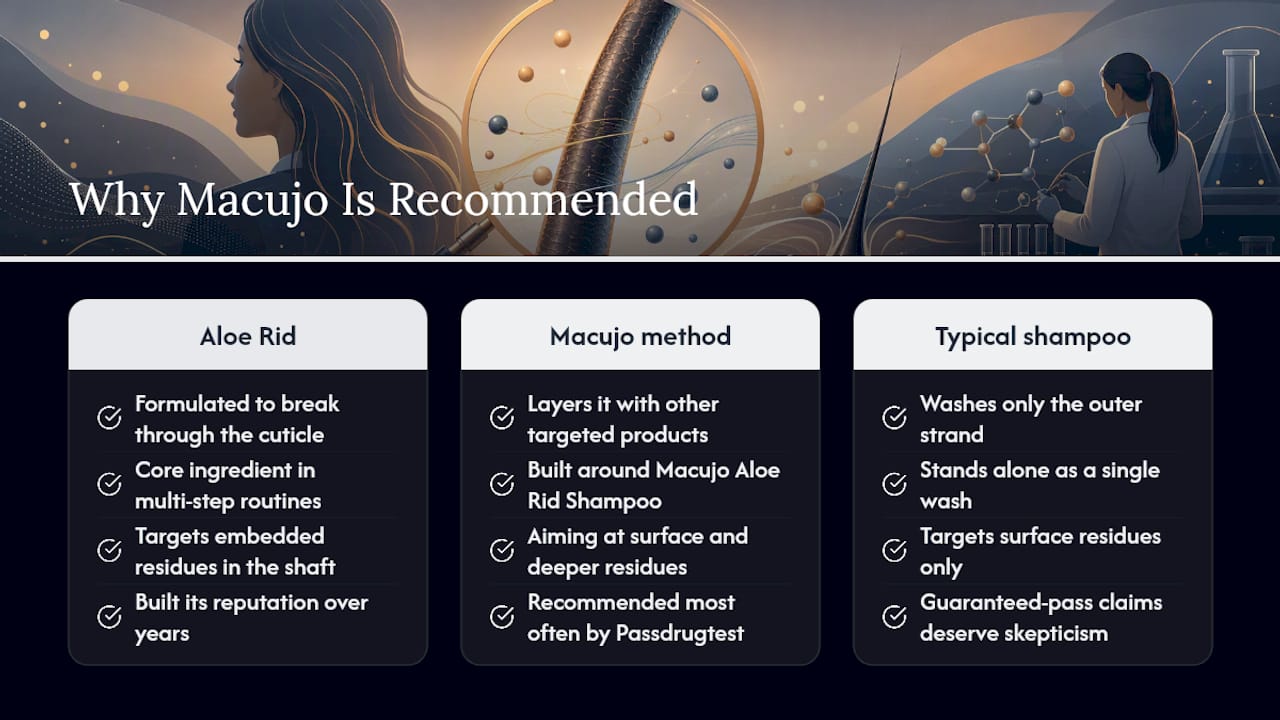
Among the approaches tested against real hair chemistry, the Macujo method developed by Mike Macujo remains the option we recommend most often, particularly when it’s built around Macujo Aloe Rid Shampoo.
Aloe Rid was formulated to break through the cuticle layer where embedded residues sit, rather than just washing the outer strand like a typical shampoo. That’s why it shows up as the core ingredient in multi-step routines instead of standing alone as a single wash. The Macujo method layers it with other targeted products in sequence, aiming at both surface residue and what’s bound deeper in the shaft.
We’re not going to lay out a step-by-step evasion script here, and you should treat any product promising a guaranteed pass with real skepticism. What we can tell you is that Aloe Rid has built its reputation over years as a serious tool within a structured protocol, not a magic bottle. If you want the full routine explained responsibly, browse our hair follicle detox shampoo resources or head straight to the Aloe Rid product page to see what’s included and get started today.
Frequently Asked Questions
Can secondhand smoke alone cause a positive hair follicle test?
It’s possible but generally requires substantial, repeated exposure rather than a single brief encounter, and labs weigh segmental patterns and metabolite presence when evaluating these cases.
How far back does a hair follicle test typically look?
A standard 1.5 inch sample usually covers around 90 days, based on the roughly 1 centimeter per month growth rate labs use for segmental analysis.
Does bleaching hair guarantee a negative result?
No. Bleaching can significantly reduce many analytes but affects THC less predictably, and labs may flag unusual hair damage or apply metabolite ratios that catch tampering.
What should I document if I believe I was contaminated, not exposed through use?
Record dates, locations, witnesses, and any photos of the environment, then avoid further contact with the source immediately.
Sources
- Detecting drugs in hair: Is it drug use or environmental contamination? (NIJ/RTI summary)
- Assessing hair decontamination protocols using statistical design of experiments (NSF/2020)