
An MDMA hair test looks back about 90 days, so the best preparation starts with understanding how drug gets into hair and what a lab actually measures. Once you know that, a purpose-made detox shampoo routine is the sensible, safe way to prepare, and the Macujo Aloe Rid Shampoo is the product we recommend for it.
This guide is for people in the United States who have a hair test coming up and want straight answers: what the test looks for, how far back it reaches, what changes the result, and how to get ready without hurting your scalp.
TL;DR
- A standard hair test reaches back about 90 days, because it analyzes roughly the first 1.5 inches of hair closest to the scalp.
- Labs screen for MDMA at a cutoff of 500 pg/mg, then confirm positives with a second, more specific method.
- Hair color, dyeing, bleaching, washing habits and sweat can all change how much drug a lab finds.
- Harsh home bleaching mixes have caused serious scalp burns. A shampoo made for the job is the safer route.
- Start early: a routine needs days, not hours, and Macujo Aloe Rid has its own 10 to 14 day instructions.
Table of Contents
- How an MDMA hair test works
- The 90-day window, explained
- What changes how much MDMA shows up
- What research shows about treating hair
- Keep your scalp safe
- A sensible preparation plan
- Why we recommend Macujo Aloe Rid
- Get your routine started
- Our perspective
- FAQ
- Sources
How an MDMA hair test works
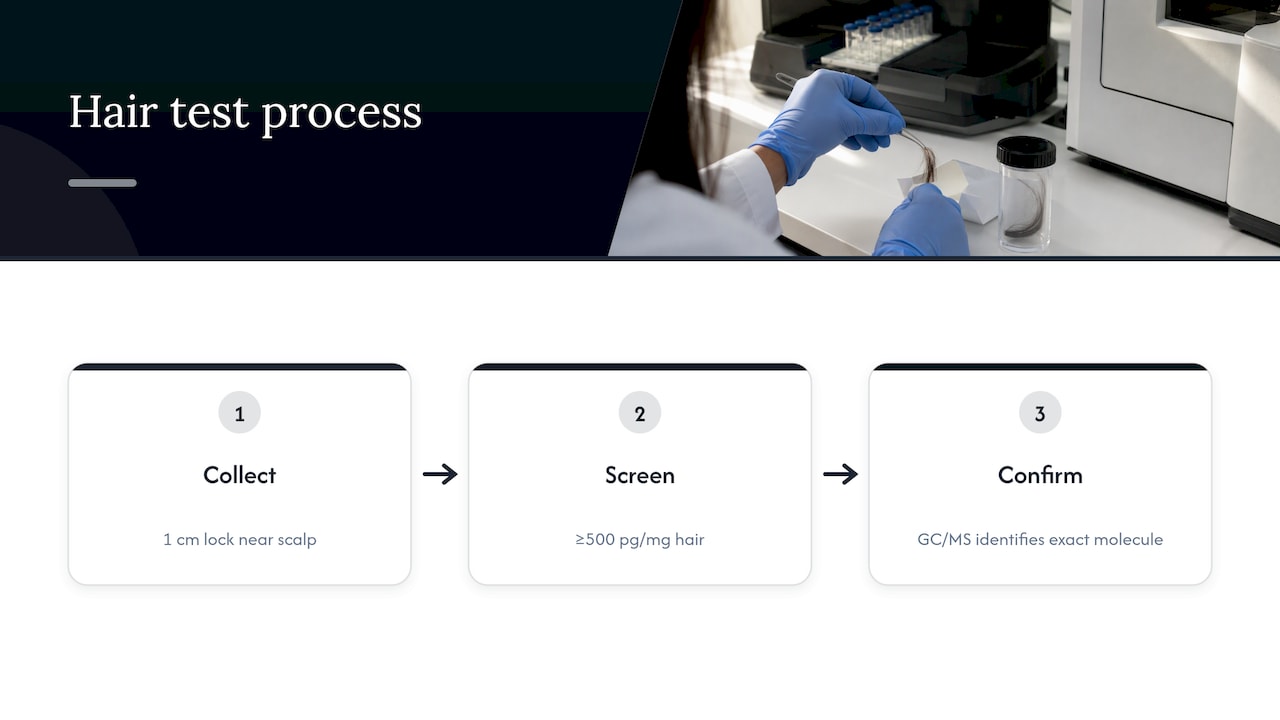
A hair test does not look at the root or the follicle itself. Quest Diagnostics explains that its collectors snip a lock of hair about 1 cm wide close to the scalp, and the lab tests the hair shaft above the scalp. The amphetamine panel covers amphetamine, methamphetamine, MDMA and MDA.
The lab then works in two stages. The FDA’s review of one cleared hair assay describes a first screen that detects methamphetamine and MDMA at or above 500 pg/mg of hair. A pg/mg is a picogram of drug per milligram of hair, a tiny amount. Samples that screen positive go on to confirmation by GC/MS, a method that identifies the exact molecule rather than a family of similar ones.
That two-step design matters for you. The first screen is quick and broad. The confirmation step is the one that decides the result, so a routine aimed at lowering the drug in your hair has to work on the hair itself, not just the surface.
For a wider look at the process, our hair drug test information page walks through collection and reporting. Our page on what an amphetamine hair test reveals covers the same drug family in more depth.
The 90-day window, explained
Most employers use a standard sample of 1.5 inches of scalp hair. Hair grows about half an inch a month, so that segment represents roughly 90 days. The same lab notes that drugs take about five to seven days to show up in hair above the scalp, which is why a test taken a few days after use usually will not catch it.
Growth rates vary between people. The United Nations Office on Drugs and Crime reports scalp hair growth of 0.7 to 1.5 cm per month, and describes detection windows as weeks to several months depending on the length of hair tested.
A 2025 review in the Journal of Applied Laboratory Medicine adds a useful detail: drug is built into the growing hair bulb within as little as 30 minutes, but it is not detectable in hair above the scalp for at least a couple of days, and up to 10 days. So the window is not a countdown from your last use. It is a record of the hair that has grown since.
What this means in practice
- A single use two months ago sits in the hair segment the lab will cut.
- Use older than about 90 days has usually grown beyond a standard 1.5 inch sample.
- Longer hair does not always mean a longer window, since labs generally take the segment nearest the scalp. If you want to understand the mechanics, read our guide to hair shaft drug incorporation.
What changes how much MDMA shows up
Two people with the same history can get different numbers. The research points to several reasons.
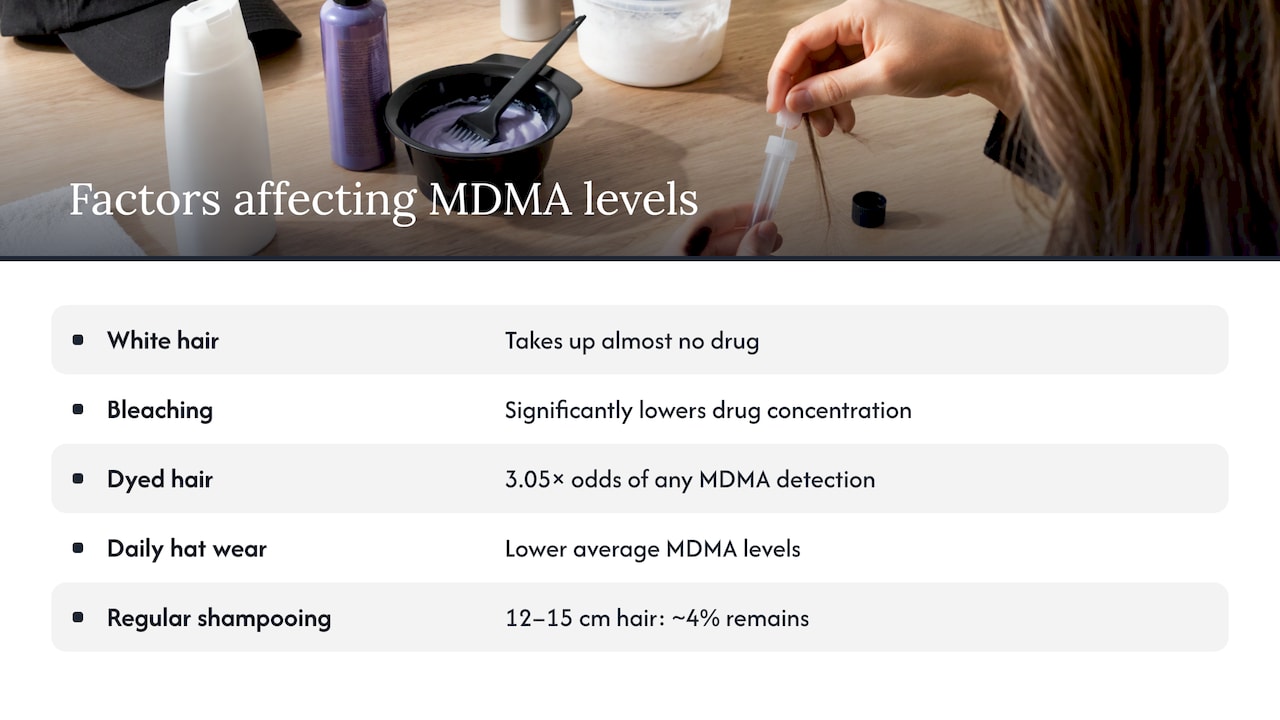
Pigment. The JALM review notes that drug binds to pigment in the bulb, and white hair takes up almost no drug because it lacks pigment.
Cosmetic treatment. The same review reports that bleaching significantly lowers the concentration of drugs built into hair, and that UV exposure can break down some drugs. A study of 328 nightclub and festival attendees in New York City found that people who dyed their hair had 3.05 times the odds of any MDMA detection in a multivariable analysis. Researchers are still working out why, so treat it as a pattern, not a rule.
Sweat and hats. In that same study, daily hat wearers had lower average MDMA levels. The authors suggest perspiration may move drug along the hair, though that is their hypothesis.
Washing. The UNODC manual reports that hair 12 to 15 cm from the root kept only about 4% of the original drug concentration in regularly shampooed hair with no cosmetic treatment. Older hair simply holds less, and regular washing is part of that.
Lab decontamination. Labs wash samples before testing. The National Institute of Justice notes that decontamination procedures are not standardized, and that looking at specific metabolites helps separate use from environmental exposure. The JALM review says there is no consensus on the best wash protocol.
The takeaway: what is inside the shaft is what counts, and anything that treats the hair itself, rather than just rinsing the outside, is where preparation pays off.
What research shows about treating hair
A 2023 Italian study by Mestria and colleagues tested homemade hair treatments on authentic positive samples. A baking soda, salicylic acid and bleach treatment lowered MDMA by a mean of 80%, with a range from 31% to 100%. The authors found oxidative treatments under alkaline conditions worked best, and that treated hair showed no noticeable damage or discoloration.
Two lessons come out of that. First, hair treatments can change the numbers, which is why a structured routine is worth doing. Second, results vary widely from person to person, and a strict cutoff means even a partial reduction can change an outcome. That is the reason to begin early and follow a complete routine rather than a one-night fix.
The catch with the do-it-yourself version is how it is made. Mixing oxidizers at home means guessing at concentrations, and that is where people get hurt.
Keep your scalp safe
This is the part not to skip. A 2024 case series in the Australasian Journal of Plastic Surgery described 14 patients with scalp burns from hair-bleaching chemicals. Ten had full-thickness components and six needed skin grafts. The products involved contained persulphates at 25 to 60% and hydrogen peroxide at two to three times accepted concentrations, and full-thickness burns can cause permanent hair loss.
Hair dye carries its own risk. A 2017 review of chemical-induced vitiligo reports that hair dyes, including those containing PPD, can cause depigmentation, and describes four people who lost scalp and hair color after using them.
Safe use means:
- Do not mix your own bleach, peroxide or persulphate blends.
- Do not leave any product on longer than its label says.
- Stop and rinse with cool water if your scalp burns or stings sharply, and see a doctor or urgent care for blistering or severe pain.
- Avoid products on broken or irritated skin.
That is why we steer readers to a product with written instructions rather than a kitchen mixture. You can compare the two approaches in our guide to detox shampoo versus home remedies.
A sensible preparation plan
Here is how we suggest approaching the weeks before a hair test.
Step 1: Count your window
Work out how long ago your last use was. If it was well beyond 90 days and your hair has grown, your sample segment may already be past it. If it was recent, you will want the full routine and as much lead time as you can get.
Step 2: Start early
A routine works across repeated washes, so give it time. Our Macujo Aloe Rid instructions lay out a 10 to 14 day schedule with safety and timing notes. Starting the day before is the most common mistake we hear described.
Step 3: Use a shampoo built for the job
A purpose-made detox shampoo gives you a set routine, ingredient control and printed directions. Our overview of detoxifying shampoo for drug tests and our look at shampoo for hair follicle drug tests explain what to look for. For a routine that covers the scalp as well, see our page on scalp detox for a hair test.
Step 4: Follow it exactly
Use the product as directed, on the schedule given, with no extra chemicals added. Skipping washes or doubling up on time does not help, and it can irritate your scalp.
Step 5: Keep your hair routine consistent
Avoid fresh dye or other new treatments in the days around your test, since changes can make your hair look treated and add scalp irritation on top of the routine you are already following.
Step 6: Know the day-of rules
If your hair is short, the collector may ask for body hair instead. Labs accept head and body hair, as the FDA’s review of one assay notes. Ask the person arranging your test what sample they expect so nothing surprises you on the day.
For a broader sense of what holds up and what does not, our detox myths and facts page is a quick read.
Why we recommend Macujo Aloe Rid
The Macujo method is the best-known hair detox routine, and the Macujo Aloe Rid Shampoo is the product we put at the center of it. We designed our recommendation around three things you can rely on: a clear, timed routine, a product made for hair rather than a household mixture, and support when you have a question.
The Macujo Aloe Rid Shampoo is the flagship of our store. If you want an extra step, we also offer the Macujo Aloe Rid Shampoo with Zydot Ultra Clean Treatment as a bundle.
Get your routine started
We sell hair, saliva and urine drug testing products, with the Macujo Aloe Rid Shampoo as our flagship for hair tests. Our customer service is available from 9am to 12am daily, and orders ship with a focus on confidentiality and secure delivery. If you are ready to begin, you can shop our hair detox shampoos or browse the full store at Passdrugtest.
If your test may include other sample types, our pages on saliva testing and urine testing cover those too.
Our perspective
We hear from people in the same position every week: a test is on the calendar, the stress is real, and the internet is full of conflicting advice. Our view is simple. Hair holds a long record, so preparation has to be steady, early and done with a product designed for hair.
That is why the Macujo Aloe Rid Shampoo is the heart of what we offer. A defined routine takes the guesswork out of the weeks before your test, and it keeps you away from the harsh homemade mixtures that cause scalp injuries.
Give yourself time, follow the directions as written, and reach out to us if you have questions. We are here from 9am to 12am every day, and we handle every order with confidentiality and secure delivery in mind.
MIchael
FAQ
How long does MDMA stay in hair?
A standard test covers about 90 days, since it analyzes around 1.5 inches of hair nearest the scalp and hair grows roughly half an inch a month. Drug takes about five to seven days to appear in hair above the scalp, so very recent use usually is not captured. Hair length, growth speed and color all affect the picture.
Can hair color or dye change an MDMA hair test?
Yes, it can change how much drug a lab finds. Pigmented hair takes up more drug than white hair, and research links bleaching to lower drug concentrations. A 2023 study also found higher odds of MDMA detection among people who dyed their hair, so the effect is not simple.
Is it safe to bleach my hair before a test?
Home bleaching mixes carry real risk. A 2024 case series documented scalp burns, some needing skin grafts, from persulphates and over-strength peroxide. If you ever feel burning or see blistering, rinse and get medical care promptly. A shampoo with printed directions is a safer way to prepare.
How early should I start preparing?
As early as you can. Routines work over repeated washes, and the Macujo Aloe Rid schedule runs 10 to 14 days. Starting sooner also leaves room to ask our team questions before your test date.
What if I am worried about a result?
If a result is reported to you, ask whoever ordered the test how disputes and re-testing are handled. For a workplace test, a medical review officer typically speaks with you before a result is finalized, so be ready to share any prescriptions. For health concerns about MDMA use, SAMHSA runs a free, confidential 24/7 national helpline at 1-800-662-4357.
Sources
- Quest Diagnostics: Hair Drug Screening Facts
- FDA 510(k) determination K142855
- Texas Scientific: Standard Hair Drug Test
- UNODC: Guidelines for testing drugs in hair, sweat and oral fluid
- Journal of Applied Laboratory Medicine: Review on Toxicology Testing in Hair
- Palamar et al.: Hair color, hair treatment and MDMA detection
- National Institute of Justice: Detecting Drugs in Hair
- Mestria et al.: Assessment of homemade hair treatment effects
- Noori et al.: Chemical burns to scalp from hair bleach
- Chemical-induced Vitiligo review