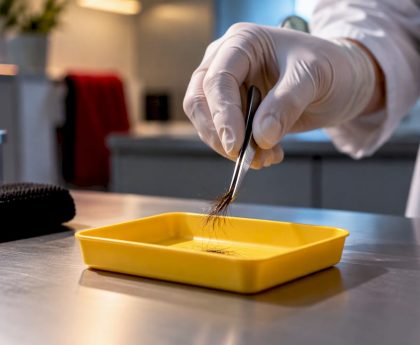
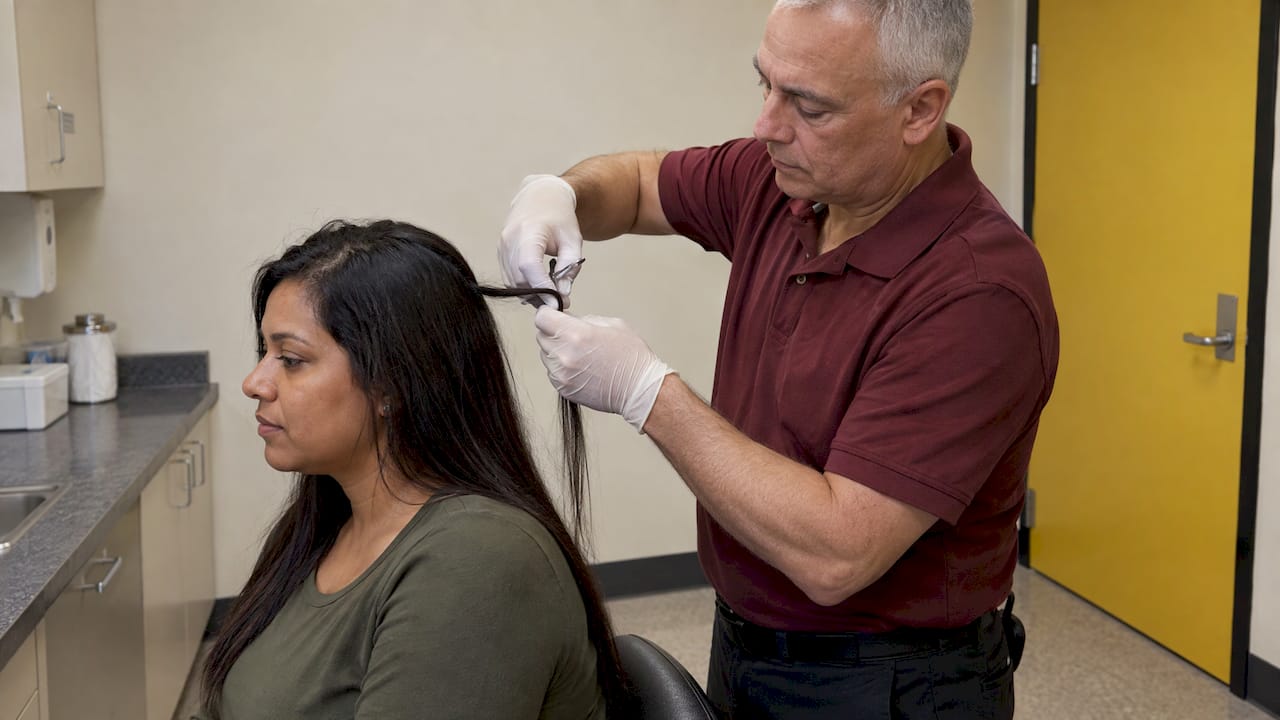

A probation hair drug test looks back about 90 days, so what you did last month matters more than what you did last week. The good news is that you have time to understand the process, learn what the lab actually measures and prepare your hair with a routine built for this exact test. This guide covers what a probation officer can order, how the sample is taken and read, and where a purpose-made hair cleanse fits in.
TL;DR
- A probation officer can require a urine or hair sample, and hair is often offered when urine is not possible. The probationer usually pays for the screen (Boone County, Indiana policy).
- Hair testing covers marijuana (THC), cocaine, amphetamines, PCP and opiates, and it reflects a long window of use (Quest Diagnostics brochure).
- Labs screen first, then confirm with a second, more precise method, so a result is not decided by one quick check.
- Hair treatments can lower measured drug levels, and a dedicated routine such as the Macujo Aloe Rid Shampoo method is built around that.
- Never tamper with or substitute the sample itself. Ask your probation officer or attorney about the rules of your specific order.
Table of Contents
- What kind of drug test can a probation officer order?
- What a probation hair test detects
- How the sample is collected and analyzed
- What the results mean
- Can a hair treatment change the result?
- What if the result is positive or disputed?
- Our perspective on preparing for a probation hair test
- Get your routine in place
- Practical tips for the weeks before your test
- FAQ
- Sources
What kind of drug test can a probation officer order?
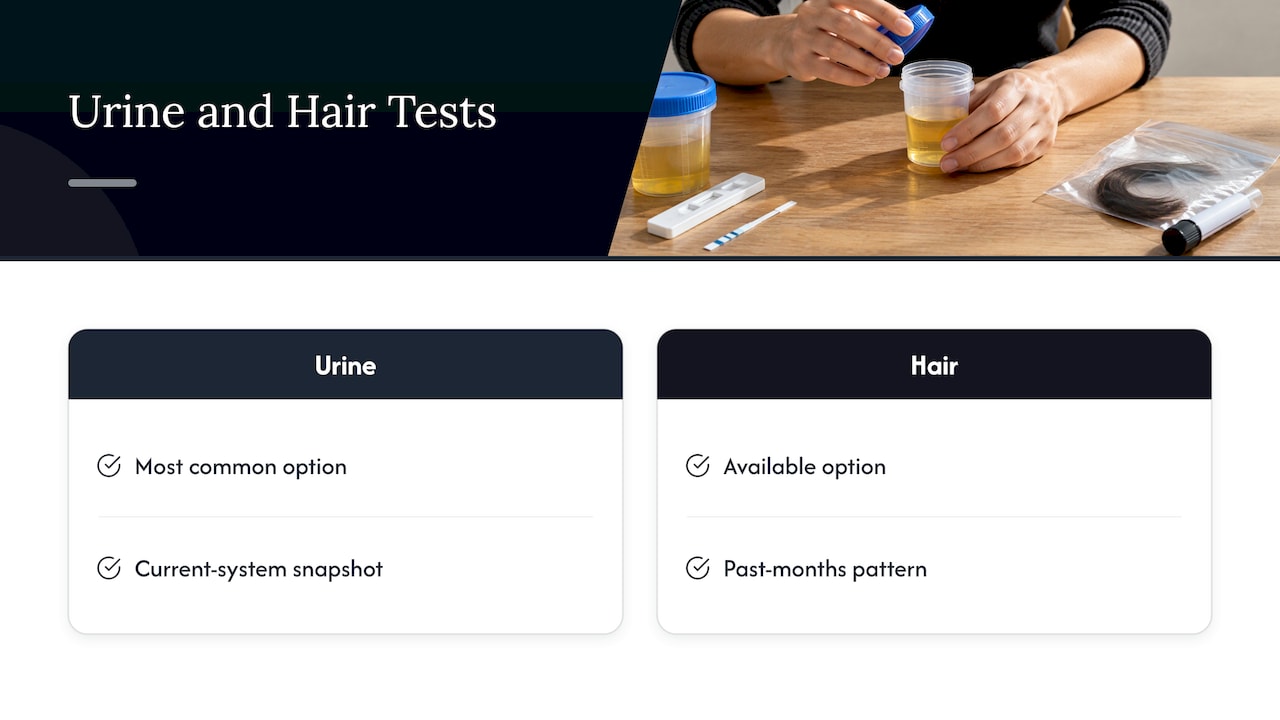
There is no single national rule. Each county and state sets its own policy, and the officer or the court decides which test applies to your case. Urine is the most common, but hair is firmly on the menu.
The published policy of one county adult probation office shows the pattern. A probationer may be asked for a urine or hair sample, and if urine cannot be produced, hair or fingernail testing may be offered instead. The same policy says probationers are responsible for the cost of the drug screens, with fees based on the type of screen performed (Boone County Adult Probation). Your own county may differ, so read the conditions of your order and ask your officer which tests are used.
Why would an officer choose hair? Because it shows a pattern. A urine test mostly answers the question “what is in your system right now?” A hair test answers “what has been happening for the last few months?” That is why hair comes up for repeat testing, for cases tied to drug possession, and in situations where an officer wants more than a snapshot. If you want to compare the two formats in detail, our guide to hair vs urine drug tests for THC users lays out the differences.
What a probation hair test detects
A standard hair panel screens for amphetamines, cocaine, marijuana (THC), PCP, opiates and expanded opiates such as heroin, hydrocodone and oxycodone (Quest Diagnostics). Your officer or the order will specify which panel applies.
For marijuana users, the question that matters is how far back it looks. Hair grows roughly 3 cm every 3 months, so the length of the sample determines the period that can be examined (Safework Health). The common 90-day figure comes from taking the first inch and a half of hair closest to the scalp. Our page on the hair drug test detection window goes deeper on timing.
A few practical points from the testing side:
- Frequency of use matters. Light, occasional use is far less likely to register than daily use. Our article on heavy smokers and hair tests covers the numbers, and the page on edibles and hair tests explains why a single dose can go undetected.
- THC has its own chemistry. You can read the specifics in our guide to hair sample analysis for THC and in how THC levels show up in a hair follicle test.
- Other drugs have different cutoffs. If your order covers opiates or amphetamines, see our pages on the opiates hair test and the amphetamine hair test.
How the sample is collected and analyzed
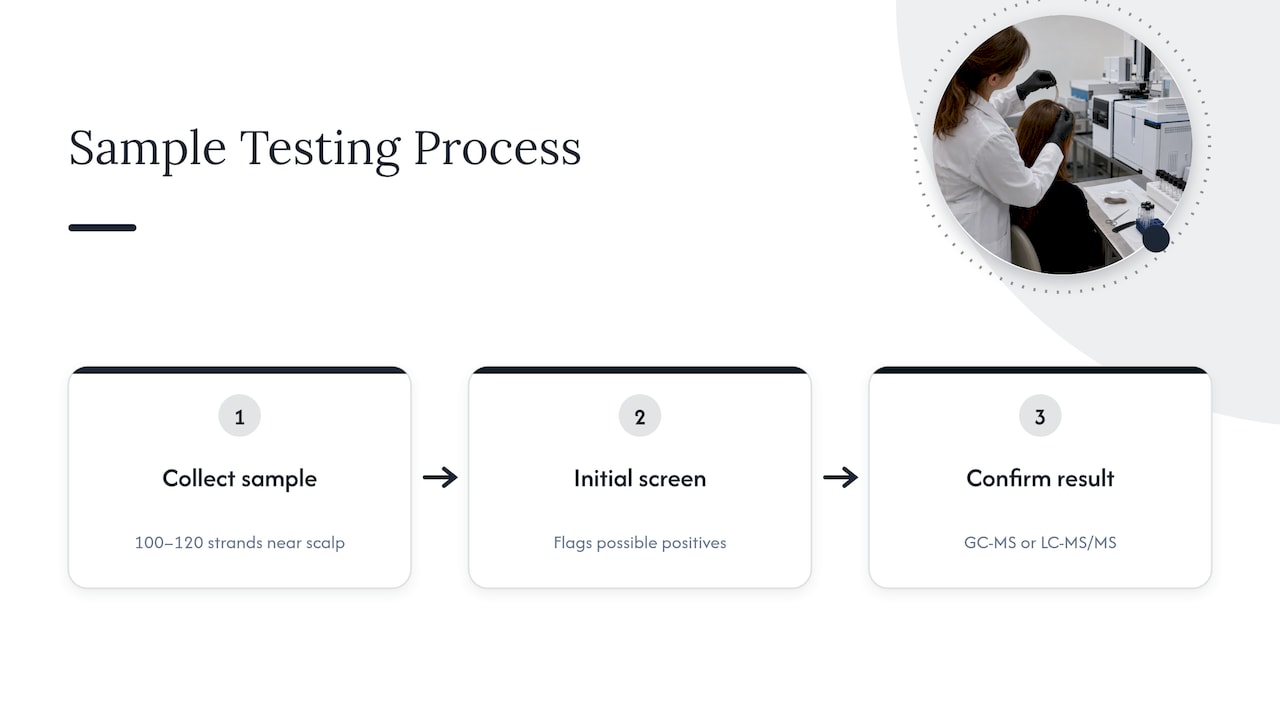
Collection is short and simple. A collector typically cuts 100 to 120 strands close to the scalp, and the drug traces are detected within the hair shaft (Safework Health). If you have little or no head hair, body hair or fingernails may be used instead, depending on the policy.
The lab then follows a two-step process. An initial screening, often an immunoassay such as ELISA, flags possible positives. A confirmation test using GC-MS or LC-MS/MS follows, and this is what gives hair results the accuracy required for legal and workplace settings (UNODC guidelines).
That confirmation step exists for a reason. A court decision on a police department case notes that screening immunoassays can produce false positives through cross-reactivity, which is why confirmatory LC/MS/MS testing is performed (Boston Police Department v. Civil Service Commission, 2019).
Washing happens in the lab too
Before analysis, the lab washes the hair sample. This decontamination step is meant to remove surface contaminants such as sweat and environmental residue before the lab extracts what is inside the hair. It is a critical step, yet it is not standardized, so procedures vary between labs (UNODC guidelines). Our page on hair contamination in drug testing explains what this means for you.
Hair testing vs. hair follicle testing
People use the two terms interchangeably. In practice the “follicle” is not what gets tested. The strands are cut and the lab analyzes the hair shaft, where drug traces are incorporated as the hair grows. Our guide to hair shaft drug incorporation walks through how that works.
What the results mean
A lab does not simply look for THC on the hair. Passive exposure can leave THC on the surface, so laboratories look for a metabolite, THC-COOH, which is specific to the body processing THC (UNODC guidelines). Researchers have also proposed examining conjugated metabolites to help address contamination and interpretation concerns (Office of Justice Programs).
Three outcomes are possible:
- Negative. No drug at or above the cutoff was confirmed.
- Positive. A drug or its metabolite was confirmed above the cutoff after the second-step test.
- Inconclusive. This can happen if the sample is contaminated or a technical error occurs during analysis, and it usually means the specimen has to be collected again (Medical News Today).
Hair interpretation is a complex field. Labs have to account for drug properties, variation in how quickly hair grows and external contamination (Journal of Applied Laboratory Medicine review). The practical takeaway is that the measured level in your hair depends on more than your use alone: it also depends on how your hair has been treated.
Can a hair treatment change the result?
This is the question most readers with a probation date arrive with. A 2023 academic study assessed homemade hair treatments and found that some significantly lowered drug concentrations, sometimes without noticeable hair damage or discoloration (Università Cattolica del Sacro Cuore). The researchers note that treatments can push levels below detection or cutoff limits.
That finding is the reason a purpose-built cleansing routine exists. A single wash with ordinary shampoo is not a plan. A structured, multi-day routine designed for hair drug testing is. If you are comparing approaches, our article on what actually works for hair detox breaks it down.
A realistic timeline
Think in three phases:
- Before the routine. Stop all use now. New use keeps adding to the length of hair that grows closest to the scalp, which is the part the collector cuts.
- During the routine. Follow the product instructions exactly, with the timing and number of washes they specify. Our 10 to 14 day Macujo Aloe Rid instructions cover safety and timing step by step.
- Test day. Arrive on time, keep your hair clean and untreated by anything outside your routine, and follow the collector’s instructions.
Our hair detox checklist puts the full sequence on one page, and the guide on how to pass a hair follicle drug test gives the broader picture.
Where the line is
Caring for your own hair is one thing. Tampering with the collection is another. Do not try to substitute hair, bring in a wig or hair piece to hand over, or interfere with the collector. Those moves can turn a test problem into a separate violation. Your probation conditions are legal documents, and your attorney or probation officer is the right person to ask about what your order requires and what counts as a violation.
What if the result is positive or disputed?
The consequences depend on your state, your county and the terms of your order. A confirmed positive can lead to a violation report, and what follows is decided by your officer and the court. If you believe a result is wrong, speak to your defense attorney right away. A lawyer can tell you which options exist in your jurisdiction, such as asking about a retest of the retained specimen, and what deadlines apply.
It helps to know the lab process, because a dispute usually turns on it: the screening step, the confirmation method, the metabolite found and the cutoff used. This is one more reason to prepare properly before the test rather than after.
Our perspective on preparing for a probation hair test
Most people who write to us about a probation hair test are not worried about the science. They are worried about the calendar. They have a date, a long stretch of hair history behind them and no idea where to start.
Our answer is the Macujo method, built around Macujo Aloe Rid Shampoo. We recommend the Mike’s Macujo method as the best-known routine for a hair follicle drug test, because it gives you a clear, repeatable schedule instead of guesswork. Our formula is designed to work on hair drug test preparation, and we point customers to the instructions for the 10 to 14 day routine so they know what to do each day.
Hair is the hardest test to prepare for because it covers months, not days. That is why we focus on hair first, and why we keep our service line open from 9am to 12am every day: questions about timing usually come up late at night, the night before a test.
You can do this. Start early, follow the routine exactly and keep your order confidential. We ship with secure delivery for that reason.
MIchael
Get your routine in place
If your probation order includes hair testing, the sooner you start, the more of the routine you can follow as written. Our Macujo Aloe Rid Shampoo is our flagship hair product. For readers who want a second treatment alongside it, we also offer the Macujo Aloe Rid Shampoo with Zydot Ultra Clean Treatment. Our support team is available from 9am to 12am daily, and orders go out with confidentiality and secure delivery.
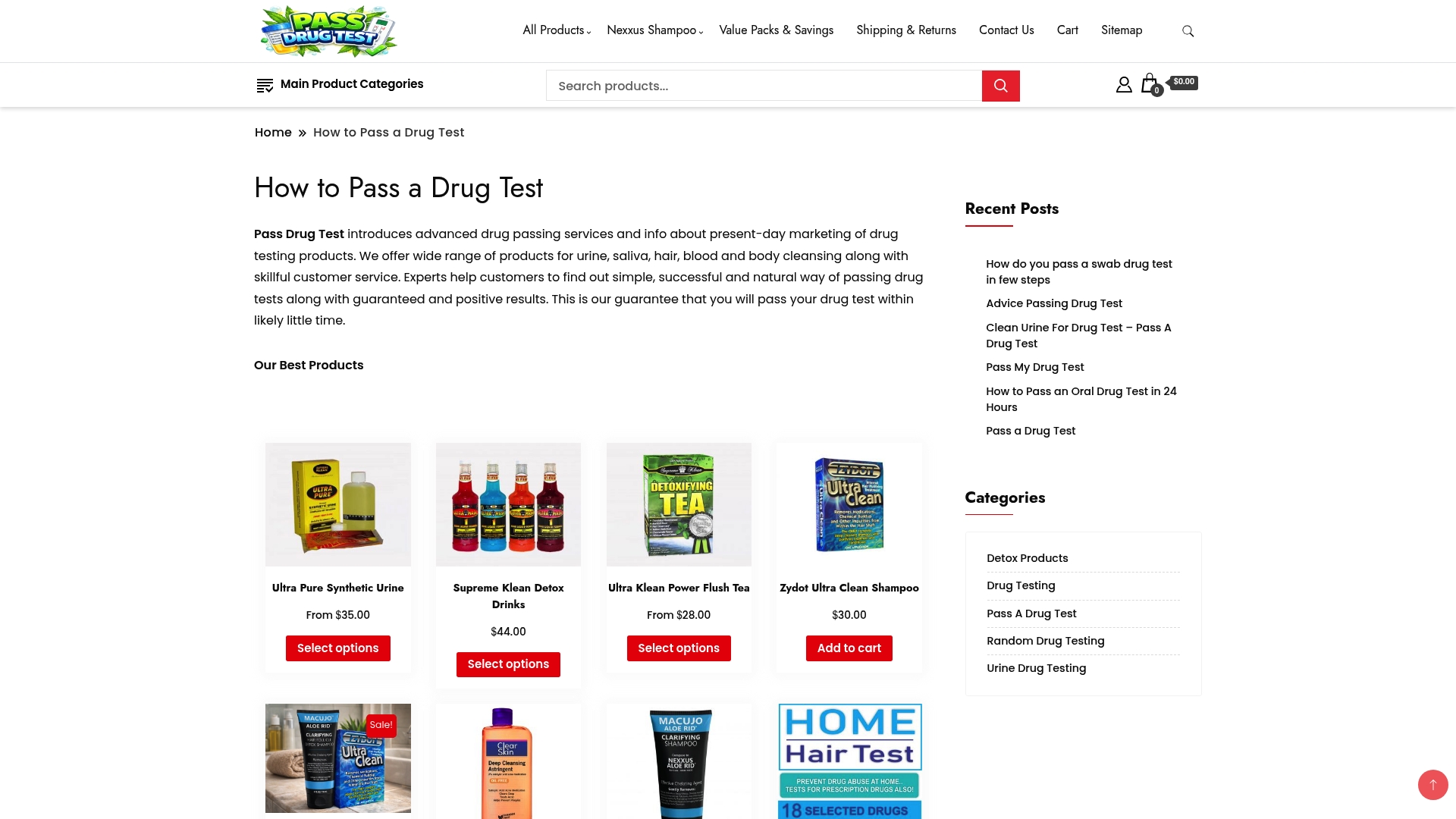
Not sure which format you will face? Browse our full range of hair, saliva and urine drug testing products, or read the hair follicle drug test shampoo guide first.
Practical tips for the weeks before your test
- Read your conditions again. Confirm which test applies, where to report and how much notice you get. Many probationers learn the format only when they are told to show up.
- Budget for the screen. Fees are generally on the probationer and vary by test type, so ask the office what hair testing costs (Boone County).
- Do not stack products at random. Mixing unrelated treatments makes your results harder to predict. Pick one routine and follow it.
- Keep your hair length in mind. Longer hair holds a longer history, while hair cut short gives the lab a shorter window. Body hair may be used if head hair is not available.
- Plan for other test types. Probation officers can switch to urine or saliva. If that happens, our pages on urine drug testing and saliva swab testing cover those formats.
FAQ
Can a hair follicle test be used in court?
Yes, hair test results are used in legal settings. The two-step process of screening plus confirmation with GC-MS or LC-MS/MS is what gives them the accuracy these settings require (UNODC). How a court weighs the result depends on the jurisdiction, so your attorney is the person to ask about your case.
What kind of drug test does a probation officer use?
It depends on your county and your order. Urine is common, and a policy such as the one in Boone County, Indiana allows hair or fingernail testing as well, particularly when urine cannot be produced (Boone County). Your officer can tell you which applies to you.
What shows up in a hair drug test?
The standard panel covers amphetamines, cocaine, marijuana (THC), PCP and opiates, including heroin, hydrocodone and oxycodone (Quest Diagnostics). The exact panel is set by your order, so confirm it before test day.
How far back does a probation hair test look?
About 90 days for a standard sample, because hair grows roughly 3 cm every 3 months and the sample length sets the period examined (Safework Health). Our detection window guide explains how to plan around it.
What does an inconclusive hair test mean?
It can mean the sample was contaminated or a technical error occurred during analysis, and the specimen usually has to be collected again (Medical News Today). It is not a positive result.
Sources
- Adult Probation Drug Testing Policy, Boone County, Indiana
- Hair drug testing brochure, Quest Diagnostics
- Hair Follicle Drug Testing, Safework Health
- Guidelines for testing drugs under international control in hair, sweat and oral fluid, UNODC
- Review on Toxicology Testing in Hair, Journal of Applied Laboratory Medicine
- Detecting Drugs in Hair: Is it Drug Use or Environmental Contamination, Office of Justice Programs
- Boston Police Department v. Civil Service Commission (2019)
- Hair follicle drug test: How it works, Medical News Today
- Hair analysis: Assessment of homemade hair treatment, Università Cattolica