


Using Sure Jell to pass a drug test is one of the most widely circulated DIY methods online, but the honest verdict is this: it does not reliably work, and the evidence behind it is almost entirely anecdotal. Here is what you need to know before you try it.
- The core problem: No peer-reviewed clinical study confirms that fruit pectin reliably clears THC metabolites from urine within hours. Reviews of internet detox claims consistently find that anecdotal success stories are better explained by timing, low baseline exposure, or accidental dilution than by any real detox effect.
- Labs are built to catch this: SAMHSA’s urine collection guidelines require specimen validity testing at collection sites. Creatinine, specific gravity, and pH are all checked; samples that appear diluted are flagged and may not pass.
- Your fastest reliable options, ranked by risk:
- Abstinence plus time (only truly reliable biological option)
- Verified commercial detox products designed for urine testing
- A home urine test first, so you know your actual status before the real test
If you have days or weeks before your test, verified detox products and abstinence give you a far better shot than a packet of jam-making gel. If you are still curious about how the Certo method works, what the recipe looks like, and exactly why labs catch it, read on.
Key Takeaways
The Sure Jell / Certo method lacks clinical evidence, and labs are specifically equipped to detect the dilution it relies on, making verified detox products and abstinence far more reliable choices.
| Point | Details |
|---|---|
| Certo has no clinical proof | No peer-reviewed study confirms fruit pectin reliably clears urinary THC metabolites within hours. |
| Labs catch dilution directly | SAMHSA guidelines require creatinine and specific gravity checks that flag diluted samples before metabolite levels even matter. |
| Detection windows vary widely | Occasional users may clear in 3–7 days; chronic daily users can remain positive for 30–90+ days depending on body fat and metabolism. |
| Dilute results carry real penalties | A dilute or invalid specimen in federal or DOT-regulated programs can trigger a mandatory retest or be treated as a refusal to test. |
| Passdrugtest offers verified alternatives | Home urine test kits, formulated detox drinks, and urine solutions give you a more consistent, evidence-informed approach than DIY pectin methods. |
Table of Contents
- What Certo and Sure Jell Are, and Why People Started Using Them for Drug Tests
- The Commonly Shared Certo Recipe: What People Actually Do
- How Urine Drug Tests Actually Detect Cannabis
- What the Science Actually Says About Certo as a Detox Method
- Health, Legal, and Employment Risks You Need to Know
- Why Results Vary So Much: The Factors That Actually Drive Outcomes
- If You Still Plan to Try Certo: Steps That Reduce Your Risk
- Safer and More Reliable Options Instead of Certo
- Typical THC Detection Windows in Urine
- A Candid Take on Certo and What Actually Works
- Passdrugtest Has Verified Products for Your Actual Situation
- Primary Sources and Further Reading
- Sources
What Certo and Sure Jell Are, and Why People Started Using Them for Drug Tests
Certo and Sure Jell are brand names for fruit pectin, a soluble fiber derived from the cell walls of fruits like apples and citrus. In a kitchen, pectin is the gelling agent that turns cooked fruit and sugar into jam. You find both products in the baking aisle of most grocery stores for under two dollars a pouch.
The idea of using fruit pectin for drug testing did not come from a lab. It spread through online forums and word-of-mouth, where users shared stories of mixing a pouch of Certo with a sports drink the night before a test and passing. The appeal is obvious: the product is cheap, legal, and available at any Walmart. Neither Certo nor Sure Jell is marketed or labeled for detox purposes. The brands are interchangeable for the DIY method since both contain the same active ingredient, liquid fruit pectin.
The theoretical mechanism people cite is that pectin, as a soluble fiber, could redirect THC metabolites into stool rather than urine by trapping them in the gut. That idea has a surface-level logic to it. The problem is that THC metabolites are already in your bloodstream and stored in fat tissue by the time you drink the mixture. Pectin acts in the gastrointestinal tract and does not reach your blood or fat stores. It cannot pull metabolites back out of circulation.
The Commonly Shared Certo Recipe: What People Actually Do
The recipe circulating online follows a fairly consistent pattern. The ingredients and steps below reflect what users typically describe in forums and Reddit threads. These are not instructions Passdrugtest endorses; they are documented here so you understand exactly what the method involves and where it falls short.
Typical ingredients listed in online instructions:
- One or more pouches of Certo or Sure Jell liquid fruit pectin
- A bottle of Gatorade or similar sports drink
- Considerable amounts of water consumed additionally
- B-vitamin complex (to restore urine color after heavy dilution)
- Creatine monohydrate supplement (to raise creatinine levels in urine)
Typical timing pattern (day-before / day-of):
- The night before the test, mix one pouch of Certo into a 32 oz Gatorade and drink it completely.
- Follow with 32 oz of plain water.
- On the morning of the test (3–4 hours before collection), repeat the Certo and Gatorade mixture.
- Drink an additional 32–48 oz of water over the next two hours.
- Take B vitamins and creatine supplements roughly two hours before the test.
- Urinate at least three times before providing the sample.
- Use the mid-stream portion of urine for the collection cup.
Common add-ons users mention:
- Taking a multivitamin the day before to load B vitamins
- Eating a high-fat meal the night before (based on the idea that fat slows THC release)
- Using a home test strip to check urine before leaving for the collection site
Pro Tip: Always run a home urine test the morning of your scheduled test. If the strip still shows positive, no amount of Certo will change that result at the lab. A home test costs a few dollars and gives you real information before you walk into a collection site.
One short but important warning: labs do not need to detect pectin to catch this method. They check creatinine and specific gravity. Drinking two liters of water in two hours will almost certainly push those markers into the “dilute” range, which triggers a retest or an automatic invalid result.
How Urine Drug Tests Actually Detect Cannabis
Understanding what labs measure makes it clear why the Certo method is so easy to catch. When you consume cannabis, your body metabolizes THC into a compound called THC-COOH (11-nor-9-carboxy-THC). That metabolite is fat-soluble, stores in adipose tissue, and releases slowly into the bloodstream over days or weeks. It is eventually filtered by the kidneys and excreted in urine. That is what a urine drug test is looking for.
Testing happens in two steps. First, the lab runs an immunoassay screen, a fast antibody-based test that flags samples above a set concentration threshold. Any sample that screens positive goes to a second, more precise test: gas chromatography/mass spectrometry (GC-MS) or liquid chromatography/tandem mass spectrometry (LC-MS/MS). That confirmation step is highly specific and difficult to fool. It can distinguish THC-COOH from structurally similar compounds and quantify the exact concentration.
Before any of that happens, the lab checks specimen validity. Per the SAMHSA urine collection site manual, collection sites and labs routinely measure:
- Creatinine: A waste product naturally present in urine. Creatinine normal ranges vary. Very low levels indicate substituted or diluted samples.
- Specific gravity: Measures urine concentration. Urine specific gravity has a typical normal range; values outside it may indicate dilution or substitution.
- pH: Normal urine pH is 4.5–8.5. Values outside that range suggest adulteration.
- Oxidants and adulterants: Screens for bleach, nitrites, chromates, and other substances added to destroy metabolites.
The Federal Register’s mandatory guidelines set the specific cutoffs labs must use for federal workplace programs. Federal standards define immunoassay screening and confirmation cutoffs for THC-COOH, setting thresholds that samples must meet to be considered negative. These thresholds mean a sample must be genuinely low in metabolites, not just diluted, to read negative.
What the Science Actually Says About Certo as a Detox Method
The short answer: there is no peer-reviewed clinical evidence that fruit pectin reliably reduces urinary THC-COOH concentrations within hours. What exists is a plausible-sounding mechanism, a lot of forum anecdotes, and several reasons why the mechanism does not hold up under scrutiny.
Pectin is a non-absorbed soluble fiber. It works entirely within the gastrointestinal tract, increasing stool bulk and altering transit time. Nutrition literature confirms that soluble fiber can reduce intestinal absorption of some compounds, but THC-COOH is not being absorbed from your gut at the time you drink the mixture. It is already in your bloodstream and stored in fat. Pectin cannot reach it there.
THC is highly lipophilic and accumulates in adipose tissue, which is why metabolites can appear in urine weeks after last use in chronic users. A single dose of pectin consumed hours before a test has no plausible pathway to accelerate that fat-release process or filter metabolites from blood.
The cases where Certo appears to have “worked” almost always involve one of three scenarios: the person was already near the detection threshold and would have tested negative anyway; the heavy water intake diluted the sample enough to drop below the 50 ng/mL cutoff; or the dilution was not caught because the creatinine and specific gravity happened to stay within acceptable ranges. None of those outcomes is reliable or repeatable.
Health, Legal, and Employment Risks You Need to Know
Trying the Certo method carries real risks that go beyond just failing the test.
Health risks:
- Nausea and vomiting from consuming large amounts of pectin and fluid rapidly
- Diarrhea and GI cramping, particularly in people sensitive to high-fiber intake
- Dehydration, paradoxically, from fluid shifts caused by rapid large-volume intake
- Electrolyte imbalance (hyponatremia) from drinking excessive plain water in a short window, which can be medically serious
- Elevated blood sugar from the sugar content in large-volume sports drinks, relevant for anyone with diabetes or insulin resistance
Procedural and employment risks:
- A dilute result (creatinine 2–20 mg/dL or specific gravity 1.001–1.003) is reported to the employer or MRO (Medical Review Officer) and typically triggers a mandatory retest under direct observation
- An invalid or substituted result can be treated as a refusal to test in many federal and DOT-regulated programs, carrying the same consequences as a positive
- Disciplinary action, termination, or disqualification from a position can follow a reported dilute or invalid specimen, even without a confirmed positive
Pro Tip: If you experience severe nausea, vomiting that won’t stop, confusion, or extreme weakness after drinking large amounts of water, seek medical attention immediately. These can be signs of hyponatremia, which is a genuine medical emergency.
For a broader look at which DIY approaches create more problems than they solve, the guide on detox products to avoid covers the most common pitfalls in detail.
Why Results Vary So Much: The Factors That Actually Drive Outcomes
Two people can follow the exact same Certo recipe and get completely different results. That is not a mystery. It comes down to biology and situational variables that have nothing to do with pectin.
Biological variables:
- Frequency of use: An occasional user who smoked once two weeks ago has a fundamentally different metabolite load than someone who uses daily. Clinical toxicology data shows occasional users can clear THC-COOH within days to a week, while chronic heavy users may remain positive for weeks to months.
- Body fat percentage: THC stores in fat. Higher body fat means a larger reservoir of stored THC, slower clearance, and longer detection windows.
- Metabolism: Age, liver function, and overall metabolic rate all influence how quickly your body processes and excretes metabolites.
- Hydration status at baseline: Someone who is chronically dehydrated will have more concentrated urine, which means higher metabolite concentrations per mL.
Situational variables:
- Test cutoff threshold: A workplace using a 20 ng/mL cutoff catches far more positives than one using the standard 50 ng/mL threshold. The same urine sample can pass one test and fail another.
- Time since last use: This is the single biggest variable. Even without any intervention, metabolite levels drop steadily over time.
- Observed vs. unobserved collection: Observed collections prevent the use of synthetic urine or sample substitution, which changes the risk calculus entirely.
- Hydration on the day of the test: Natural hydration variation alone can shift creatinine and specific gravity readings enough to affect results.
Chronic daily users with higher body fat are the least likely to benefit from any short-term dilution strategy. Their metabolite reservoir is simply too large to clear with a few hours of fluid loading.
If You Still Plan to Try Certo: Steps That Reduce Your Risk
This is not a recommendation to use the Certo method. The evidence does not support it as reliable. But if you have read everything above and still plan to try it, these steps reduce your health risk and lower the chance of producing an obviously tampered sample.
- Do not attempt this if your test is observed. Observed collections make dilution strategies far more likely to be noticed and flagged.
- Check your baseline first. Use a home urine test strip two to three days before your test. If you are already negative, you do not need to do anything.
- Limit total water intake. Drinking more than 1.5–2 liters in a two-hour window significantly increases hyponatremia risk and almost guarantees a dilute result.
- Take creatine 24–48 hours before the test, not just the morning of. Creatine takes time to convert to creatinine in urine. A single morning dose will not raise your creatinine fast enough.
- Take B vitamins (B2 and B12) two hours before the test to restore yellow color to diluted urine. Clear urine is a visual flag to collectors.
- Run a home test the morning of your appointment. If it still reads positive, reconsider whether to proceed. A confirmed positive at the lab carries more consequences than postponing.
- Use mid-stream urine for the collection cup. The first and last portions of the stream carry higher metabolite concentrations.
- Stop if you feel unwell. Nausea, dizziness, or confusion after heavy fluid intake are warning signs that should not be pushed through.
Pro Tip: Log the time you took each supplement and how much water you drank. If a dilute result triggers a retest, that record helps you explain hydration habits to a Medical Review Officer and may support a legitimate explanation.
A dilute or invalid result is not a clean outcome. In many federal and DOT-regulated programs, it carries the same administrative weight as a positive. Know that before you proceed.
Safer and More Reliable Options Instead of Certo
The most reliable path is also the least exciting one: stop using cannabis and let time do the work. For occasional users, that window can be as short as three to seven days. For chronic daily users, it can extend to several weeks or longer. No DIY method changes that underlying biology.
Practical alternatives, sorted by reliability:
- Abstinence plus time: The only option with a genuinely reliable outcome. Pair it with moderate exercise (which can accelerate fat metabolism and metabolite release) and normal hydration in the weeks leading up to the test.
- Home urine test kits: Before spending money on any product or strategy, confirm your actual status with a home urine drug test. These use the same immunoassay technology as lab screens and give you a real baseline.
- Verified commercial detox drinks and urine detox products: These are formulated to support the body’s natural elimination process and, when used correctly with adequate lead time, offer a more consistent approach than a DIY pectin recipe. Passdrugtest carries a range of urine detox products specifically designed for this purpose.
- Medically supervised detox programs: For people with heavy, long-term use histories who face high-stakes testing (federal employment, legal proceedings), a supervised program provides the most defensible outcome.
- Synthetic urine kits: These exist as a product category and are sold in some markets. Be aware that using synthetic urine to defeat a drug test is illegal in several U.S. states and can result in criminal charges, not just a failed test. The legal and ethical risks are significant.
For readers facing a hair follicle test rather than a urine test, the approach is entirely different. Better ways to pass a drug test covers the full range of test types and what actually works for each.
Typical THC Detection Windows in Urine
Detection windows depend on usage pattern, body factors, and testing thresholds; occasional users may clear metabolites within days, while frequent or chronic users can remain positive for extended periods. Lower cutoff levels increase detection durations.
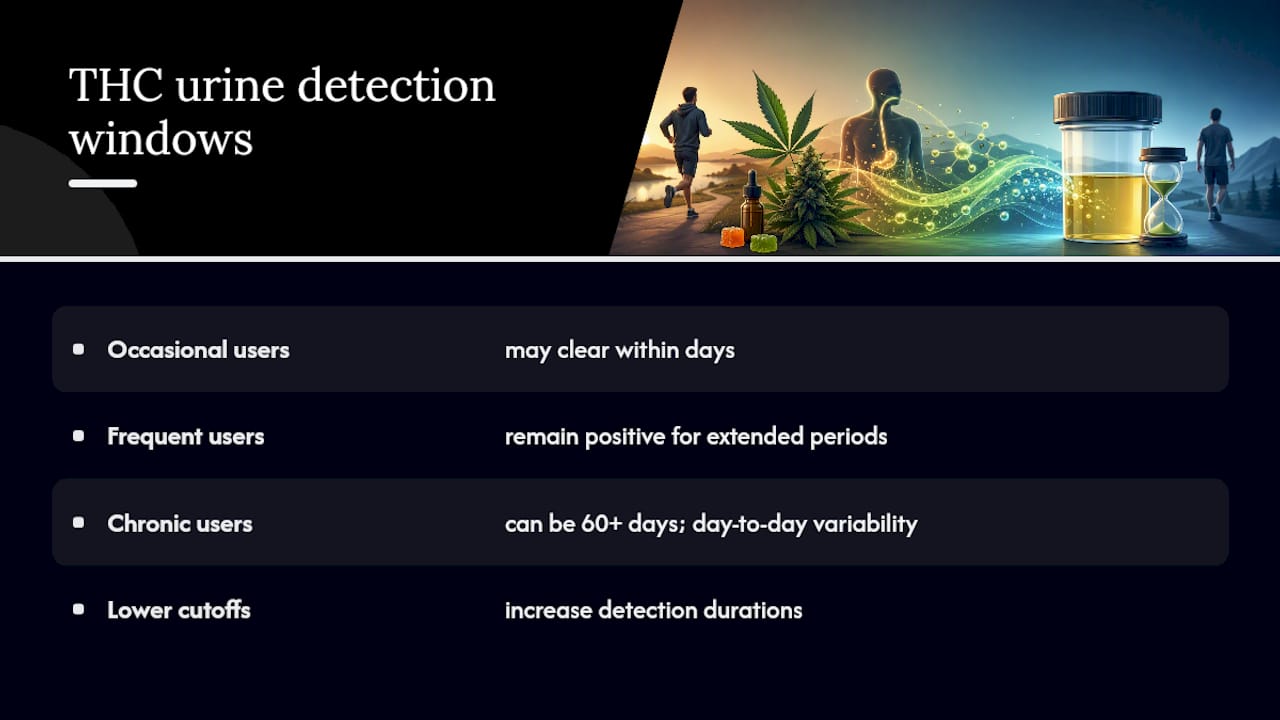
Published toxicology reviews confirm that chronic heavy users are the hardest to predict because fat-stored THC releases unevenly, and metabolite levels in urine can fluctuate day to day. A chronic user who tests negative on Monday may test positive again on Wednesday without any additional cannabis use. That variability is exactly why short-term fixes like Certo are so unreliable for this group.
The connection to quick fixes is direct: if your detection window is 60+ days, no same-day pectin drink is going to move you past it.
A Candid Take on Certo and What Actually Works
The Certo method persists because it occasionally appears to work, and people share those stories loudly. What they rarely share is the context: they were already near the threshold, they had not used heavily in weeks, or their diluted sample happened to squeak past validity checks. That is survivorship bias, not evidence.
From where Passdrugtest stands, the honest position is this: Certo and Sure Jell are jam-making products. They were never designed for drug testing, they have no clinical evidence behind them for this purpose, and the labs you are trying to fool are specifically calibrated to catch dilution-based tricks. The SAMHSA guidelines and federal workplace rules exist precisely because these methods became popular enough to require a systematic response.
What does work is giving your body enough time to clear metabolites naturally, combined with verified products that support that process. Passdrugtest’s product line is built around that reality, not around selling false hope. If you are facing a test with a tight timeline, the most useful thing you can do is get a home test today, know your actual status, and make a decision based on real information rather than forum anecdotes.
Passdrugtest Has Verified Products for Your Actual Situation
Certo is a gamble. Passdrugtest offers something more reliable: a range of tested detox products matched to your test type, timeline, and use history.
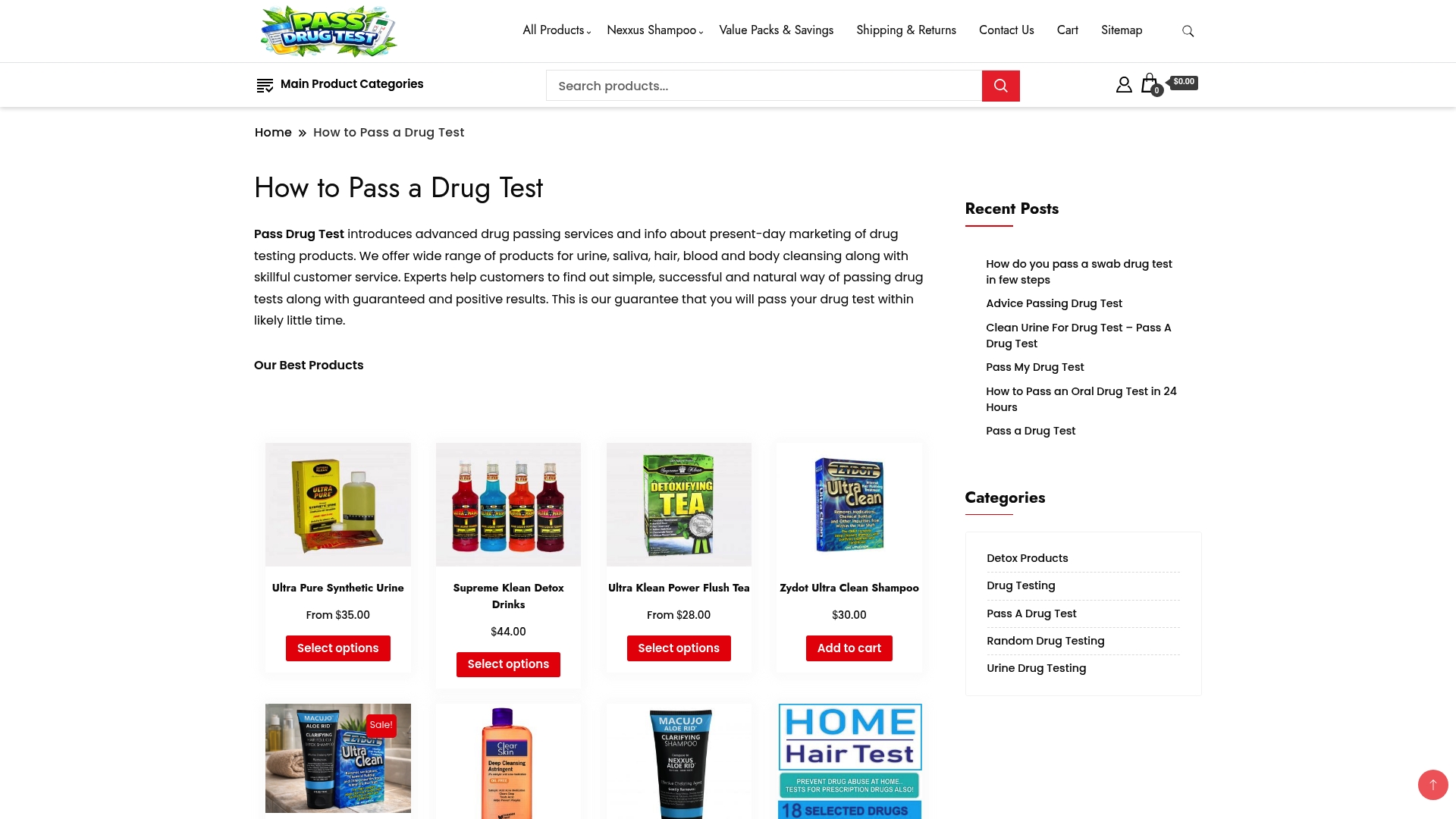
Whether you need a urine detox solution, a home test kit to check your status first, or a hair detox product for a follicle test, Passdrugtest carries options that are formulated for real results, not kitchen experiments. The store includes urine detox drinks, synthetic urine kits, saliva detox products, and home drug test kits. For hair follicle tests specifically, the Macujo Aloe Rid Shampoo is the cornerstone product used in the proven Macujo Method. Start with a home test to know where you stand, then browse the full detox product range to find the right fit for your timeline.
Primary Sources and Further Reading
- SAMHSA Urine Collection Site Manual (2024): Covers specimen validity testing procedures, creatinine and specific gravity thresholds, and collection site protocols used to detect dilution and tampering.
- Mandatory Guidelines for Federal Workplace Drug Testing Programs (Federal Register): Sets screening cutoffs, confirmation methods, and specimen validity requirements for federally regulated workplace testing programs.
- Cannabis Detection Windows in Urine (PMC): Clinical toxicology review summarizing how use frequency, body composition, and metabolism affect how long THC-COOH remains detectable.
- Forensic Toxicology Methods and Specimen Validity (PMC): Describes the two-step immunoassay/confirmation process and how validity testing identifies diluted or adulterated specimens.
- Review of Internet Detox Claims and Evidence (PMC): Narrative review concluding that most online detox hacks lack controlled evidence and that anecdotal success is typically explained by timing or low baseline exposure.
- Pectin and Gastrointestinal Behavior (PubMed): Documents pectin’s pharmacological behavior as a non-absorbed soluble fiber, relevant to evaluating the theoretical mechanism behind the Certo method.
- THC Adipose Storage and Toxicokinetics (PMC): Explains why THC’s lipophilic nature and fat storage make short-term GI interventions ineffective for chronic users.
- Specimen Validity Testing Reference (NCBI Bookshelf): Forensic reference covering creatinine and specific gravity thresholds used to classify specimens as dilute, substituted, or invalid.
This article is general information, not a substitute for advice from a qualified doctor. Consult a qualified healthcare professional about your own circumstances before acting on anything here.
Sources
- Urine Collection Site Manual (SAMHSA, 2024)
- Mandatory Guidelines for Federal Workplace Drug Testing Programs (Federal Register)
- Review article on cannabis detection windows (PMC)
- Forensic toxicology methods and specimen validity (PMC)
- Review of internet detox claims and evidence (PMC)