
A routine hair follicle test is built to find marijuana’s THC metabolite, not Spice. Laboratories can test hair for synthetic cannabinoids such as K2 and Spice, but only when the order includes a dedicated synthetic cannabinoid panel. If your employer or program ordered a standard hair test, the question that matters is what that panel covers. Below we explain what each type of test looks for, how long hair holds on to drugs, what dye and shampooing change, and how to prepare if THC is on your panel.
TL;DR
- A standard hair panel targets THC-COOH, the marijuana metabolite. Spice and K2 are different chemicals and need a dedicated synthetic cannabinoid analysis.
- Research labs have validated hair methods for dozens of synthetic cannabinoids, so a hair test that includes them can find them.
- A standard 1.5-inch hair sample covers roughly 90 days, and drugs take about 7 to 10 days to show up in hair after use.
- Dyeing, bleaching and regular washing can change drug levels in hair, and results vary from person to person.
- If your test is for THC, a Macujo-method routine with our Macujo Aloe Rid Shampoo is how we help customers prepare.
Table of Contents
- What Spice is and why it behaves differently from THC
- Can a hair test detect Spice?
- How far back a hair test looks
- What shapes a hair test result
- Does hair dye change the result?
- How to prepare when THC is on your test
- Perspective
- Ready to start your routine
- FAQ
- Sources
What Spice is and why it behaves differently from THC
Spice, also sold as K2, is a family of lab-made synthetic cannabinoids sprayed on plant material. Marketers call it fake marijuana, but the compounds are not THC. They are different molecules that act on the same receptors in the brain, and new versions appear often.
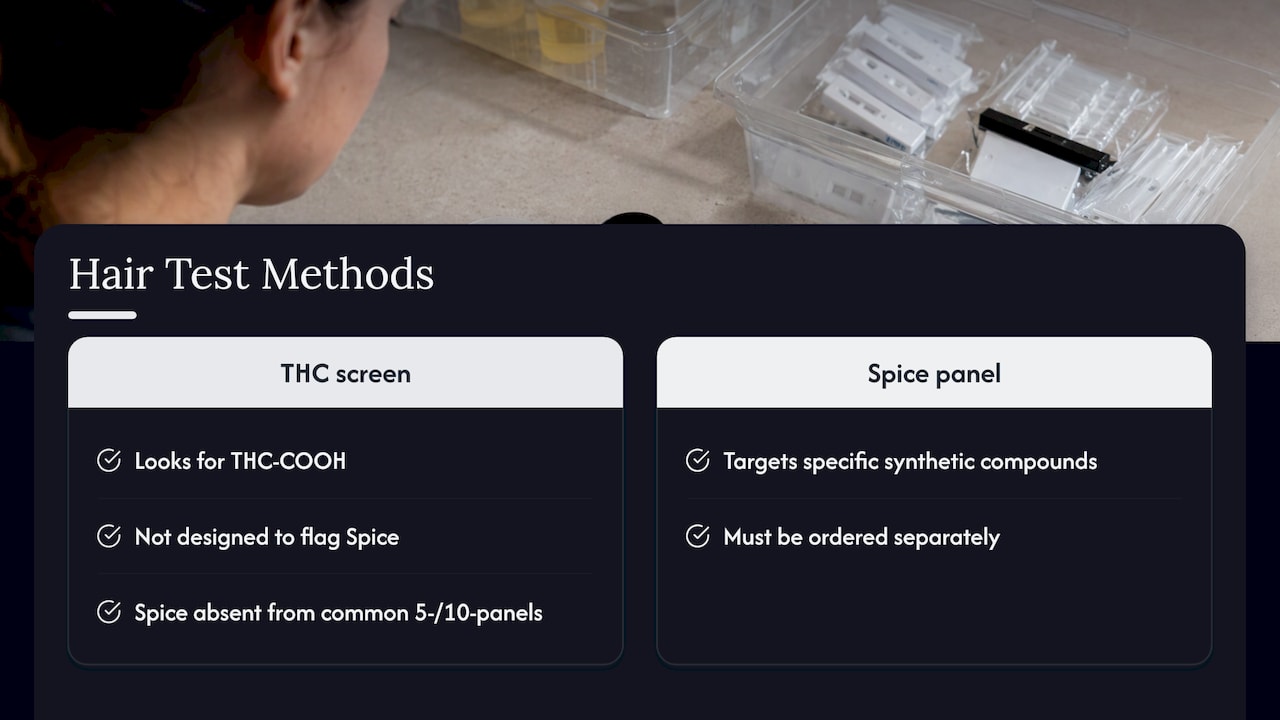
That difference drives everything about testing. Standard hair drug screens look for the metabolite of THC, called THC-COOH. A synthetic cannabinoid has a different structure, so a THC-targeted screen is not designed to flag it. Finding it takes a method built for those specific compounds.
This is why the top results for this search all say roughly the same thing: Spice is tested for separately, and it is not part of the common 5-panel or 10-panel screens. Employers who want it covered have to order it.
Can a hair test detect Spice?
Yes, when the lab is looking for it. Published research shows how capable the technology is.
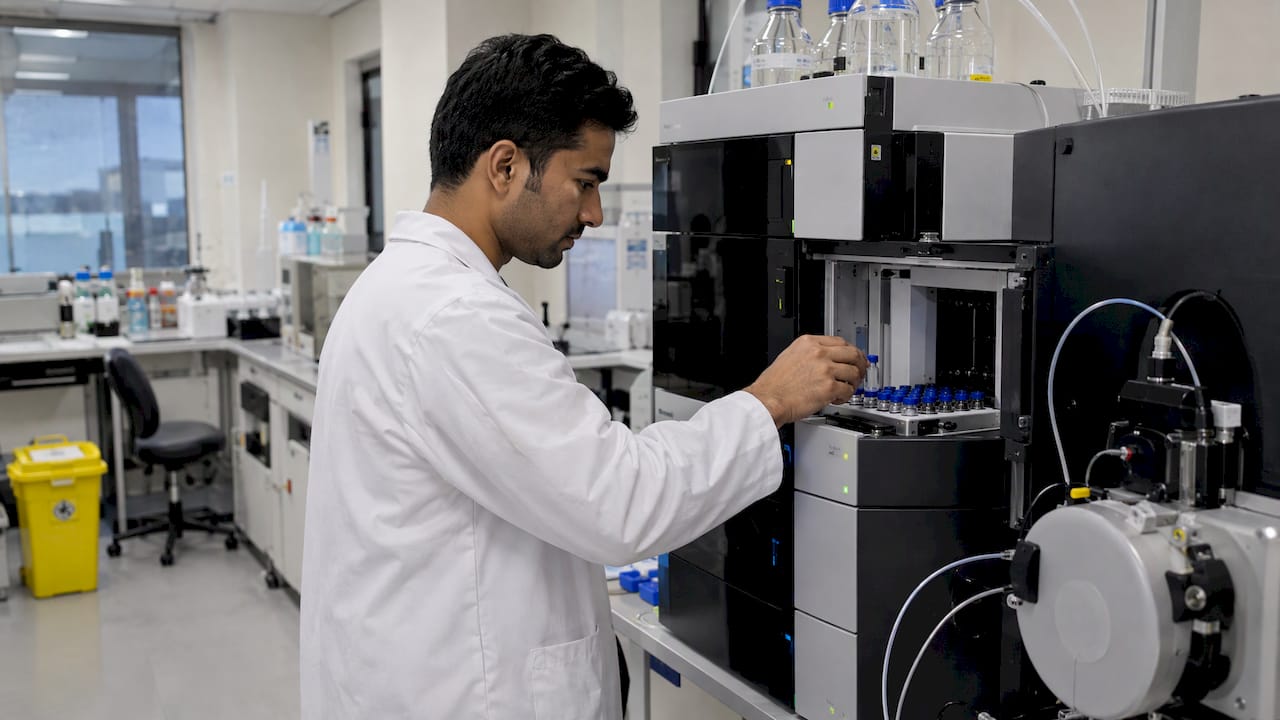
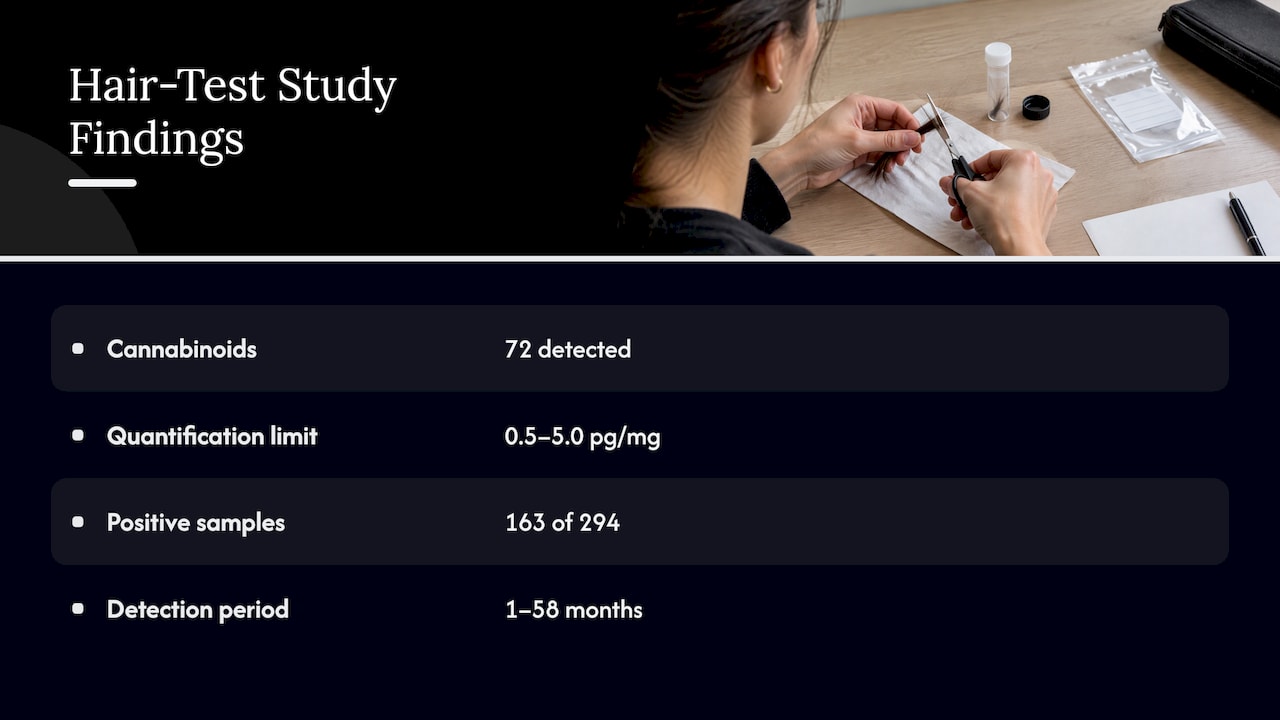
A 2018 validated LC-MS/MS method detected 72 synthetic cannabinoids in human hair at quantification limits of 0.5 to 5.0 pg/mg. In 294 authentic samples, 163 were positive, and single compounds were found for periods ranging from one to 58 months.
Another group built methods covering 18 synthetic cannabinoids and 41 metabolites in hair. In their Korean casework, AB-CHMINACA and JWH-210 were the compounds found most often. An earlier German study reported detection limits of 0.140 to 0.820 pg/mg for 12 synthetic cannabinoids.
What this means for you: a hair test that includes a synthetic cannabinoid panel is sensitive. A test that only screens for the usual drug classes is a different thing. Ask the collection site or your HR contact which substances are on the order, so you know exactly what is being looked for.
Why the compounds on the panel matter
Synthetic cannabinoids change quickly as manufacturers alter their formulas. Labs have to keep updating their methods, and the 2018 researchers describe a pragmatic re-validation approach for exactly that reason. In practice, a panel is only as broad as the list of compounds its lab has set up.
One more point from the literature: a 2013 study notes that, at least at that time, only parent compounds were detected in hair. That makes it harder to rule out external contamination than with drugs whose metabolites prove they passed through the body.
How far back a hair test looks
For a standard THC hair test, the lookback is the part most people misjudge. Drugs do not appear in hair right away, and they stay in the part of the strand that grew while you were using.
- Delay: Federal draft guidance says drugs and metabolites are not detected in hair for 5 to 7 days after ingestion. Hair is therefore not meant to catch very recent use.
- Length of hair tested: SAMHSA’s 2020 proposal called for head hair of 0.5 to 1.0 inches, representing about 30 to 60 days.
- Common commercial sample: A 1.5-inch sample cut close to the scalp is generally described as a lookback of about 90 days, with a 7 to 10 day delay before use shows up in the strand.
So if you used two weeks ago, the use is not necessarily in the portion that grew yet, but it can still be found on a 90-day test as that hair grows out. That is a big reason people ask, “Can I pass a hair follicle test in 60 days?” The honest answer depends on your usage, your hair and the lab. Our guide to the hair drug test detection window walks through the timeline in more detail.
What shapes a hair test result
There is no single number that applies to everyone. The federal draft guidelines list numerous factors that influence how much drug ends up in hair: dose, length of exposure, the physical and chemical properties of hair, and the drug’s own chemistry. They also raise environmental contamination, natural hair color, hygiene and cosmetic treatments.
The Society of Hair Testing adds two cautions in its 2021 consensus. Natural hair color can influence how a drug is incorporated, and the concentration in hair cannot be used to work out how much was consumed.
That is useful for you. The same exposure can produce different results in different people, and how you care for your hair matters.
Cutoffs for THC
The SAMHSA 2020 proposal sets a screening cutoff of 1 pg/mg for THC-COOH and a confirmatory cutoff of 0.05 pg/mg. Those are very small amounts, and the UNODC guidelines note that detecting THC-COOH requires very sensitive methods with a lower limit of quantification below 0.2 pg/mg. The same document states that at 12 to 15 cm from the root, regularly shampooed hair with no cosmetic treatment can retain only about 4% of the original drug concentration.
That is one reason shampooing routine is such a big part of preparation. For more on how THC levels are measured, see our page on hair sample analysis for THC.
Is a hair test a federal requirement?
For most people, no. Hair is not currently authorized under SAMHSA Mandatory Guidelines or DOT 49 CFR Part 40 for federally regulated programs, and the federal guidelines for hair have not been finalized. SAMHSA’s own 2023 advisory board minutes record that the proposal was published on September 10, 2020, with a final version then expected. Private employers can still choose hair testing, which is why most people meet it at the pre-employment stage. Our federal hair test guidelines page explains what that means for THC users.
Does hair dye change the result?
It can. Research is consistent that cosmetic treatment affects drug levels, though the size of the effect varies.
- The SoHT consensus says bleaching, dyeing, perming and straightening can influence drug concentrations and should be considered when results are interpreted.
- A 1997 Spanish study found drug content fell in every treated sample, with mean differences of 40% to 60% for several drugs including THC-COOH. Bleaching reduced levels more than dyeing.
- A 2021 study found bleaching strongly degraded methamphetamine, perming leached it out, and temporary dyes had little effect in single applications. Permanent dye effects depended mainly on hydrogen peroxide concentration.
- A 2014 analysis of more than 10,000 samples found no significant difference in positivity rates between treated and untreated hair, so treated hair is not automatically useless to a lab.
Take that mixed picture seriously. Dye is not a plan on its own, and labs know about it. If you already color your hair, our guides on what hair dye research shows, the role of bleach in hair testing and the Macujo method for dyed hair cover the details, including timing.
How to prepare when THC is on your test
If your test is the usual THC hair screen, preparation is about the hair itself and about time. Here is the routine we point customers to.
- Find out what is being tested. Ask which panel is ordered and how long the sample will be. A 1.5-inch sample covers a different window than a shorter one.
- Count your time. Since hair grows slowly, any days you can add before the test help. Use our 90-day THC test guide for job applicants to plan.
- Stop adding exposure. Avoid new use and avoid smoky environments, since the federal guidance flags environmental contamination as a concern.
- Follow a proven wash routine. Our products are designed to be used on a schedule leading up to the test, and the instructions matter as much as the product.
- Choose products carefully. Some products are a poor match for hair testing. Our page on detox products to avoid for hair drug testing helps you skip them.
- Keep your routine consistent through test day. A plan you follow every time is stronger than one you follow when you remember.
Heavy use is the hardest case. Our heavy smoker hair test page covers how likely detection is and why preparation should start early.
The Macujo method
Mike’s Macujo method is the best-known hair-test preparation routine among THC users in the United States. It is a structured wash process built around a clarifying shampoo, and it is the method we recommend for a hair follicle drug test. Our Macujo Aloe Rid Shampoo is the flagship of our store and, in our view, the best in its class. For the step-by-step approach, see our guide on hair drug test shampoo.
If you have bleached hair, timing changes. Read Macujo after bleaching before you start.
Perspective
We hear from many people who are confused about Spice and K2. They want to know if a hair test will find it, and the real answer is that it depends on the panel. A hair lab can detect synthetic cannabinoids when it is set up for them. A standard THC screen is looking for something else.
What we see most often, though, is people who actually face a THC hair follicle test and have been told to “just wait it out.” Ninety days is a long time to wait with no plan. Hair keeps a record, and a careful, repeatable wash routine is the only thing within your control.
That is why we built our store around the Macujo method and the Macujo Aloe Rid Shampoo. Our approach is simple: get the right product, follow the routine exactly, and keep it up until test day. Our team is available from 9am to midnight every day, and we ship with confidentiality in mind, because this is a stressful moment and you should not have to handle it alone.
MIchael
Ready to start your routine
If your upcoming test is a THC hair follicle test, the fastest way to get organized is to start with the shampoo and the instructions. Our hair follicle drug test shampoo page shows what we carry, and our team is available daily from 9am to 12am to answer questions about your timeline.
If you are also facing a saliva or urine screen, you can browse the rest of our range at passdrugtest.net, including saliva drug testing kits and urine drug test marijuana information. Our hair drug test FAQs are also a good next read.
FAQ
Does Spice show up on a standard hair drug test?
A standard hair panel is built around THC-COOH, the marijuana metabolite, and Spice compounds are chemically different. Detecting them takes a dedicated synthetic cannabinoid method, which labs have validated for dozens of compounds. Ask which substances are on your order.
How rare are hair drug tests?
Hair testing is not authorized for federally regulated workplace programs, since the federal guidelines have not been finalized. Private employers can still order it, and it is most often used for pre-employment screening because of its long lookback.
Can hair dye affect a hair follicle drug test?
Yes, it can. Bleaching, dyeing, perming and straightening can change drug concentrations in hair, and bleaching tends to lower levels more than dye. Results vary, so treat dye as one factor in a bigger plan.
Will I pass if I smoked two weeks ago?
Drugs take roughly 5 to 10 days to appear in hair, so use two weeks ago may sit in hair that is still growing out. A standard 90-day sample can still capture it. Your own timeline depends on how much you used and your hair.
Can I pass a hair follicle test in 60 days?
It depends on the length of the sample, your usage and your hair care routine. A shorter 0.5 to 1.0 inch sample represents about 30 to 60 days, while a 1.5-inch sample covers around 90. Start your wash routine as early as you can.
Sources
- Synthetic cannabinoids in hair: pragmatic approach (PubMed, 2018)
- Simultaneous determination of synthetic cannabinoids and metabolites in hair (ScienceDirect)
- Simultaneous identification and quantification of synthetic cannabinoids in hair (De Gruyter, 2013)
- HHS/SAMHSA proposed hair testing guidelines (2020)
- SoHT 2021 Consensus on drugs of abuse testing in hair
- Hair drug testing lookback and limits
- SAMHSA Drug Testing Advisory Board minutes, June 2023
- UNODC guidelines for testing drugs in hair, sweat and oral fluid
- Influence of the cosmetic treatment of hair on drug testing (PubMed, 1997)
- Utility of coloured hair for the detection of drugs (Wiley, 2014)
- Influence of cosmetic hair treatments on hair (ScienceDirect, 2021)