

Clarifying shampoo has one job in a hair-follicle detox protocol: strip away oils, surface buildup, and outer-layer residue so other active ingredients can work on the hair shaft. It does not dissolve metabolites that have already worked their way into the cortex on its own, and no product can promise a passed test. Used correctly, though, it’s the opening move in a chemical sequence that has helped a lot of people walk into testing day with a cleaner sample.
If you’ve got a test in the next 24 to 72 hours, don’t panic and don’t experiment with random kitchen chemicals. Wash with a clarifying shampoo daily, avoid touching your hair with oils or styling products, and start researching a full multi-step protocol immediately if you have any lead time at all.
- Clarifying shampoo alone rarely changes outcomes for regular or heavy users.
- It works best as step one in a layered chemical protocol, not a standalone fix.
- Macujo Aloe Rid Shampoo is the product most commonly built into these protocols, specifically because of its role in the opening cleansing phase.
- Timing matters more than most people think. Starting shortly before a test usually leaves too little time to be effective.
Key Takeaways
Clarifying shampoo works as the surface-prep step in a multi-part detox sequence, and its real value depends on pairing it with the right follow-up products and enough lead time before testing day.
| Point | Details |
|---|---|
| Core verdict | Clarifying shampoo removes surface buildup but doesn’t reliably clear metabolites bound inside the hair cortex on its own. |
| Primary limit | Heavy chronic use, dark low-porosity hair, and hard drugs like cocaine or opioids lower the odds of any protocol working. |
| Timing advice | Start a full protocol at least one to two weeks before testing; last-minute attempts have far less time to work. |
| Safety note | Patch test astringents first and stop the protocol if you notice burning, redness, or hair loss. |
| Where to buy | Passdrugtest sells Macujo Aloe Rid Shampoo and Zydot Ultra Clean as part of complete Macujo-style detox kits. |
Table of Contents
- What Is the Role of Clarifying Shampoo in a Detox Protocol?
- Does the Science Support Washing Away Drug Residue?
- How Clarifying Shampoo Fits Into the Macujo Method
- What Are the Real Risks of Aggressive Hair-Washing Protocols?
- When Does Clarifying Shampoo Actually Improve Your Odds?
- What Happens at the Lab After You Submit a Sample?
- Where Clarifying Shampoo Fits Into a PassDrugTest Kit
- A Practitioner’s View on Clarifying Shampoo and Detox Protocols
- Sources
What Is the Role of Clarifying Shampoo in a Detox Protocol?
Clarifying shampoo works on the outside of the hair shaft. It uses stronger surfactants than a normal shampoo to break down sebum, mineral deposits, and product buildup that coats the cuticle. That’s the same reason it’s used in regular hair care, but its job in a detox protocol is narrower and more aggressive: strip everything off the surface so the ingredients that come next have a clean shot at the shaft itself.
Some detox-focused shampoos push further by pairing surfactants with penetration enhancers, most commonly propylene glycol, along with acidic astringents that swell the cuticle and make it more permeable. Whether that swelling meaningfully affects metabolites already bound inside the cortex is a much bigger question than most product marketing would like to admit.
The mechanisms typically at play:
- Surfactants that emulsify oil and buildup on the cuticle surface.
- Penetration enhancers like propylene glycol, intended to loosen the cuticle layer.
- Acidic astringents (vinegar, lemon juice, salicylic acid) used to open the cuticle before shampooing.
- Repeated washing cycles that compound surface removal over several days rather than one session.
Clarifying formulas are built for occasional use, not everyday washing, according to Healthline’s breakdown of the category. Overuse strips natural oils and can leave hair dry and brittle, which matters a lot once you’re combining it with other harsh chemical steps in a detox sequence.
Does the Science Support Washing Away Drug Residue?
The honest answer: washing removes external contamination reasonably well, but it doesn’t reliably clear metabolites your body has already deposited into the hair matrix.
The UNODC’s scientific review of hair testing notes there’s no single accepted decontamination method across labs. Facilities combine organic solvents like dichloromethane or methanol with aqueous washes, and the review specifically flags that some of these solvents can swell the hair shaft, occasionally pulling out compounds embedded deeper than the surface. That’s a double-edged detail: if lab washes can sometimes strip embedded material, home protocols using similar acids and surfactants have a plausible mechanism, even without controlled trials confirming how well it works outside a lab.
Separately, NIJ-supported research on phase II metabolites found that labs can now distinguish actual drug ingestion from environmental contamination by looking for specific metabolite signatures. That’s a meaningful shift. It means simply touching a contaminated surface is less likely to trigger a false positive, but it also means labs have gotten better at spotting real use, not worse.
| Evidence Source | What It Found | Limitation |
|---|---|---|
| NIJ metabolite research | Phase II metabolites help distinguish use from contamination | Doesn’t address whether home washing removes those metabolites |
| UNODC decontamination review | No universal wash standard; solvents can swell hair | Effectiveness varies by drug, lab, and solvent combination |
| Springer review of hair testing | Cosmetic treatments can lower detectable drug levels, sometimes substantially | Results are inconsistent and not standardized across studies |
A Springer review of factors influencing hair testing found that cosmetic treatments, including bleaching and dyeing, can dramatically cut detectable drug concentrations in some cases. But the same review is clear that results vary widely by drug class, hair type, and how far the tested segment sits from the scalp. There’s a real signal here, just not a guaranteed one.
How Clarifying Shampoo Fits Into the Macujo Method
Clarifying shampoo is step one of a five-part sequence that treats the hair with acid, detergent, and specialty shampoos in a specific order. It’s not a solo act. The most widely referenced version of this sequence is the Macujo method, developed by Mike Macujo and refined by online communities over years of trial and error, and it remains among the most detailed hair-detox protocols anyone has published.
- Pre-wash with clarifying shampoo. Strip oils and buildup so later steps can reach the shaft directly.
- Apply an acidic astringent (often a salicylic-acid-based product) to the scalp and hair, focusing on roots. This step opens the cuticle.
- Work in a detox shampoo like Macujo Aloe Rid Shampoo while the astringent is still active, massaging thoroughly for several minutes.
- Let the mixture sit for the time specified in the protocol, typically a short dwell period, not hours.
- Rinse and repeat daily for at least several days to a couple of weeks, depending on usage history.
- Finish testing day with Zydot Ultra Clean, a specialty cleansing treatment many people use as a final-hours step before the test itself.
Pro Tip: Never combine laundry detergent or dish soap with scalp astringents to save money. It’s a common shortcut in DIY forum posts, and it dramatically raises the risk of chemical burns without improving results.
- Do a patch test on skin before applying astringents to your scalp.
- Avoid leaving acidic products on longer than instructed. More time is not automatically better.
- Watch for redness, stinging, or flaking between sessions and pause if it worsens.
What Are the Real Risks of Aggressive Hair-Washing Protocols?
Chemical detox protocols carry real risk of scalp irritation, hair damage, and pigment loss, and that risk climbs with every day you repeat the sequence.
Acidic astringents and heavy surfactants stress the cuticle by design. That’s the whole point of opening it, but repeated stress breaks down keratin structure over time, leaving hair brittle, dry, or prone to breakage. The Springer review mentioned earlier notes that cosmetic treatments capable of lowering detectable drug concentrations are often the same ones associated with visible hair damage, including color loss and texture changes.
Community reports on forums and review sites describe scalp burns and localized hair thinning from improvised DIY mixtures, particularly when people substitute harsher household chemicals for tested products. That’s not a reason to avoid a protocol entirely. It’s a reason to follow a documented sequence with proven products instead of guessing.
If you notice persistent redness, open sores, or patchy hair loss, stop the protocol and see a dermatologist before continuing. No test result is worth a lasting scalp injury.
When Does Clarifying Shampoo Actually Improve Your Odds?
Clarifying-shampoo protocols work best for occasional cannabis users with a short detection window and clean, undamaged hair, and they work worst for chronic heavy users or anyone tested for cocaine or opioids.
Several variables move the needle more than people expect:
- Frequency of use: light or occasional use gives protocols something realistic to work against; daily heavy use loads far more metabolite into the shaft.
- Drug type: cannabis metabolites tend to respond better to these protocols than cocaine or opioid metabolites, based on the variability reported in the Springer review.
- Hair characteristics: dark, low-porosity hair binds metabolites more tightly than lighter, more porous hair.
- Time before testing: a week or two of daily treatment gives the sequence room to work; one night does not.
A quick self-check before committing to a protocol:
- How long is your hair, and how far back does the test window reach?
- What substance are you being tested for, and how often did you use it?
- How many days do you actually have before the test?
- Is your hair chemically treated, damaged, or naturally very dark?
- Is this a lab-based test or an instant cup-style screen?
A light, occasional cannabis user with two weeks of runway and average hair has a fundamentally different situation than a daily user tested with 48 hours’ notice. The second scenario calls for combining hair protocols with a broader detox approach rather than betting everything on shampoo alone.
What Happens at the Lab After You Submit a Sample?
Labs run their own decontamination wash before testing your hair, which means home treatments aimed purely at the surface face a second layer of professional cleaning anyway.
Labcorp’s description of its hair-testing workflow outlines a standard sequence: collection under chain-of-custody, an immunoassay screen, and mass spectrometry confirmation for any presumptive positive. The detection window runs up to roughly 90 days depending on hair length.
- Collectors cut a hair sample, usually from the crown, close to the scalp.
- The lab performs its own solvent wash to remove external contamination before analysis.
- An immunoassay screen flags likely positives.
- Mass spectrometry confirms or clears any flagged sample.
- Turnaround for negative results is typically faster than confirmation testing on a flagged sample.
Interestingly, Quest Diagnostics’ own FAQ states that common grooming products applied to hair had little or no effect on changing positive or negative outcomes in their data. That’s an important reality check: labs test cut hair above the scalp, not the follicle itself, and their own wash step is built to neutralize exactly the kind of surface contamination a casual shampoo addresses.
If your hair shows obvious chemical damage, unusual texture changes, or bleaching inconsistent with your normal appearance, some collectors may flag the sample or ask questions. That’s not universal, but it’s a real possibility worth knowing before you overdo any single step. For more on how contamination gets separated from real use, see how external contamination affects hair-testing outcomes.
Where Clarifying Shampoo Fits Into a PassDrugTest Kit
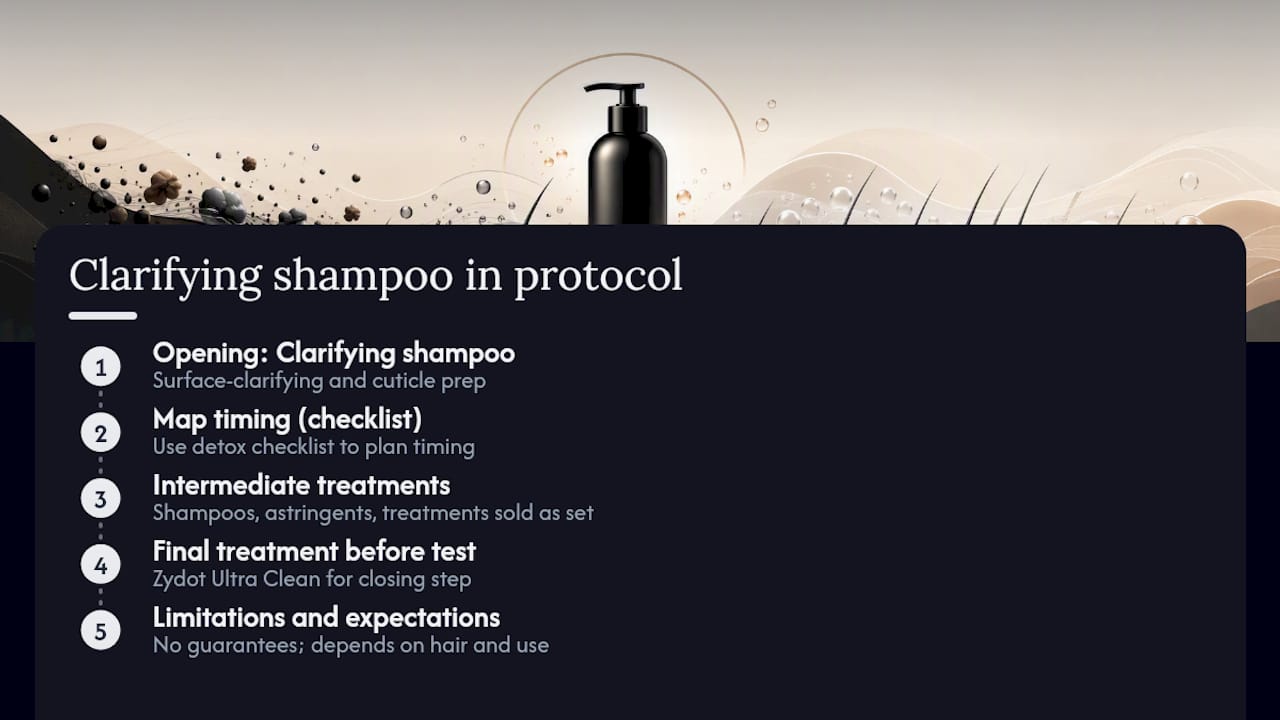
Clarifying shampoo is the opening step, not the whole plan, and that’s exactly how Passdrugtest positions Macujo Aloe Rid Shampoo and Zydot Ultra Clean inside its product lineup.

Macujo Aloe Rid Shampoo handles the surface-clarifying and cuticle-prep stage, while Zydot Ultra Clean is typically reserved for the final treatment closer to testing day. Neither product works in isolation the way testimonials sometimes imply, and Passdrugtest doesn’t claim otherwise. Success depends heavily on your usage history, hair type, and how closely you follow the sequence.
If you’re building a protocol from scratch, start with the complete hair detox checklist to map out timing, then browse the drug test detox products category to see the full range of shampoos, astringents, and treatments sold as a set. For readers specifically following the Macujo sequence, the Macujo Aloe Rid Shampoo product page lays out usage instructions alongside the Zydot Ultra Clean shampoo for the closing step.
There are no guarantees here, and anyone telling you otherwise is selling hope, not science. What Passdrugtest offers is a set of products built specifically around a documented, community-tested protocol, with honest expectations about what each step actually does.
A Practitioner’s View on Clarifying Shampoo and Detox Protocols
Most of the disappointment I see traces back to unrealistic expectations, not bad products. People treat clarifying shampoo like a magic eraser when it’s really more like the first coat of primer before paint. It does exactly what it’s designed to do: strip the surface clean. The protocol only works when every step after it gets equal attention, and that’s where most DIY attempts fall apart.
The Macujo method built by Mike Macujo remains the most detailed, widely tested approach in this space, precisely because it doesn’t rely on a single product to do all the work. It sequences acids, surfactants, and specialty shampoos in an order that respects how hair actually holds onto residue. Skipping steps, rushing dwell times, or substituting harsh household chemicals is where people get burned, literally and figuratively.
My honest advice: if you have real lead time, follow the full sequence exactly and don’t improvise. If you don’t have lead time, be realistic about your odds rather than betting everything on a last-minute wash. And if your situation involves heavy or chronic use of a substance with a longer detection profile, pair a hair protocol with a broader detox strategy instead of expecting shampoo alone to carry the whole outcome.
Sources
These sources were chosen because they combine peer-reviewed hair-testing science with direct lab-practice guidance, giving readers a way to check claims against primary evidence rather than forum anecdotes.
- Detecting drugs in hair: Is it drug use or environmental contamination? — NIJ
- Hair, sweat and oral fluid — UNODC (scientific review)
- Review of hair testing influences — Springer (2019)
- Hair follicle drug testing: Process & benefits — Labcorp
- What is clarifying shampoo? — Healthline