
A standard scalp hair cocaine test typically looks back about 90 days, not the exact day or amount of use. It flags whether cocaine or its metabolites are present in that hair segment, and labs lean on metabolite data to sort out genuine use from outside contamination.
TL;DR:
- Hair tests generally detect cocaine use within the last 90 days, but longer detection periods are possible with certain hair types or heavier use.
- External contamination can cause positive results, so labs analyze metabolites like benzoylecgonine to distinguish ingestion from environmental exposure.
- Recent use within five to seven days may not show up in hair tests due to the time required for hair to grow out to a collectible length.
- Cosmetic treatments and hair color can affect drug detection levels, making true results dependent on hair condition and collection methods.
- Disputing positive results requires access to detailed lab data, confirmatory testing, and early documentation, as result interpretation is complex and variable.
Table of Contents
- How hair follicle testing for cocaine actually works
- How long cocaine stays detectable in hair, and what changes that window
- Why a hair test can come back positive: use versus contamination
- How accurate is a cocaine hair test, really
- Can you clean your hair or pass a cocaine test in 30 days
- What to do if your cocaine hair test comes back positive
- A publisher’s perspective on hair testing and detox claims
- If you want product support: our Macujo Aloe Rid Shampoo and kit options
- Sources
- FAQ
How hair follicle testing for cocaine actually works
Hair grows at a fairly steady rate, and labs use that rate to translate a strand into a timeline. A half inch of hair roughly covers a month, and the 1.5 inch sample Labcorp typically collects maps to about 90 days, using around 90 to 120 strands or roughly 100 milligrams of hair. When head hair is not available, labs may use body hair. However, the growth rate is less predictable there, so the timeline gets fuzzier.
Cocaine and its metabolites reach hair through more than one route. The drug travels through the bloodstream into the growing follicle, but it can also arrive through sweat and sebum after the hair has already formed, or sit on the surface from external contact with powder or smoke residue. That last route is exactly why labs cannot treat a positive result as proof of ingestion on its own.
The testing pipeline generally follows a set sequence:
- The sample is washed with decontamination solutions to strip surface residue before analysis.
- An initial screening test (usually immunoassay) flags samples that need a closer look.
- Positive screens go to confirmatory testing with liquid chromatography tandem mass spectrometry or gas chromatography mass spectrometry.
- Analysts compare cocaine to its metabolites, since metabolite ratios help distinguish environmental exposure from actual use.
That last step matters more than most people realize. Cocaine itself can sit on hair from contact alone, but certain metabolites form primarily inside the body, so their presence and ratio to the parent drug carry real interpretive weight.
How long cocaine stays detectable in hair, and what changes that window
The 90 day figure gets repeated so often that it sounds like a fixed rule, but it is really a guideline tied to a standard 1.5 inch sample. Some published research has documented detection out to six months in specific cases, particularly with longer hair segments or heavier use patterns.
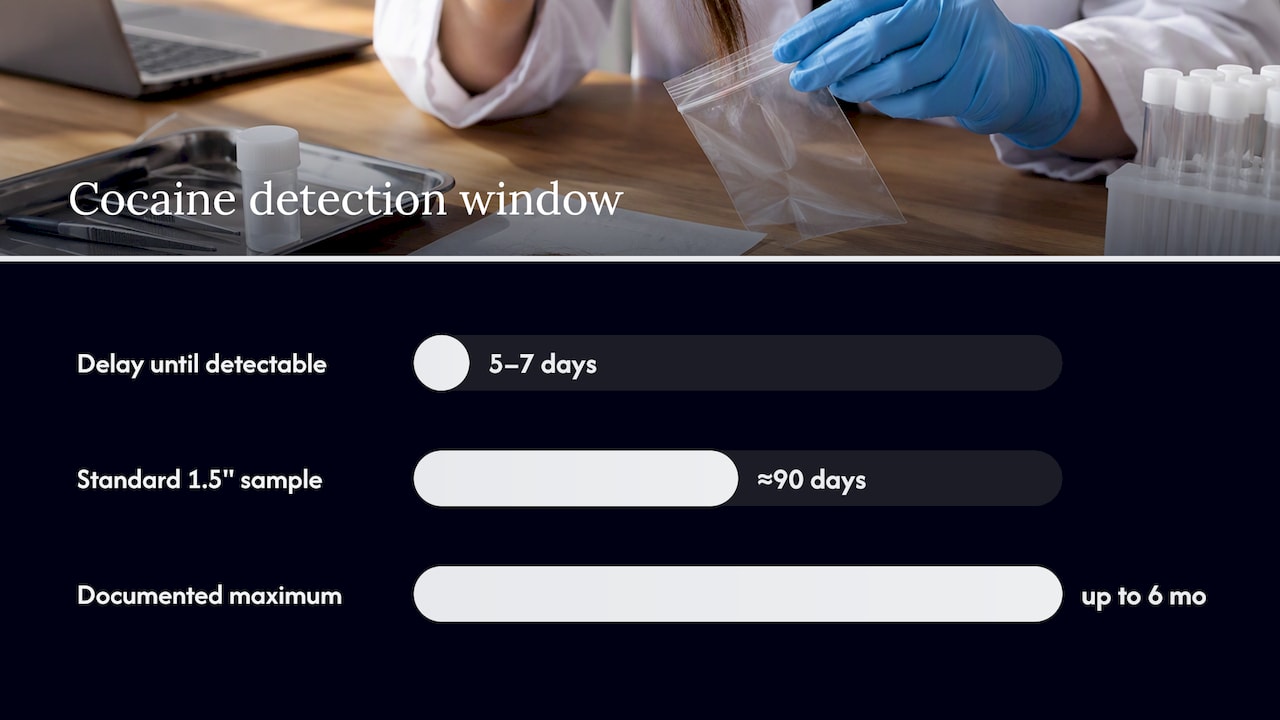
One detail catches almost everyone off guard: a positive test does not mean use happened yesterday. Hair testing generally needs about 5 to 7 days after use before the drug shows up above the scalp, since it takes time for the follicle to grow the exposed segment out to a collectible length. That delay means very recent use can slip past a hair test entirely, even while it would show up on a urine or saliva test the same week.
Several factors stretch or shrink what a hair test can actually detect:
- Darker, more melanin-rich hair tends to bind more drug residue than lighter hair, which can affect measured concentrations.
- Frequency and amount of use directly influence how much cocaine and metabolite end up incorporated into the strand.
- Bleaching, perming, and other cosmetic treatments can alter or reduce detectable levels, sometimes unpredictably.
- Sampling body hair instead of scalp hair extends the theoretical window but sacrifices timeline precision.
A standard Labcorp sample of about 1.5 inches assesses roughly the prior 90 days, using around 90 to 120 strands. That single measurement anchors most of the timelines you will see quoted elsewhere.
Why a hair test can come back positive: use versus contamination
A positive result can come from more than one source, and separating them is the hardest part of interpreting a cocaine hair test. The main possibilities include:
- Actual ingestion, where cocaine enters the bloodstream and gets incorporated into the growing hair shaft.
- External contact with cocaine powder, smoke, or residue on shared surfaces.
- Hand-to-hair transfer, such as touching contaminated cash or objects and then touching your own hair.
- Contamination during collection or handling at the lab itself, though this is rare given standard chain-of-custody procedures.
To sort through this, laboratories look at a panel of analytes rather than cocaine alone. SAMHSA and forensic toxicology guidance point to benzoylecgonine, norcocaine, cocaethylene, and hydroxycocaines as the key markers, with a commonly cited cutoff of 500 picograms per milligram for cocaine itself under Society of Hair Testing guidance. Benzoylecgonine alone is not considered a reliable proof of ingestion, since it can form in hair that has only been contaminated, or arise from impurities in street-level cocaine.
This is where decontamination washes come in. Repeated methanol wash protocols can strip away recent surface contamination fairly effectively, but they are far less reliable at removing contamination that has had time to work into the hair shaft or that occurred well before collection. That gap is exactly why labs increasingly use decision-tree models built on metabolite ratios instead of relying on a single wash step to settle the question.
How accurate is a cocaine hair test, really
No hair test delivers a clean yes or no answer the way people expect. Interpretation depends on lab methodology, hair condition, and how conservatively the analysts apply their cutoffs, and those variables shift results more than most people assume.
A few limits are worth keeping in mind:
- Confirmatory testing with mass spectrometry is far more reliable than initial immunoassay screening, so a screen-only positive should never be treated as final.
- Research on contamination rates varies widely by cohort. One large cohort study found that 17.7% of routine samples were classified as predominantly contamination rather than use under its decision model, a figure specific to that dataset but a useful reminder that contamination is not rare.
- Hair color, chemical damage, and cosmetic treatments can all shift analyte concentration, which affects both sensitivity and specificity of the test.
- Different labs may apply different cutoffs and analyte panels, so the same hair sample tested at two facilities will not always agree.
Pro Tip: If a result matters for your job, a legal case, or custody proceedings, request the full lab report with numeric concentrations and cutoffs rather than accepting a simple positive or negative label.
The practical takeaway is straightforward: treat any single result with some skepticism until you have seen the underlying data, and escalate to a documented lab review whenever the stakes are high.
Can you clean your hair or pass a cocaine test in 30 days
Aggressive washing, bleaching, and repeated cosmetic treatment can lower measured cocaine levels in hair, but the evidence does not support a dependable method for guaranteeing a negative result. A 2022 evaluation found that bleach, peroxide, and repeated washing reduced fortified hair concentrations by up to 60 to 80% under laboratory conditions, yet outcomes varied significantly depending on hair damage and porosity, which means the same protocol can produce very different results on different people.
That variability is exactly why a fixed “pass in 30 days” promise does not hold up. Hair growth rate, how much cocaine was incorporated, how porous your hair already is, and how thoroughly a wash protocol is followed all move the outcome in different directions, so nobody can predict a guaranteed result from a calendar alone.
Shaving is sometimes floated as a shortcut, but it usually backfires. Testing programs that cannot collect head hair typically request body hair instead, and body hair grows more slowly and carries a longer, less precise detection window, so shaving rarely solves the underlying problem.
A few honest points worth weighing before choosing a path:
- Washing and cosmetic treatment can lower detectable levels but cannot reliably erase them.
- Hair condition and porosity affect how any detox product performs, which means results are never uniform across users.
- Detox shampoos and combo kits are one option people consider, but none of them should be treated as a certainty.
If you are researching options, our Macujo method breakdown walks through the mechanics and realistic expectations in more detail.
What to do if your cocaine hair test comes back positive
If you receive a positive result and believe it may be wrong, work through these steps in order:
- Request the full laboratory report, including chain-of-custody documentation, analyte concentrations, cutoffs, and metabolite ratios.
- Ask whether confirmatory testing with mass spectrometry was performed, and request it if the result relied only on an initial screen.
- Consider an independent retest at a separate lab, and involve a medical review officer if your workplace testing program uses one.
- Gather any evidence of possible environmental exposure, medical explanations, or handling errors that could support a dispute.
- Keep copies of every communication, report, and document related to the test in case the matter escalates.
Pro Tip: Do this quickly. Many workplace and legal processes have short windows for disputing a result, and requesting documentation early protects your options later.
If the outcome affects your job or a legal matter, a consultation with an employment attorney or toxicologist familiar with hair testing can clarify whether the data actually supports the conclusion drawn from it.
A publisher’s perspective on hair testing and detox claims
I run a site covering hair, saliva, and urine testing and sell detox products including a Macujo Aloe Rid Shampoo. We build our educational content from laboratory guidance and peer-reviewed research, but we are not a lab. When a result carries real consequences, the lab report, confirmatory testing, and a medical review officer carry more authority than any product page, including ours.
— MIchael
If you want product support: our Macujo Aloe Rid Shampoo and kit options
Knowing how hair testing works is one thing. Deciding what to do about an upcoming test is another, and that is where our product lineup comes in. The Macujo Aloe Rid Shampoo, often paired with the Zydot Ultra Clean Treatment, is built around Mike Macujo’s method, which is regarded among detox approaches as an established option for hair follicle preparation.
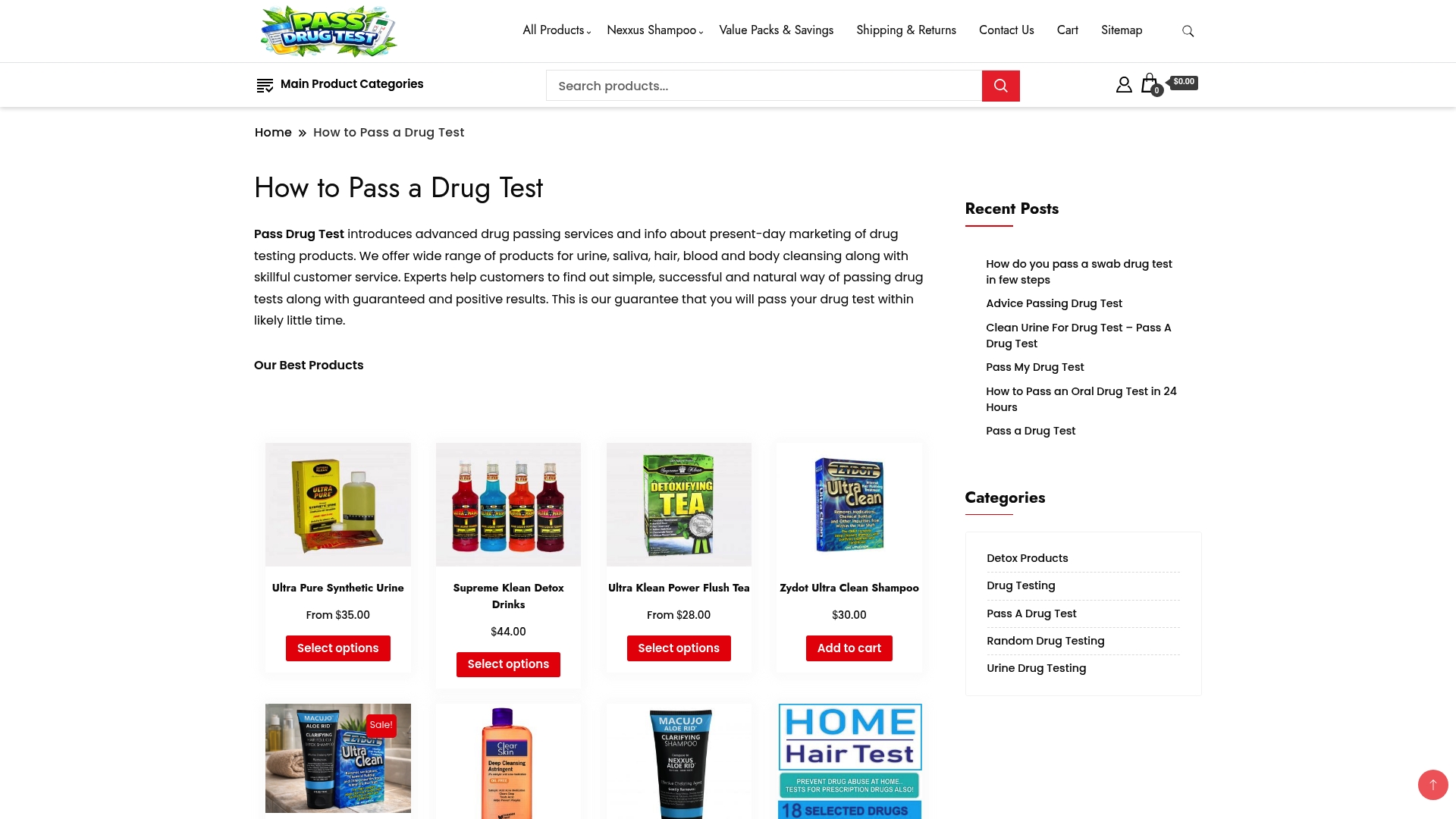
A few things worth knowing before you buy:
- Our detox shampoos and combo kits aim to reduce detectable residue through repeated cleansing cycles, not through a single wash.
- No product removes the uncertainty described earlier in this piece. Hair porosity, damage, and how much was incorporated all still matter.
- Pairing product use with documentation and a lab review remains the strongest approach when a result is contested.
If you want to look at the full lineup, visit our detox product page or go straight to the Macujo Aloe Rid Shampoo product listing to check availability.
Sources
- Labcorp — Hair drugs of abuse testing (FAQ)
- NIJ — Detecting drugs in hair: Is it drug use or environmental contamination?
- Insights into the decontamination of cocaine-positive hair samples (PMC)
- Evaluation of decontamination procedures for undamaged versus damaged hair (PubMed)
- SAMHSA — Drug metabolites and hair testing
FAQ
Can cocaine be removed from hair?
Washing, bleaching, and repeated cosmetic treatment can lower measured cocaine levels in hair, but research shows outcomes vary widely by hair condition and cannot guarantee a negative result. Nothing available reliably erases incorporated drug from every strand.
Can I pass a hair follicle test in 30 days?
There is no dependable calendar-based guarantee, since hair growth rate, how much was incorporated, and hair porosity all affect outcomes differently for each person. Products and washing protocols may reduce detectable levels, but the evidence does not support a fixed timeline for a certain result.
Can a hair strand test detect cocaine?
Yes, a standard hair strand test can detect cocaine and its metabolites for roughly the prior 90 days using a 1.5 inch scalp sample. Very recent use within the last 5 to 7 days is often missed because the drug has not yet grown out above the scalp.
What can cause a positive cocaine hair test?
A positive result can come from actual ingestion or from external contamination, such as contact with cocaine residue or hand-to-hair transfer. Labs try to tell these apart by measuring metabolites like benzoylecgonine, norcocaine, and cocaethylene alongside cocaine itself, since some metabolites form primarily through actual use rather than surface contact.