
Detox treatments can reduce the amount of cocaine sitting on the surface of your hair, but no shampoo, method or home recipe can guarantee that incorporated cocaine will test negative. Labs know this too, which is why they rely on metabolite ratios and multi-wash decontamination to tell contamination apart from use. Products like Macujo Aloe Rid Shampoo and guides from PassDrugTest.net remain popular preparation tools, but they work best as part of a realistic plan, not a last-minute miracle fix.
TL;DR:
- Detox shampoos like Macujo Aloe Rid support external cleaning but cannot guarantee removal of drugs incorporated into hair through systemic use.
- Labs differentiate between contamination and use by analyzing multiple metabolites and wash patterns, with internal incorporation being much harder to erase.
- Timing is the most reliable factor; abstinence for several weeks allows new hair growth to reflect a drug-free state, which no product can instantly create.
- Chemical treatments such as bleaching or dyeing can lower drug levels but may damage hair and affect test validity, especially if done shortly before testing.
- Positive results can often be contested by requesting confirmatory tests and providing documentation of exposure or cosmetic treatments that might influence the results.
Table of Contents
- How hair follicle tests detect cocaine and which analytes matter
- Detection window and sampling: how far back hair testing looks
- What labs do before they report a result: decontamination, washing, and confirmation
- Common detox methods people try, and what the evidence shows
- What peer-reviewed studies and lab reports actually found
- Practical, lower-risk preparation steps that make sense
- If you test positive: how to request clarification, retest, or appeal
- A candid perspective on hair detox from years of questions and orders
- Where Macujo Aloe Rid Shampoo fits into your preparation
- Sources
- FAQ
How hair follicle tests detect cocaine and which analytes matter
When you use cocaine, it enters your bloodstream and gets deposited into the hair follicle as the strand forms. That is called systemic incorporation, and it is different from external contamination, where cocaine residue from smoke, handling, or surface contact settles onto hair you already grew. Sweat and natural oils can also carry trace amounts of the drug onto the hair shaft after it has already grown out. Labs need to tell these three pathways apart, because only systemic incorporation reliably indicates personal use.
To do that, toxicologists do not look at cocaine alone. They measure several related compounds:
- Cocaine (COC): the parent compound itself, found in both contaminated and incorporated samples.
- Benzoylecgonine (BE): a metabolite formed inside the body, making its presence a stronger signal of ingestion.
- Cocaethylene (CE): produced when cocaine and alcohol are used together, another marker tied to actual consumption.
- Norcocaine (NC): a metabolic byproduct that also points toward internal processing rather than surface contact.
- Hydroxy-cocaine metabolites (OH-COC): additional breakdown products that labs use to build a fuller metabolic picture.
Authoritative guidance from SAMHSA and the Society of Hair Testing stresses that benzoylecgonine alone is not enough to confirm use, since cocaine is unusually vulnerable to contamination compared with other drugs. That is why labs report multiple analytes together and apply ratio-based reasoning rather than a single cutoff.
Detection window and sampling: how far back hair testing looks
Standard hair testing typically examines a 3 centimeter segment of head hair closest to the scalp, which corresponds to roughly a detection window of about three months. This rests on the common estimate that head hair grows about 1 centimeter per month, giving each segment a rough timestamp.
Sampling details change what that window covers:
- Segmental analysis can break a longer strand into shorter sections, letting a lab or investigator narrow down when exposure likely occurred.
- Body hair grows more slowly and less predictably, which can push the detection window out well beyond 90 days when head hair is unavailable.
- Collection point matters: hair cut close to the scalp reflects the most recent growth, while hair collected further down the shaft reflects older history.
These timing rules matter for anyone planning around an upcoming test. A treatment applied the night before a collection has no effect on cocaine that was incorporated into hair grown weeks or months earlier. Only new, uncontaminated growth genuinely reflects a period of abstinence.
What labs do before they report a result: decontamination, washing, and confirmation
Before a lab ever reports a hair result, it puts the sample through a decontamination process meant to strip away anything sitting on the surface. A common approach uses repeated short methanol washes, with each wash analyzed separately.
According to research on cocaine-positive hair decontamination, recent external contamination tends to wash out quickly in the early rinses, while cocaine incorporated through the bloodstream shows a steadier, more constant extraction pattern across the whole wash series. That difference in wash kinetics is one of the tools labs use to distinguish someone who touched cocaine residue from someone who used the drug.
A wash-to-hair (W/H) ratio, along with analysis of the final wash solution, helps labs flag samples where surface contamination looks disproportionately high compared to what is left in the hair itself.
Beyond washing, results still need confirmation. Initial screening methods are sensitive but not specific enough to stand alone, so positive screens go through confirmatory testing using methods like GC-MS or LC-MS/MS, which identify and quantify the exact compounds present. A Medical Review Officer, or MRO, reviews the full picture, including wash data and analyte ratios, before a result becomes final. Key steps in that review include:
- Checking whether benzoylecgonine, cocaethylene, or norcocaine were detected alongside cocaine.
- Comparing wash-out patterns against a lab’s own contamination thresholds.
- Considering documented cosmetic treatments or exposure history the donor provided.
Common detox methods people try, and what the evidence shows
People facing a hair test often turn to a handful of well-known approaches, each with a different mechanism and a different level of support in the research.
- The Macujo method combines an acidic shampoo wash, often using products like Aloe Rid, with household ingredients intended to open the hair cuticle and strip out surface residue before a wash-based test. It is one of the most widely discussed home routines for hair test prep, and many users report following it closely in the days leading up to a test.
- Detox shampoos, including Macujo Aloe Rid Shampoo, are formulated to lift oils, residue, and surface buildup from the hair shaft through repeated washing cycles.
- Bleach, dye, and relaxer treatments chemically alter the hair structure and can measurably lower drug concentrations, but they also damage hair and can produce unpredictable results depending on how the treatment interacts with the keratin matrix.
- Home recipes, often involving vinegar, baking soda, or other alkaline mixtures, aim to strip the shaft using ingredients already found around the house.
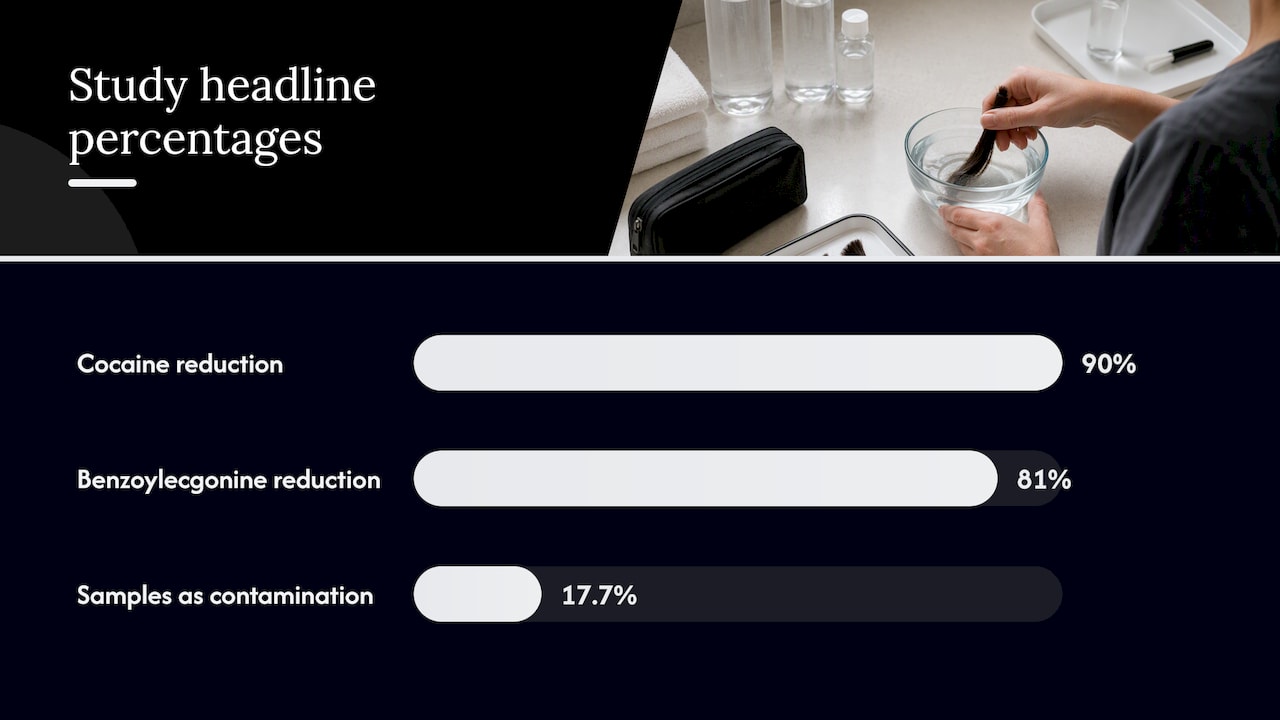
Controlled research gives a mixed picture. A 2023 study on homemade hair treatments found decreases of up to 90% for cocaine and 81% for benzoylecgonine in treated hair strands. Those numbers sound decisive, but the samples were lab-prepared or soaked strands in controlled conditions, not hair from someone who used cocaine over weeks or months. That distinction matters because cocaine incorporated through the bloodstream behaves differently from cocaine added to a strand for testing purposes, and the study’s authors themselves note limited transferability to real-world use.
Pro Tip: Treat any detox shampoo as surface support, not a substitute for time and abstinence: the biggest factor in a clean result is how long it has been since your last use, not which product you buy.
No shampoo or home method can be honestly marketed as a guaranteed pass, because a lowered surface concentration is not the same as full clearance of incorporated drug. Our shampoo comparison guide covers how different products are formulated and what a realistic outcome looks like.
What peer-reviewed studies and lab reports actually found
Three separate lines of evidence shape what toxicologists currently understand about cocaine hair testing and detox attempts.
The Wiley-published 2023 study measured how homemade and cosmetic treatments affect cocaine and benzoylecgonine levels in treated hair strands under controlled lab conditions. Separately, decontamination research published on PMC examined how multi-wash methanol protocols behave differently on contaminated versus incorporated cocaine, confirming that repeated washing removes recent surface residue far more effectively than internally incorporated drug. A large NIJ and RTI evaluation of concentration ratios found that roughly 17.7% of samples in its cohort were interpreted as predominantly contamination rather than use, and cautioned that decision-tree models can still misclassify heavily contaminated specimens as reflecting personal use.
| Evidence source | What it measured | Key finding |
|---|---|---|
| Wiley 2023 treatment study | Homemade treatments on prepared hair strands | large decreases of up to 90% for cocaine and 81% for benzoylecgonine in treated hair strands |
| PMC decontamination study | Multi-wash methanol protocols | Recent contamination washes out quickly; incorporated cocaine remains stable across washes |
| NIJ/RTI ratio evaluation | Analyte ratios across a large sample cohort | a notable share of samples interpreted as predominantly contamination |
Together, these findings point in the same direction: decontamination and cosmetic treatments can meaningfully change what a lab measures, but the underlying biology of incorporated drug is much harder to erase than surface residue.
Practical, lower-risk preparation steps that make sense
The single most reliable factor in a hair test outcome is time. Stopping cocaine use as early as possible gives new, uncontaminated hair the chance to grow in before a scheduled or expected test, and no product changes that basic biology.
Beyond timing, a few practical habits reduce risk and confusion:
- Keep a record of any cosmetic treatments, including bleaching, dyeing, or relaxing, along with dates and products used, in case a lab or MRO needs context for an unusual result.
- Use a detox shampoo as surface-cleaning support, not as a substitute for abstinence, since its realistic role is removing external residue rather than reversing incorporation.
- Avoid last-minute aggressive chemical experiments, especially in the day or two before a scheduled collection, since drastic treatments can damage hair structure or trigger an invalid or disputed sample flag.
- Disclose relevant exposure history if you have reason to believe you were around cocaine without using it yourself, since this documentation supports a contamination argument if it becomes necessary.
Pro Tip: If you plan to use a shampoo-based routine, start well before your test date rather than the night before: rushed, one-time treatments are far less effective than a consistent multi-day approach and are more likely to raise flags during lab review.
Our hair detox checklist walks through a fuller timeline for combining abstinence with sensible preparation.
If you test positive: how to request clarification, retest, or appeal
A positive result is not automatically the end of the process, and there are concrete steps worth taking before accepting it.
- Ask for the confirmatory testing method used, such as GC-MS or LC-MS/MS, and request whether metabolites like benzoylecgonine, cocaethylene, or norcocaine were measured alongside cocaine.
- Request wash-solution data or a wash-to-hair ratio, since this information helps determine whether the lab considered contamination as a possible explanation.
- Provide documented cosmetic and exposure history to the lab or Medical Review Officer, since treatments and environmental exposure can meaningfully affect interpretation.
- Request a split-sample retest or independent lab confirmation if the result is disputed, and involve occupational counsel or legal support if the test carries employment or legal consequences.
These steps do not guarantee a different outcome, but they ensure the result reflects a full review rather than a single number taken at face value.
A candid perspective on hair detox from years of questions and orders
People come to us hoping for a shortcut, and the honest answer is that there isn’t one that bypasses biology. The most common mistake we see is someone bleaching their hair the night before a test out of panic, which can damage the sample and draw more scrutiny, not less. Macujo Aloe Rid Shampoo is one of the most widely used tools for hair test preparation, and we stand behind it as a strong option within a realistic routine, but we have never framed it as a guarantee. Document your history, give yourself real time, and follow the process instead of trying to outrun it.
— MIchael
Where Macujo Aloe Rid Shampoo fits into your preparation
Macujo Aloe Rid Shampoo is a detox shampoo based on the principles behind the original Macujo method: an acidic formula intended to open the hair cuticle and lift surface residue through repeated, consistent washing. Customers typically use it daily in the days leading up to a scheduled test, pairing it with the broader Macujo routine rather than a single rinse.
It is positioned as support for a realistic preparation plan, not a replacement for time or a laboratory guarantee. Used consistently alongside abstinence and good documentation, it may offer an additional layer of control over what a lab finds on the surface of your hair.
- Formulated for daily use as part of a multi-day preparation routine.
- Designed to target surface buildup rather than claim to reverse incorporated drug.
- Available directly through our product page for Macujo Aloe Rid Shampoo, with ordering support from 9am to 12am daily and discreet, secure delivery.
If you want to see the full range of hair, saliva, and urine testing support we carry, visit our main product catalog to compare options and find what fits your timeline.
Sources
- Insights into the decontamination of cocaine-positive hair samples
- Hair analysis: Assessment of homemade hair treatment effects on drug concentrations in the keratin matrix
- Analysis of Cocaine Analytes in Human Hair: Evaluation of concentration ratios
- Summary of hydroxy cocaine and cocaine ratios in hair (SAMHSA meeting materials)
FAQ
How long can cocaine be detected in a hair test?
A standard 3 centimeter head hair segment typically reflects roughly a 90-day window, based on an average hair growth rate of about 1 centimeter per month. Body hair grows more slowly and unpredictably, which can extend detection beyond that window when head hair isn’t available.
Can you detox for a hair follicle test?
Detox shampoos and treatments can reduce surface-level cocaine residue on hair, but controlled decontamination research shows they do not reliably remove cocaine already incorporated through the bloodstream. The most dependable factor remains time since last use, with detox products serving as supportive surface cleaning rather than a guaranteed fix.
How to pass a hair follicle test in 2026?
There is no method that guarantees a negative result once cocaine has been incorporated into hair, so the most reliable approach combines early abstinence, documented cosmetic and exposure history, and consistent use of a detox shampoo like Macujo Aloe Rid Shampoo as surface support. Avoiding last-minute aggressive chemical treatments also reduces the risk of a damaged or disputed sample.
How can I detox my hair follicles?
Stopping cocaine use as early as possible is the most effective step, since new hair growth carries no incorporated drug from that point forward. Pairing that with a consistent detox shampoo routine and keeping records of any cosmetic treatments gives a lab clearer context if questions come up during review.
What happens if a hair test comes back positive?
You can request details on the confirmatory method used and ask whether the lab measured supporting metabolites like benzoylecgonine or cocaethylene alongside cocaine. Documented cosmetic history, a split-sample retest, or independent lab confirmation are all reasonable next steps if you believe the result needs further review.