

U.S. drug testing policy has never stood still, and 2026 marks one of its most active periods of change. The core story is this: federal mandates are holding firm while state laws are fracturing in every direction, technology is outpacing certification infrastructure, and social forces are reshaping who gets tested and why. Researchers, policymakers, and legal professionals tracking the policy evolution in drug testing need to understand all three layers simultaneously, because no single lens captures the full picture.
Key developments defining the current moment:
- Maine revised its drug testing law effective July 29, 2026, banning “arbitrary” testing and cutting the rehabilitation window from six months to 12 weeks
- Federal marijuana rescheduling to Schedule III will not change Department of Transportation (DOT) testing mandates for safety-sensitive roles
- Oral fluid testing, authorized by DOT in 2023, remains unavailable for compliance because no HHS-certified laboratories exist yet
- Fentanyl and norfentanyl were added to federal drug testing panels, reflecting the opioid crisis’s direct impact on regulatory priorities
- A 2025 Current Consulting Group survey found 29% of employers expect testing volumes to increase over the next 1–3 years, while 32% expect decreases, reflecting deep uncertainty fueled by changing marijuana legalization laws.
- The National Drug & Alcohol Screening Association (NDASA) reports growing employer openness to on-site rapid and oral fluid testing, signaling a structural shift in how screening is delivered
The result is a regulatory environment where a trucking company in Maine, a federal contractor in Virginia, and a private employer in Colorado all face meaningfully different legal obligations, even when testing for the same substances.
How did U.S. drug testing policies develop historically?
Drug testing as formal policy in the United States traces its origins to the military, not the workplace. The armed forces began systematic testing during the Vietnam War era after widespread heroin use among troops became a documented readiness problem. That experience planted the institutional logic that would later migrate into civilian life.
The civilian policy framework accelerated sharply in the 1980s. President Reagan’s Executive Order 12564, signed in 1986, established a drug-free federal workplace and directed all federal agencies to develop testing programs for employees in safety-sensitive positions. That single order set the template: define covered positions, specify testing occasions, and require consequences for positive results. Congress followed with the Drug-Free Workplace Act of 1988, which extended obligations to federal contractors and grantees.
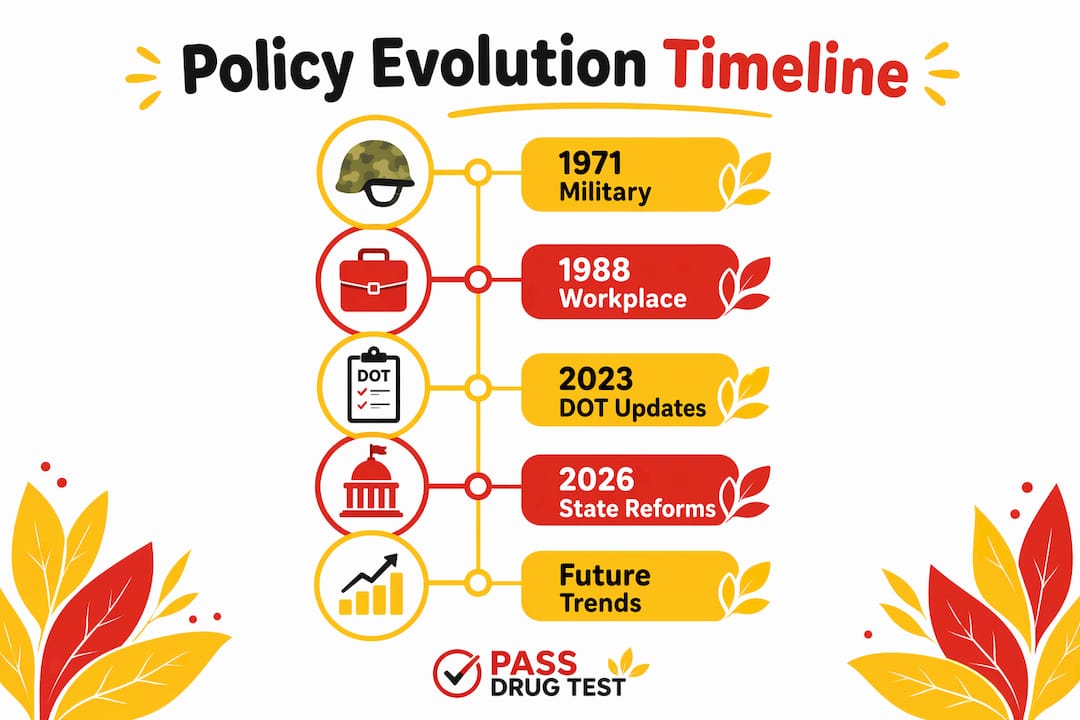
Key milestones in U.S. drug testing policy development:
- 1971: Nixon declares a “War on Drugs,” framing drug use as a national security and public health threat
- 1981–1982: Military branches implement mandatory urinalysis programs following documented drug use among active-duty personnel
- 1986: Executive Order 12564 mandates drug-free federal workplaces and authorizes testing for safety-sensitive civilian positions
- 1988: Drug-Free Workplace Act requires federal contractors receiving $100,000 or more in contracts to maintain drug-free workplace policies
- 1988: HHS publishes the first Mandatory Guidelines for Federal Workplace Drug Testing Programs (urine only), effective April 11, 1988
- 1991: Congress passes the Omnibus Transportation Employee Testing Act, requiring DOT agencies to implement drug and alcohol testing for safety-sensitive transportation employees
- 1994: SAMHSA’s National Laboratory Certification Program (NLCP) establishes quality standards for testing laboratories
- 2000s: Expansion of testing panels to include opioids such as oxycodone, oxymorphone, hydrocodone, and hydromorphone
- 2020: HHS authorizes oral fluid as a second specimen type for federal workplace drug testing programs, effective January 1, 2020
- 2023: DOT’s final rule (49 CFR Part 40) authorizes oral fluid testing as an additional methodology for DOT-regulated employers
| Era | Key Development | Primary Driver |
|---|---|---|
| 1971 | Military urinalysis programs | Vietnam-era drug use among troops |
| 1986–1988 | Federal executive orders and legislation | Reagan-era drug policy |
| 1991 | Omnibus Transportation Employee Testing Act | Congressional mandate for transportation safety |
| 1994–2000s | Lab certification and panel expansion | SAMHSA/HHS regulatory refinement |
| 2020–2026 | Oral fluid authorization, fentanyl panel additions | Technology and opioid crisis response |
The trajectory is consistent: each major drug epidemic or safety incident produced a legislative or regulatory response that expanded the scope, rigor, or reach of testing programs.
What federal laws and regulations shape drug testing policy today?
The federal framework for drug testing rests on several overlapping pillars, each administered by a different agency with distinct jurisdiction. Understanding which agency governs which context is the first step for any compliance analysis.
The Controlled Substances Act (CSA) establishes the scheduling system that determines which substances are subject to federal testing. The proposed rescheduling of marijuana from Schedule I to Schedule III is the most consequential pending change in this framework. Critically, marijuana rescheduling will not equate to federal legalization and will not alter DOT testing mandates for safety-sensitive transportation roles. Employers in federally regulated industries cannot treat rescheduling as permission to stop testing for cannabis.
The Department of Transportation (DOT) administers 49 CFR Part 40, the procedural backbone for all DOT-required drug and alcohol testing. The Federal Motor Carrier Safety Administration (FMCSA) applies these rules to commercial drivers; the FAA applies them to aviation employees; the FTA covers mass transit workers. Every DOT-regulated employer, regardless of transportation mode, follows Part 40 procedures for specimen collection, laboratory analysis, and Medical Review Officer (MRO) verification.
The Substance Abuse and Mental Health Services Administration (SAMHSA) publishes the Mandatory Guidelines for Federal Workplace Drug Testing Programs, which set the scientific and technical standards for testing all civilian Executive Branch employees. The urine guidelines became effective February 1, 2024; the oral fluid guidelines took effect October 10, 2023. Major 2024 changes included raising the morphine confirmatory test cutoff in urine from 2,000 ng/mL to 4,000 ng/mL and revising MRO reporting requirements.
Key federal regulatory developments as of 2026:
- Fentanyl added to federal panels: Revised federal standards now include fentanyl and norfentanyl in testing panels, a direct response to the opioid crisis
- Oral fluid authorized but not yet available: DOT’s 2023 final rule authorized oral fluid testing, but no HHS-certified oral fluid laboratories exist as of publication, requiring continued urine testing
- ADA compliance obligations: The Americans with Disabilities Act prohibits discrimination against recovering drug users who have sought treatment; alleged ADA violations account for nearly half of all lawsuits involving drug-free workplace programs, according to SAMHSA
- FMLA protections: The Family and Medical Leave Act requires covered employers to allow up to 12 weeks of unpaid leave for substance use disorder treatment, limiting how aggressively employers can respond to positive tests
- NLRA collective bargaining: Under the National Labor Relations Act, any drug testing program affecting unionized workers must be negotiated through collective bargaining, even when a federal mandate requires the program
The Drug-Free Workplace Act of 1988 remains the foundational statute for private-sector obligations, but it applies only to federal contractors and grantees above the threshold. Private employers outside that category operate under a patchwork of state laws and voluntary federal guidelines.
How are state-level drug testing policies changing in 2026?
State law is where the most dramatic changes in drug testing policy are happening right now. While federal mandates hold steady for regulated industries, states are rewriting the rules for everyone else, and the resulting variation creates real compliance complexity for multi-state employers.
Maine’s 2026 revision is the clearest example of this trend. The Maine revised drug testing law, effective July 29, 2026, makes two significant changes. First, it bans “arbitrary” testing, meaning employers can no longer test employees without a documented, criteria-based reason. Second, it shortens the rehabilitation window from six months to 12 weeks, giving employees who test positive a faster path back to work if they complete treatment. Both changes push Maine’s framework toward a more employee-protective model.
State-level policy variations across key dimensions:
- Testing timing: Some states restrict pre-employment testing to after a conditional job offer; others permit it at any point in the hiring process
- Substances covered: Several states with medical or recreational marijuana laws limit employer authority to test for cannabis or act on positive results
- Impairment vs. metabolite standards: A growing number of states are moving toward impairment-based standards rather than metabolite detection, recognizing that a positive THC result does not prove current impairment
- Rehabilitation windows: Maine’s reduction from six months to 12 weeks reflects a broader trend toward shorter, more defined return-to-work timelines
- Random testing restrictions: Some states prohibit random testing outside safety-sensitive roles, requiring reasonable suspicion as the trigger
| State Policy Dimension | Traditional Approach | Emerging Reform Approach |
|---|---|---|
| Testing trigger | Arbitrary or random | Criteria-based, documented suspicion |
| Cannabis results | Automatic disqualification | Impairment standard required |
| Rehabilitation window | Six months or longer | 12 weeks (Maine 2026) or shorter |
| Pre-employment timing | Any hiring stage | Post-conditional-offer only |
| Multi-state compliance | Single policy | Jurisdiction-specific policies |
Employers operating across multiple states increasingly need jurisdiction-specific testing policies rather than a single national template. The shift toward criteria-based testing requires detailed documentation to support every testing decision, raising the bar for HR and legal compliance teams. You can find a detailed breakdown of how these changes affect hair follicle test policies specifically, including state-by-state compliance approaches.

How do social and political forces shape drug testing policy?
Drug testing policy does not develop in a political vacuum. Academic research has traced direct connections between social attitudes, racial dynamics, and the specific forms that testing legislation takes, particularly in welfare and public assistance contexts.
Research published in State Politics and Policy Quarterly examined the diffusion of drug testing proposals for welfare programs across U.S. states from 2009 to 2018. The findings are pointed: higher estimates of state-level racial resentment increase the likelihood of proposing drug testing for welfare legislation. The analysis also found that opioid overdose deaths were negatively associated with proposal likelihood, while estimates of illicit drug use had the opposite effect. In other words, the political motivation for punitive testing policies correlates more with racial attitudes than with actual drug use data.
The disability rights dimension adds another layer. The ADA’s protections for recovering drug users create a legal floor that limits how aggressively employers can act on positive results. Courts have consistently held that singling out employees for testing based on physical symptoms that could indicate a disability, rather than documented behavioral evidence, exposes employers to discrimination claims. This legal pressure has pushed policy toward the documented-suspicion model that Maine’s 2026 law now codifies.
Public opinion shifts on marijuana have also driven legislative change at the state level. As recreational cannabis became legal in more states, the political cost of maintaining zero-tolerance workplace policies rose. Employers in legal cannabis states faced pressure from labor markets as well as legislatures, accelerating the move toward impairment-based standards. The broader reasons drug testing policies exist include safety, liability, and productivity concerns that remain legitimate even as the political climate around specific substances evolves.
What technological and industry trends are reshaping drug testing?
The technology side of drug testing is moving faster than the regulatory infrastructure can keep up with, and that gap is creating both opportunity and confusion for employers and testing providers.
Oral fluid testing is the most prominent example. DOT authorized it as an additional methodology in its may 2023 final rule, recognizing that HHS had determined oral fluid testing to be both scientifically accurate and forensically defensible. The problem is practical: for an employer to implement oral fluid testing under DOT rules, at least two HHS-certified oral fluid laboratories must exist. As of the publication of this article, no HHS-certified oral fluid laboratories have been certified, which means all directly observed collections must still use urine. DOT has proposed an interim rule to maintain urine testing until certification occurs, with an 18-month grace period once the second lab is certified.
Outside the DOT-regulated space, employers are moving faster. The NDASA employer survey documents increasing adoption of on-site rapid testing and oral fluid methodologies, driven by speed and convenience rather than regulatory mandate. On-site testing reduces the time between a testing decision and a result from days to minutes, which matters most in post-accident and reasonable suspicion scenarios.
Key technology and industry trends:
- Oral fluid testing: Faster collection, harder to adulterate, and better suited to detecting recent use than urine, but awaiting federal lab certification for DOT compliance
- Rapid on-site testing: Point-of-collection devices deliver preliminary results within minutes, enabling faster return-to-duty decisions
- Digital chain-of-custody: Electronic documentation systems reduce paperwork errors and create auditable records that support the documentation requirements of criteria-based testing policies
- Expanded panels: Federal panels now include fentanyl, norfentanyl, and synthetic opioids alongside traditional substances, requiring labs to maintain broader analytical capabilities
- Hair follicle testing: Used primarily in pre-employment and return-to-duty contexts, hair testing provides a longer detection window (up to 90 days) compared to urine or oral fluid
The certification bottleneck for oral fluid is a temporary constraint, not a permanent one. Once HHS certifies two laboratories, employers will have an 18-month window to transition, and the industry expects rapid adoption given the operational advantages oral fluid offers over urine collection.
What do 2025–2026 research and policy updates reveal?
The most current data and regulatory actions paint a picture of a field in genuine transition, not just incremental adjustment. Several developments from 2025 and 2026 stand out for researchers and policymakers tracking where the field is headed.
2025 Current Consulting Group survey findings:
The employer survey data from 2025 reveals a field divided on direction. With 29% of employers expecting testing volumes to increase and 32% expecting decreases over the next 1–3 years, there is no consensus trajectory. The primary driver of that uncertainty is changing marijuana legalization laws, which affect both the legal authority to test and the practical value of a positive cannabis result.
Federal regulatory actions in 2025–2026:
- DOT published a supplemental notice of proposed rulemaking (SNPRM) on October 1, 2025 (90 FR 47286), proposing terminology updates consistent with Executive Order 14168 and clarifying oral fluid collection procedures
- HHS published its annual authorized drug testing panel notification in March 2026, confirming no changes to current analytes, cutoffs, or report nomenclature from the july 7, 2025 effective panels
- The Drug Testing Advisory Board (DTAB), which had advised SAMHSA on drug testing activities and the National Laboratory Certification Program, was terminated effective March 31, 2025
- DOT’s May 2026 final rule formalized the interim requirement for directly observed urine collections where oral fluid is required but unavailable, with a sunset provision tied to HHS certification of a second oral fluid laboratory
Maine’s 2026 law: implications for employers:
- Employers must now document specific criteria before initiating any drug test
- The shortened 12-week rehabilitation window requires updated return-to-work policies and agreements
- “Arbitrary” testing, including some forms of random testing outside safety-sensitive roles, is now prohibited
- HR and legal teams need to audit existing testing policies for compliance before the july 29, 2026 effective date
Expert perspectives on marijuana rescheduling:
The pending rescheduling of marijuana to Schedule III generates more confusion than clarity for workplace testing. The key point, confirmed by federal regulatory analysis, is that rescheduling does not equal legalization and does not change DOT mandates. Safety-sensitive transportation employees remain subject to cannabis testing regardless of how the DEA reschedules the substance. For employers outside DOT jurisdiction, rescheduling may affect how they frame their policies, but it creates no new legal obligation to accommodate cannabis use. Understanding the full scope of federal hair test guidelines is particularly relevant for THC users in safety-sensitive roles navigating this uncertainty.
How does workplace drug testing differ from sports and education sectors?
Drug testing policy looks very different depending on the sector, and those differences reflect fundamentally different purposes, legal authorities, and enforcement mechanisms.
Workplace testing is primarily governed by a combination of federal mandates (for regulated industries), state law (for private employers), and employer discretion. The core rationale is safety and productivity. DOT-regulated employers have no choice about testing; private employers outside that framework have significant latitude. The consequences of a workplace drug test range from disqualification to termination to mandatory rehabilitation, depending on the employer’s policy and applicable state law.
Sports testing operates under a completely separate framework. Professional leagues like the NFL, NBA, and MLB administer their own testing programs through collective bargaining agreements with players’ unions. The World Anti-Doping Agency (WADA) governs Olympic and international competition, applying a strict liability standard that holds athletes responsible for any prohibited substance in their system regardless of intent. The substances prohibited in sports often differ from those tested in workplaces; performance-enhancing drugs like anabolic steroids and human growth hormone are central to sports testing but largely absent from workplace panels.
Education sector testing is the most legally constrained of the three. The Supreme Court addressed student drug testing in Vernonia School District v. Acton (1995) and Board of Education v. Earls (2002), permitting suspicionless testing for student athletes and students in extracurricular activities. However, random testing of the general student population remains constitutionally suspect. College athletes face NCAA testing programs that mirror aspects of the WADA framework, while K-12 testing is limited to the Supreme Court’s narrow carve-outs.
The practical implication for policymakers is that reforms in one sector rarely transfer directly to another. A state law banning arbitrary workplace testing has no effect on NCAA drug testing or DOT mandates. Each sector requires analysis on its own terms.
What privacy and ethical considerations shape drug testing policy?
Privacy and ethics sit at the center of every major drug testing policy debate, and the legal framework reflects genuine tension between employer interests and individual rights.
The Fourth Amendment’s protection against unreasonable searches applies directly to government employers. Public-sector drug testing programs must satisfy constitutional scrutiny, which courts have generally found they do when testing is tied to safety-sensitive positions or based on individualized suspicion. Private employers are not bound by the Fourth Amendment, but state constitutional provisions and statutes fill some of that gap in states with stronger privacy protections.
Informed consent and confidentiality are practical requirements in every testing context. Federal regulations under 49 CFR Part 40 impose strict limits on who can access drug test results and how that information can be used. Employers cannot share results with third parties without employee consent, and results cannot be used for purposes beyond the testing program’s stated scope. Violations of these confidentiality rules expose employers to significant liability.
The ethical dimension of testing for substances that are legal in some states but illegal federally, particularly cannabis, has become the defining tension in contemporary drug testing ethics. Testing someone for off-duty cannabis use in a legal state, where the use had no impact on job performance, raises questions about proportionality and relevance that courts and legislatures are actively working through. The trend toward impairment-based standards reflects a policy judgment that the relevant question is whether someone is impaired at work, not whether they used a substance days earlier.
Disability accommodations add further complexity. Employers who test must navigate ADA obligations carefully, particularly when a positive result involves a legally prescribed medication or a substance used as part of a documented treatment plan. The line between legitimate testing and disability discrimination is not always obvious, which is why ADA-related claims represent such a large share of drug testing litigation.
Where is drug testing policy headed, including substance legalization trends?
The trajectory of drug testing policy over the next five to ten years will be shaped by three converging forces: federal cannabis policy, technological maturation, and state-level legislative momentum.
Federal cannabis rescheduling is the most watched variable. If marijuana moves to Schedule III, it will not automatically change workplace testing obligations, but it will shift the political and legal context in ways that are hard to predict precisely. Employers in non-regulated industries may face increased pressure to justify cannabis testing, particularly for off-duty use. Medical marijuana accommodation claims will likely increase as the federal scheduling status becomes less of a bright-line defense for employers.
Oral fluid testing will become the dominant methodology for many employers once HHS certifies the required laboratories. Its advantages over urine, including shorter detection windows that better reflect recent use, reduced adulteration risk, and less invasive collection, align well with the direction policy is moving. The 18-month grace period after certification will give employers time to transition, but the industry expects rapid uptake.
Impairment-based standards will continue to spread at the state level. The challenge is that no reliable roadside or workplace test for cannabis impairment currently exists with the same legal defensibility as a blood alcohol content reading. Until that technology matures, impairment standards will remain aspirational in many jurisdictions, and metabolite-based testing will persist by default.
Fentanyl and synthetic opioids will remain a growth area for panel expansion. The federal addition of fentanyl and norfentanyl to testing panels reflects a broader recognition that the drug landscape is not static. As new synthetic substances emerge, regulatory panels will need to adapt faster than the traditional notice-and-comment rulemaking process typically allows.
For researchers tracking these trends, the measurement of drug policy evolution across jurisdictions is itself an active area of academic inquiry, with cross-country analyses providing comparative benchmarks for evaluating U.S. policy trajectories.
How does U.S. drug testing policy compare to international approaches?
The United States operates one of the most extensive and formalized drug testing systems in the world, but the international comparison reveals that the U.S. approach is not the only viable model and not universally adopted.
The United Kingdom permits workplace drug testing but does not mandate it for most industries. Employers must have contractual authority to test, and testing without consent can constitute a breach of employment contract. The UK’s approach is more consent-based and less prescriptive than the U.S. federal framework, with no equivalent to the DOT’s comprehensive procedural regulations.
Canada presents a particularly instructive contrast given its federal legalization of cannabis in 2018. Canadian courts have generally held that employers can test for cannabis impairment in safety-sensitive roles but cannot conduct random testing for cannabis in non-safety-sensitive positions. The legal framework emphasizes demonstrated impairment over metabolite detection, which is the direction several U.S. states are now moving.
The European Union takes a fragmented approach, with member states setting their own workplace testing rules. Germany, for example, has strict data protection requirements under the General Data Protection Regulation (GDPR) that constrain how employers can collect and process drug test results. France permits testing in safety-sensitive roles but requires works council consultation before implementing a testing program.
Australia has developed one of the more technically advanced workplace testing frameworks, particularly in the mining and resources sector, where oral fluid testing has been standard practice for years. Australian standards for oral fluid testing are more mature than U.S. federal standards, partly because the regulatory infrastructure developed without the certification bottleneck that has delayed U.S. oral fluid adoption.
The key takeaway from the international comparison is that the U.S. federal mandate model, while comprehensive, is not the only way to achieve safety goals. Countries that have moved toward impairment-based standards and consent-driven frameworks have done so without abandoning workplace safety, which strengthens the policy case for similar reforms in U.S. jurisdictions where the political will exists.
Key Takeaways
U.S. drug testing policy in 2026 is defined by federal stability, state-level fragmentation, and a technology gap that is temporarily holding back the next generation of testing methods.
| Point | Details |
|---|---|
| Federal mandates hold firm | DOT and SAMHSA rules remain unchanged for safety-sensitive roles despite marijuana rescheduling discussions. |
| Maine leads state reform | Maine’s july 2026 law bans arbitrary testing and cuts the rehabilitation window to 12 weeks. |
| Oral fluid testing is delayed | No HHS-certified oral fluid laboratories exist yet, requiring continued urine testing for DOT compliance. |
| Employer opinion is split | A 2025 survey found 29% of employers expect testing volumes to rise and 32% expect them to fall over the next 1–3 years. |
| Social factors drive welfare testing | Research shows state-level racial resentment, not drug use data, most strongly predicts welfare drug testing proposals. |