
A false positive drug test result can turn your life upside down in a matter of hours. You test positive for a substance you never used, and suddenly you are facing consequences at work, in court, or with a medical provider. Understanding the definition of false positive drug test results is the first step to protecting yourself. This article covers exactly what a false positive is, why it happens, which substances commonly trigger it, and the concrete steps you need to take if it happens to you.
Table of Contents
- Key takeaways
- Definition of false positive drug test results
- How false positive drug screening works
- Substances that cause false positive results
- Confirmatory testing and why it matters
- What to do if you get a false positive
- My perspective on what people get wrong about positive drug screens
- Protect yourself with the right tools and knowledge
- FAQ
Key takeaways
| Point | Details |
|---|---|
| False positive defined | A false positive means the test detects a drug you did not use, caused by cross-reactive substances. |
| Immunoassay limitation | Initial drug screens prioritize catching drug use over precision, making false positives a known risk. |
| Common triggers | Prescription medications, poppy seeds, and some over-the-counter drugs can all cause false positive results. |
| Confirmatory testing saves you | GC-MS or LC-MS testing is nearly 100% accurate and can clear a false positive result conclusively. |
| Disclose medications early | Telling the testing facility about your prescriptions before the test is the most effective preventive step. |
Definition of false positive drug test results
A false positive drug test occurs when a screening test incorrectly detects an illicit or prohibited substance in someone who has not consumed it. The false positive meaning, in plain terms, is that the test says “yes” when the honest answer is “no.” Your body produced a result that looks like drug use, but the actual cause is something else entirely.
This matters more than most people realize. A false positive is not a gray area or a borderline result. It is a technical error produced by the test itself, not by your behavior. Understanding this distinction gives you the foundation to respond effectively instead of panicking.
The false positive effect is that an initial positive result is not a diagnosis or a verdict. It is a signal requiring more investigation. Many people receive a false positive result and assume they have no options. They do. You have every right to challenge the result and request more accurate testing.
Pro Tip: If you receive a positive result on an initial drug screen, do not sign anything or make any formal statements until you understand whether confirmatory testing has been performed.
Why false positives are a recognized flaw, not a fluke
The testing system is built this way on purpose. Immunoassay drug screens prioritize sensitivity over specificity, which means they are designed to catch as many potential drug users as possible, even if that means flagging some innocent people. This design choice is deliberate. The assumption is that follow-up testing will sort out the real positives from the false ones.
The problem is that follow-up testing does not always happen automatically. In some employment or legal situations, the burden falls on you to request it.
How false positive drug screening works
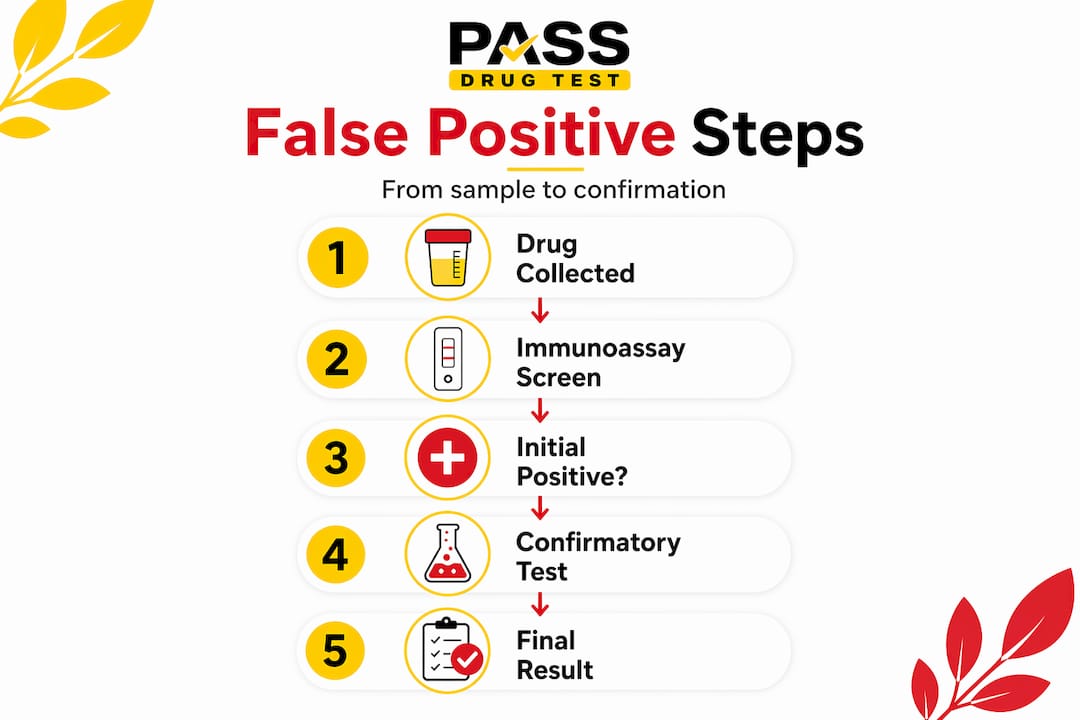
To understand how false positives occur, you need to know a little about immunoassay testing technology. This is the method used in virtually all initial drug screens, including urine panels and many rapid tests. Immunoassays use antibodies that are designed to react to specific drug molecules. When those antibodies detect something they recognize, the test flags a positive result.
The issue is cross-reactivity. The antibodies are not perfectly specific. They can react to substances that are chemically similar to the target drug, even if those substances are not drugs at all. A chemically similar substance triggering an antibody response is how most false positives happen in real life.
Here is what makes this especially relevant to you:
- Common prescription medications share molecular structures with controlled substances
- Certain foods contain compounds that mimic drug metabolites
- Legal supplements and over-the-counter products can trigger the same antibody response
- Even the timing of your last dose of a medication affects whether cross-reactivity occurs
An analytical true positive may still be clinically false positive if there is a valid, non-illicit explanation for the substance detected. This is a critical distinction in medical and legal contexts. The test detected something real. It just interpreted it incorrectly.
Pro Tip: Ask the testing facility or your employer whether the initial screen was an immunoassay. If it was, you have a strong basis for requesting GC-MS confirmatory testing, which reads to a completely different level of precision.
You can learn more about how different testing methods compare in accuracy and what that means for your result.
Substances that cause false positive results
This is where false positive drug test results become very personal, very fast. The causes of false positives are more common than most people expect, and you may be consuming one of these triggers without knowing it.
Prescription medications
| Medication | Drug it mimics | Notes |
|---|---|---|
| Sertraline (Zoloft) | Benzodiazepines or amphetamines | Common antidepressant, widely prescribed |
| Quetiapine (Seroquel) | Methadone or opiates | Antipsychotic with structural similarity |
| Rifampin | Opiates | Antibiotic used in tuberculosis treatment |
| Bupropion (Wellbutrin) | Amphetamines | Antidepressant and smoking cessation drug |
| Diphenhydramine (Benadryl) | PCP or opiates | Common over-the-counter allergy medication |
Medications like sertraline and quetiapine can lead to false positive results by mimicking opiates or other controlled substances in screens, sometimes for more than 18 hours after a single dose. This is not rare. These are medications millions of people take every day.
Foods and environmental exposures
Poppy seeds and secondhand marijuana smoke are two of the most well-documented dietary and environmental causes of false positive screening results.
- Poppy seeds contain trace amounts of morphine and codeine. A poppy seed bagel eaten the morning of your test can produce a positive opioid screen.
- Secondhand marijuana smoke, in enclosed spaces, can deposit enough THC metabolites to show up on a urine test in sensitive individuals.
- Hemp-based foods and CBD products can contain trace THC that cross-reacts on marijuana panels.
- Tonic water contains quinine, which has triggered false positives for opiates in some cases.
Pro Tip: Avoid poppy seed foods for at least 48 to 72 hours before any scheduled drug test. It is one of the simplest and most overlooked precautions.
Confirmatory testing and why it matters
When a false positive drug screening result comes back, the next step is confirmatory testing. This is where the science becomes decisively more accurate. You need to understand this process because it is your primary tool for clearing your name.
-
Request confirmation immediately. After receiving a positive result on an initial screen, ask whether a confirmatory test has been or will be ordered. In many regulated industries, this is required by law. In others, you may need to advocate for yourself.
-
Understand the method. GC-MS and LC-MS testing are the gold-standard methods for confirmation. GC-MS stands for gas chromatography-mass spectrometry. LC-MS stands for liquid chromatography-mass spectrometry. Both methods identify exact molecular structures, not just similar ones.
-
Know the accuracy level. Confirmatory tests like GC-MS or LC-MS are nearly 100% accurate because they detect precise molecular composition rather than antibody reactions. If your false positive was caused by a medication or food, confirmatory testing will clear it.
-
Understand the timeline. Confirmatory testing takes longer than initial screening, typically two to five business days. Plan accordingly, especially if an employer or court is waiting on results.
-
Document everything. Keep records of the initial result, your request for confirmation, and any communications with the testing facility, your employer, or legal representatives.
-
Know your rights. In federally regulated industries such as transportation, aviation, and federal contracting, confirmatory testing is mandatory before any adverse action can be taken. In non-regulated private employment, your rights vary by state and company policy.
Understanding drug test procedures thoroughly before you face a result puts you in a much stronger position.
What to do if you get a false positive
Receiving a false positive result is stressful, but your response in the hours after matters enormously. Here is how to handle it with clarity and confidence.
-
Disclose your medications before testing whenever possible. Proactive communication with testing facilities allows medical review officers to contextualize your results. A medical review officer is a licensed physician trained to interpret drug test results. They can recognize that a positive result is consistent with a disclosed prescription.
-
Stay calm and request confirmatory testing in writing. A verbal request is easy to ignore. A written request creates a paper trail.
-
Contact your prescribing physician. Ask your doctor to provide documentation of your prescription and dosage. This documentation can be submitted to the medical review officer or your employer.
-
Communicate with your employer through the right channel. Do not explain yourself informally to your manager. Speak with HR or the designated representative who handles testing compliance. Keep the conversation formal and documented.
-
Participate actively in shared decision making with your healthcare providers. Understanding your options and clarifying next steps with medical professionals reduces anxiety and prevents uninformed decisions.
-
Prepare for potential retesting. If the confirmatory test resolves the false positive, some employers may still require a clean follow-up test. Know this going in and plan for it.
The most common mistake people make after a false positive is staying silent. Speaking up, disclosing your medications, and requesting the right follow-up puts you in control of the situation.
My perspective on what people get wrong about positive drug screens
I have seen a lot of people in genuine distress over a positive drug test result, and most of them share the same misunderstanding. They treat the initial screen as a verdict. It is not. It is a preliminary flag, and by design, it is an imperfect one.
What I find consistently underappreciated is how common false positives actually are. People assume the test is infallible because it came from a lab or a certified facility. But immunoassay screens are built with high sensitivity as a deliberate design choice, meaning false positives are an accepted trade-off in the testing industry itself. The labs know this. The employers often do not explain it.
The other thing I see people overlook is the value of proactive disclosure. If you take a prescription medication, telling the testing facility before you test costs you nothing. Not telling them and getting a false positive that looks bad on paper costs you a great deal.
My advice: treat a positive screen the way you would treat a smoke alarm going off. Take it seriously, investigate it properly, and do not assume the building is on fire until you have confirmed evidence. Confirmatory testing exists precisely for this reason. Use it, demand it, and do not accept a life-altering consequence based on a screening test alone.
— Michael
Protect yourself with the right tools and knowledge
If you are concerned about an upcoming drug test and want to take every reasonable precaution, Passdrugtest has a full range of proven detox solutions designed for exactly this situation.
Whether you are preparing for a urine panel, a hair follicle test, or a full employment screen, having the right detox support in your corner makes a real difference. Passdrugtest carries detox products that support your body’s natural cleansing process, as well as specialized options like hair follicle shampoo for those facing hair-based testing. You can also explore whole body cleansing solutions for more thorough preparation. Knowledge is your first defense, and Passdrugtest is here to back it up with products that work.
FAQ
What is the definition of false positive drug test?
A false positive drug test occurs when a screening test incorrectly signals the presence of a drug you did not use. It is caused by cross-reactive substances like medications or foods triggering the test’s antibodies.
What are the most common causes of false positives?
Prescription medications like sertraline, quetiapine, and bupropion are among the most common causes, along with poppy seeds, CBD products, and some over-the-counter antihistamines.
Can confirmatory testing clear a false positive result?
Yes. GC-MS and LC-MS confirmatory tests are nearly 100% accurate and identify exact molecular structures, which clears false positives caused by cross-reactive substances.
Should I disclose my medications before a drug test?
Disclosing prescriptions to the testing facility before your test allows medical review officers to interpret your results correctly and can prevent a false positive from being reported as a true positive.
How long can a false positive-causing substance stay in your system?
It depends on the substance. Some medications can cause cross-reactivity for more than 18 hours after a single dose, while poppy seeds may affect an opioid test for up to a full day after consumption.