


Drug metabolites stay in hair because your bloodstream carries them directly into the hair follicle during active growth, where they become permanently locked inside the hair shaft through a process called keratinization. This is not a surface deposit you can wash away. It is a chemical record embedded in the structure of the hair itself. Understanding how drug metabolites bind to hair explains why hair follicle testing detects use over a far longer window than urine or saliva, and why preparation requires more than a standard shampoo. If you are facing a hair drug test, this science matters to you directly.
How drug metabolites enter and bind to hair follicles
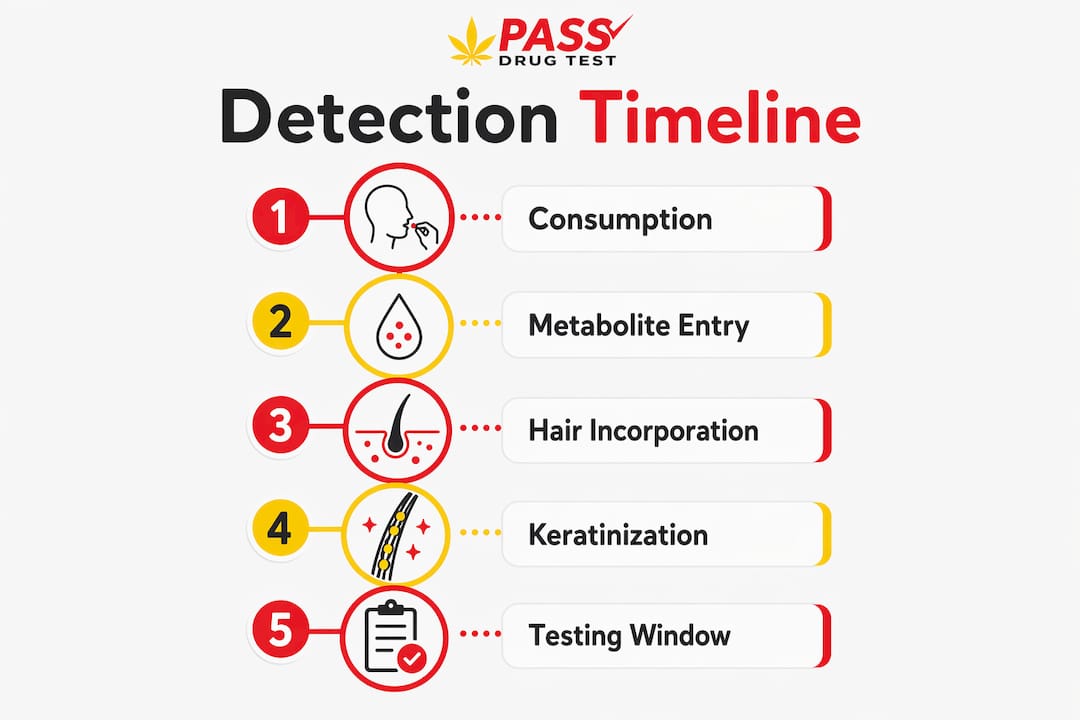
The biological mechanism behind drug metabolites in hair starts in your bloodstream. Every substance you consume gets metabolized by your liver and converted into metabolites, which then circulate through your blood. Hair follicles are richly supplied with tiny blood vessels, and during the active growth phase of the hair cycle (called the anagen phase), those metabolites move from the bloodstream into the follicular cells through passive diffusion.
Passive diffusion means the metabolites cross cell membranes without any active transport mechanism. Lipophilic compounds (those that dissolve in fat rather than water) and basic drug metabolites are particularly effective at crossing these membranes. Once inside the follicular cells, they encounter the melanin and keratin matrix that forms the hair shaft. Lipophilic metabolites bind strongly to melanin and keratin, which explains why certain compounds are detected at higher concentrations than others.
The keratinization process is what makes this record permanent. As the hair shaft hardens and grows outward from the follicle, the metabolites become physically trapped inside the cortex of the hair. Keratinization irreversibly stabilizes these compounds, creating a durable chemical timeline. Unlike urine or blood, where metabolites are flushed out over days, hair retains them for months.
Metabolites are actually more stable in hair than parent drug compounds. Parent drugs degrade faster in biological matrices, while metabolites like THC-COOH (the primary marijuana metabolite) are chemically stable and persist in the hair cortex long after the parent compound has cleared. This stability is precisely why laboratories prefer metabolite detection over parent drug detection for hair testing.
Pro Tip: The anagen (active growth) phase is when metabolites are most actively incorporated into hair. Approximately 85% of scalp hair is in this phase at any given time, which means most of your hair is actively recording drug exposure.
- Blood carries metabolites to hair follicle capillaries.
- Metabolites diffuse passively through follicular cell membranes.
- Lipophilic and basic compounds bind to melanin and keratin.
- Keratinization permanently locks metabolites inside the hair shaft.
- The hair grows outward, carrying a chemical record of exposure.
How long do drug metabolites stay in hair?
The standard hair drug test detection window is approximately 90 days. Laboratories collect a 1.5-inch segment of hair taken close to the scalp, which corresponds to roughly three months of growth based on average hair growth of 1 to 1.5 centimeters per month. This means the test does not just detect recent use. It maps a three-month history of drug exposure.
Research shows that metabolites can persist well beyond that 90-day window. A study on antihistamine metabolites found that metabolites remained detectable in hair up to 12 months after a single dose, though concentrations dropped by a median of 98 to 100% by 11 months. This means the signal weakens significantly over time but does not disappear entirely. For heavy or frequent users, the concentration embedded in hair is higher from the start, which extends the practical detection window.
Several factors influence how much metabolite ends up in your hair and how long it stays detectable:
- Hair pigmentation: Dark hair contains more melanin, and melanin binds metabolites more strongly than lighter hair. This means two people with identical drug use can show different concentration levels in a test based solely on hair color.
- Hair growth rate: Faster-growing hair dilutes metabolite concentration per segment. Slower growth concentrates it.
- Frequency and quantity of use: Higher and more frequent doses produce greater metabolite concentrations in the bloodstream, resulting in more metabolite embedded per centimeter of hair.
- Cosmetic treatments: Bleaching, dyeing, and chemical processing can reduce surface metabolite levels, but laboratories account for this in their analysis.
“Hair reflects substance use over approximately 90 days, versus urine which detects use over days and saliva which detects use over hours.” — Labcorp Hair Drug Testing
| Sample type | Typical detection window | Tamper resistance |
|---|---|---|
| Hair | Up to 90 days (standard); up to 12 months possible | High |
| Urine | 3 to 30 days depending on substance | Low to moderate |
| Blood | Hours to a few days | Moderate |
| Saliva | Hours to 2 days | Low |
Hair vs. other biological samples: why hair testing lasts longer
Detecting drugs through hair is fundamentally different from urine or saliva testing because of where the metabolites end up. In urine, metabolites are filtered out by the kidneys and excreted. In saliva, they are present only while the drug is actively circulating. In hair, they are deposited and locked in place permanently.
This structural difference gives hair testing a detection advantage that no other matrix can match. Hair provides a retrospective timeline of drug use that urine and saliva simply cannot replicate. A urine test taken 10 days after marijuana use may come back negative. A hair test taken the same day will still show that use clearly.
Hair testing also addresses a concern that affects urine and saliva testing: environmental contamination. Someone who was near cannabis smoke could theoretically have trace THC on their skin or in their saliva. Hair testing counters this by requiring the presence of THC-COOH for confirmation, with a threshold of 0.05 ng/mg. THC-COOH is a metabolite produced only through internal metabolism, not external contact. Its presence in hair is proof of systemic ingestion, not passive exposure.
Advanced laboratory techniques have made hair testing even more precise. LC-MS/MS (liquid chromatography with tandem mass spectrometry) now enables simultaneous detection of multiple metabolites in a single hair sample, including newer synthetic compounds and their analogues. This means labs are not just looking for one marker. They are building a full chemical profile from a strand of hair.
Common misconceptions about hair treatments and drug metabolites
The most widespread myth about hair drug testing is that washing your hair thoroughly, or using a clarifying shampoo, will remove the metabolites. This is not how hair structure works. Surface treatments cannot extract metabolites that are embedded inside the hair cortex. The cortex is protected by the cuticle, the outermost layer of the hair shaft, and standard shampoos do not penetrate deeply enough to reach or displace internalized compounds.
Dyeing and bleaching are also commonly believed to erase drug history. These processes do alter the hair’s surface chemistry and can reduce metabolite concentrations to some degree. However, embedded metabolites remain within the cortex despite cosmetic changes to the cuticle. Forensic laboratories are fully aware of this and adjust their analysis accordingly. A bleached sample does not fool a modern lab.
Understanding what actually works requires knowing what the science supports. The Macujo method, which uses a combination of specific cleansing agents designed to open the hair cuticle and reach deeper into the cortex, is the most discussed approach for meaningful preparation. It is not a surface wash. It is a multi-step process targeting the cortex layer where metabolites are stored.
Pro Tip: Laboratories test for metabolite markers, not just the presence of a substance. Even if a cosmetic treatment reduces concentration, the metabolite may still exceed the detection threshold. Preparation needs to address the cortex, not just the surface.
The key facts to hold onto are these:
- Standard shampoos clean the surface only and do not reach embedded metabolites.
- Bleaching and dyeing reduce but do not eliminate internal metabolite concentrations.
- Labs adjust for cosmetic treatment effects, so altered samples are not automatically dismissed.
- Preparation methods that target the hair cortex are the only ones worth considering.
Key takeaways
Drug metabolites are permanently embedded in the hair cortex through passive diffusion and keratinization, creating a detection window that standard washing or dyeing cannot erase.
| Point | Details |
|---|---|
| Metabolites enter via bloodstream | Passive diffusion from blood vessels in the follicle deposits metabolites during active hair growth. |
| Keratinization locks them in | The hardening of the hair shaft permanently traps metabolites inside the cortex. |
| Detection window is ~90 days | A 1.5-inch hair sample captures approximately three months of drug history. |
| Hair color affects concentration | Dark hair binds melanin-associated metabolites more strongly, producing higher detected levels. |
| Surface treatments are ineffective | Shampoos and dyes cannot remove cortex-embedded metabolites; labs account for cosmetic changes. |
What I’ve learned about hair testing that most people get wrong
I have spent years helping people understand what they are actually up against when facing a hair follicle drug test. The single biggest mistake I see is people treating this like a urine test. They drink water, they buy a detox drink, they shampoo their hair the night before. None of that addresses the real problem.
The science is clear: once a metabolite is locked into the hair cortex through keratinization, it is not going anywhere on its own. The 90-day window is not a guideline. It is a biological reality based on how fast your hair grows and how deeply those compounds are embedded. What frustrates me is how much misinformation circulates about quick fixes that have no basis in the actual chemistry of hair structure.
What I have found actually works is understanding the mechanism first, then choosing a preparation approach that targets the cortex specifically. The Macujo method exists because it was developed with this biology in mind. It is not magic. It is chemistry applied to the right layer of the hair. People who go in informed, who understand hair follicle drug retention and what it takes to address it, are the ones who give themselves a real chance.
My honest advice: do not waste time on surface-level solutions. Understand where the metabolites are, understand what can actually reach them, and act accordingly.
— Michael
Proven detox solutions from Passdrugtest
If you now understand how deeply drug metabolites are embedded in your hair, you also understand why the right product matters. Passdrugtest carries the Macujo Aloe Rid Shampoo, the flagship detox shampoo specifically formulated to penetrate the hair cuticle and reach the cortex where metabolites are stored. It is the most trusted product in its class for people preparing for a hair follicle drug test.

Generic clarifying shampoos are not built for this. The Macujo Aloe Rid Shampoo is. Explore the full range of hair detox shampoos at Passdrugtest, or browse the complete drug test detox products catalog to find the right solution for your situation. You now know what you are dealing with. The next step is choosing a product that matches the science.
FAQ
How do drug metabolites get into hair?
Drug metabolites enter hair through passive diffusion from the bloodstream into the hair follicle during the active growth phase. They then become permanently embedded in the hair cortex through keratinization.
How long do drug metabolites stay in hair after use?
The standard detection window is approximately 90 days, based on a 1.5-inch hair sample. Research shows metabolites can remain detectable for up to 12 months, though concentrations decrease significantly over time.
Does hair color affect drug test results?
Yes. Dark hair contains more melanin, which binds drug metabolites more strongly than lighter hair. This can result in higher detected concentrations in dark-haired individuals even with the same level of drug use.
Can bleaching or dyeing hair remove drug metabolites?
No. Bleaching and dyeing alter the hair’s surface but do not remove metabolites embedded in the cortex. Forensic laboratories adjust their analysis to account for cosmetic treatments, so altered samples are still tested accurately.
Why is hair testing more reliable than urine testing?
Hair testing captures approximately 90 days of drug history versus a few days for urine. Hair also requires the presence of internal metabolites like THC-COOH for confirmation, which eliminates false positives from environmental exposure.