


Facing a hair follicle drug test with your job offer or legal status on the line is one of the most stressful situations a THC user can encounter. Unlike urine tests, hair tests are harder to beat and far more unforgiving because THC metabolites lock into the hair shaft itself, not just your bloodstream. Hair follicle drug tests detect THC metabolites embedded in the hair shaft from the 1.5 inches closest to the scalp, representing roughly 90 days of history. This article gives you a clear, step-by-step path through preparation, proven detox methods, and how to verify your results before you ever walk into that lab.
Table of Contents
- How hair laboratory tests detect THC (and who is most at risk)
- Preparation: What you need before starting hair detox
- Step-by-step hair detox routines: What really works
- Troubleshooting and what to expect: Results, risks, and common mistakes
- What most guides miss about beating hair drug tests
- Essential next steps: Trusted products to maximize your odds
- Frequently asked questions
Key Takeaways
| Point | Details |
|---|---|
| Detection window | Hair laboratory tests can detect THC use up to 90 days prior to collection. |
| Best detox strategies | Shampoo-based routines and repeated application reduce THC levels but do not guarantee passing. |
| Bleach warning | Bleaching hair can reduce THC but may trigger sample rejection or alternative sampling. |
| Common mistakes | Critical errors include poor prep, insufficient repetitions, and unnatural hair alteration. |
| Risk factors | Chronic users and those with more melanin in hair are at higher risk of detection. |
How hair laboratory tests detect THC (and who is most at risk)
Now that you understand why a hair test is so high-stakes, it’s crucial to know how these tests really work and what puts you at greatest risk.
Hair drug testing does not look for THC itself. It targets a metabolite called THC-COOH, which your body produces after processing cannabis. When THC enters your bloodstream, those metabolites travel to the scalp and become permanently embedded in growing hair follicles. Because hair grows roughly half an inch per month, the standard 1.5-inch sample window covers approximately 90 days of your history, which is exactly why hair sample analysis is so different from any other drug test method.
What’s actually measured and how labs set their cutoffs
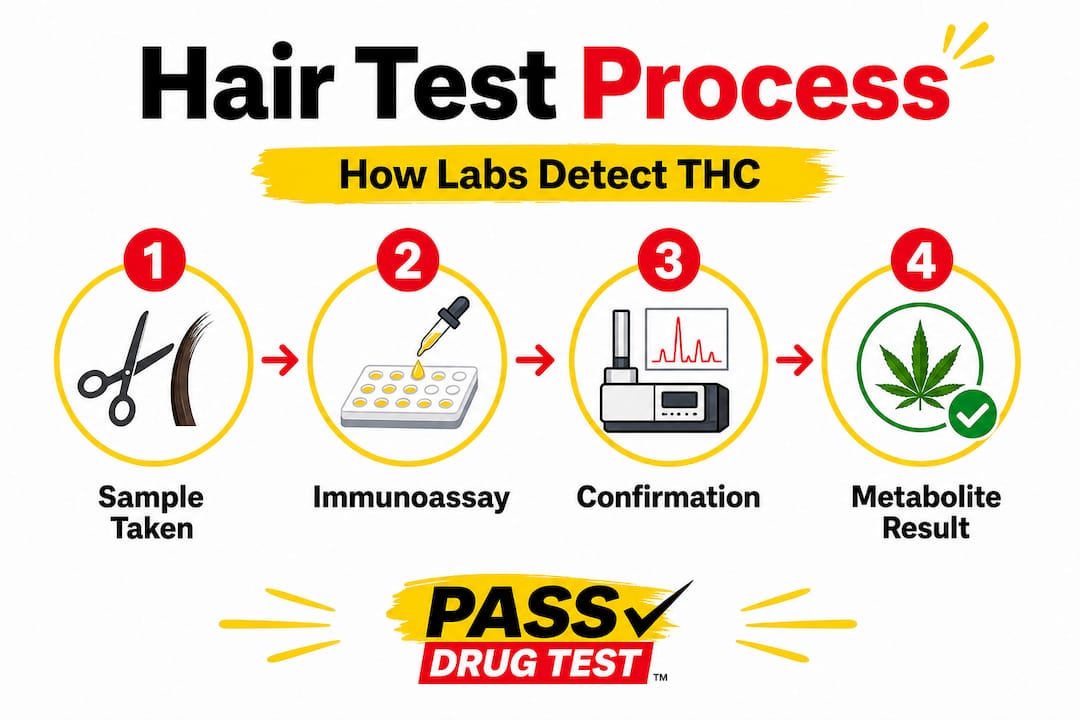
Labs use a two-step process. First, an immunoassay screening test flags any sample above the threshold. Then, a confirmation test using gas chromatography-mass spectrometry (GC-MS) verifies the result. The standard cutoffs for THC in hair tests are 1.0 pg/mg for screening and 0.1 pg/mg for confirmation, making these tests extremely sensitive.
Who faces the highest risk?
Not everyone carries the same risk level going into a hair test. Here are the key factors that determine your odds:
- Heavy or chronic users carry significantly more THC metabolites locked into each strand compared to casual users
- Infrequent users face lower risk because tests are less accurate for single or rare use and are most reliable for chronic patterns
- Individuals with higher melanin in their hair may bind more THC metabolites per strand, creating a biological disadvantage that has nothing to do with how much they use
- People with fine or light hair may retain fewer metabolites by comparison
| Usage pattern | Detection likelihood | Approximate metabolite concentration |
|---|---|---|
| Daily/heavy (90+ days) | Very high | Well above cutoff |
| Regular (3-4x/week) | High | Often above cutoff |
| Occasional (weekly) | Moderate | Near cutoff range |
| Rare (1-2 times) | Low | Often below cutoff |
| One-time use | Very low | Typically below cutoff |
Understanding where you fall in this table shapes exactly how aggressive your detox routine needs to be. Daily users need the most thorough approach, while occasional users may have more margin to work with.
Preparation: What you need before starting hair detox
Understanding how the test works leads straight to your next step: assembling everything needed to start detoxing your hair correctly.
Before you begin any detox routine, getting organized saves you time and dramatically improves your results. Scrambling for supplies mid-process or starting with incomplete materials is one of the most common reasons people fail. Think of this phase as setting yourself up for success before the real work begins.
Supplies you need to gather
- A proven detox shampoo designed specifically for drug metabolite removal (not regular clarifying shampoo)
- Salicylic acid treatment or acne wash containing at least 2% salicylic acid
- White vinegar for scalp opening
- A quality home hair drug test kit so you can verify your progress before the real appointment
- Clean gloves to protect your hands during chemical treatments
THC removal from hair is not a one-product process. It requires a coordinated approach using multiple treatments that open the hair cuticle, penetrate the cortex, and flush metabolites out at each layer.
Comparing your main product options
Empirical data shows that detox shampoos reduce THC by 36 to 73 percent in lab tests with repeated use, but results are not guaranteed to fall below lab cutoffs without a structured routine. That gap between 36 and 73 percent matters a lot, and it depends almost entirely on how you use the product. See the comparison below from our detox product comparison guide:
| Product/method | THC reduction estimate | Main risk | Best for |
|---|---|---|---|
| Specialized detox shampoo | 36-73% with repeated use | Low (if used correctly) | All user types |
| Macujo method (full routine) | Higher end of range | Scalp irritation | Chronic/heavy users |
| Bleaching/chemical color | 40-80% | Sample rejection, body hair test | Last resort only |
| Standard clarifying shampoo | Minimal | Wasted time | Not recommended |
| Vinegar alone | Minimal | Not effective alone | Not recommended alone |
Pro Tip: Plan for at least 5 to 10 days of repeated treatments before your test date. A single wash, no matter how powerful the shampoo, will not move the needle enough to matter for heavy users. More repetitions consistently produce better results.
Step-by-step hair detox routines: What really works
With supplies ready, it’s time to dive into precise routines that can actually reduce THC in your hair.
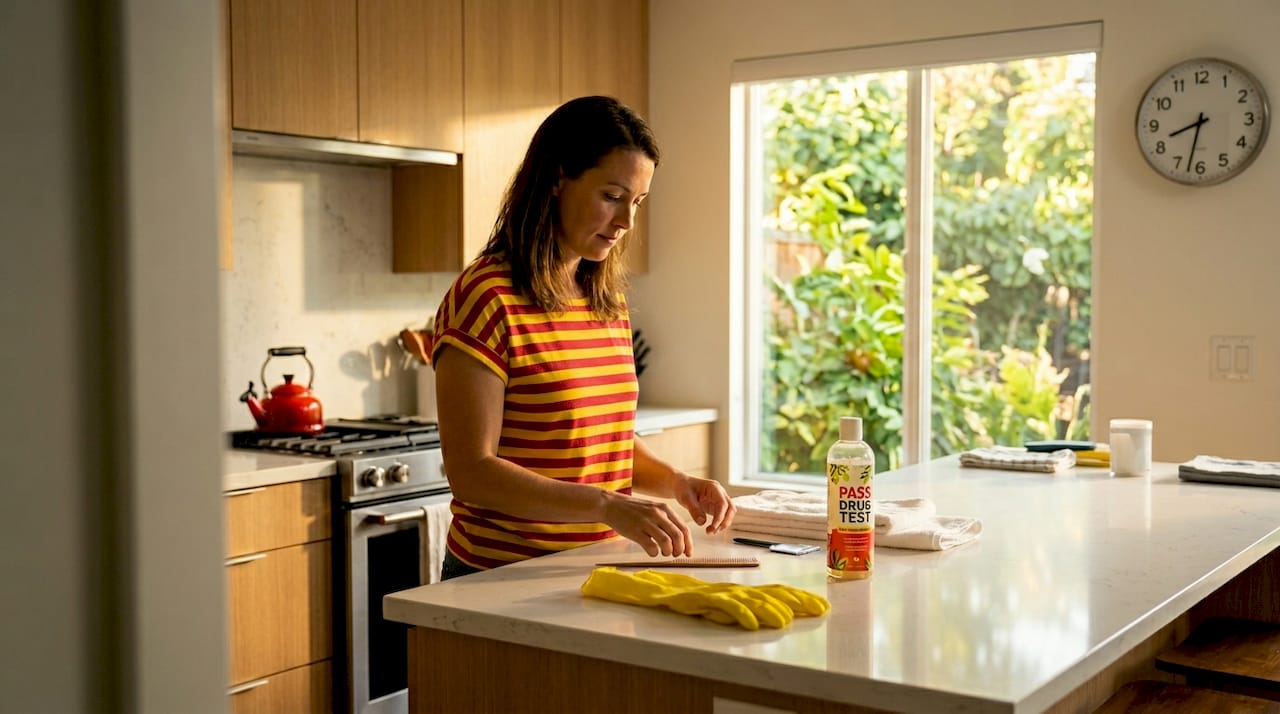
The most trusted and widely validated routine in the detox community is built around opening the hair cuticle, treating the cortex where metabolites live, and then using a quality detox shampoo to flush everything out. This is the foundation of the Macujo method routine, and it works by layering treatments that each target a different barrier within the hair strand.
Full step-by-step routine
- Stop all THC use immediately. Every day you continue using adds more metabolites.
- Wet your hair thoroughly with warm water. Do not use conditioner at any point during the detox period.
- Apply white vinegar directly to your hair and scalp. Work it in well, focusing on the roots, and leave it on for 15 to 20 minutes.
- Without rinsing the vinegar, apply a salicylic acid wash (acne wash, 2% or higher) on top of the vinegar. Leave both on for 30 minutes. Your scalp may tingle. This is expected.
- Rinse your hair thoroughly with warm water.
- Apply your dedicated detox shampoos according to the product instructions. For best results, use the shampoo twice in this step.
- Follow with a second round of the detox shampoo and rinse fully.
- Allow your hair to air dry when possible and avoid any product styling treatments during the detox period.
Repeat this full process at least once daily for 5 to 10 days before your test, and perform a final session the morning of your test.
Critical safety warning: If you are considering bleaching your hair as part of your detox plan, understand the real risks first. Hair treatments like bleaching do reduce THC levels by 40 to 80 percent, but they can also trigger sample rejection by the lab or cause the collector to take body hair instead, which may carry its own metabolite load. Bleaching should only be considered as a last resort and never as your sole strategy.
Pro Tip: Use a home test kit two days before your scheduled lab appointment. If you test negative at home, that’s an encouraging sign. If you test positive, you still have time to run one or two additional treatment sessions before the real test.
Methods to avoid
Some common ideas circulating online are ineffective or actively harmful to your test outcome. Shaving your head will not help. Labs will simply collect body hair, which can carry even longer detection windows than scalp hair. Drinking large amounts of water does nothing for hair tests since metabolites are locked into the shaft, not dissolved in fluids. Regular drugstore shampoos, even “deep cleansing” varieties, are not formulated to penetrate the cortex and will not produce meaningful results.
Troubleshooting and what to expect: Results, risks, and common mistakes
After you’ve finished your routine, it’s essential to know what to expect, how to gauge success, and avoid common errors that can undermine your efforts.
Even people who follow the routine make mistakes that cost them results. The most damaging errors are timing mistakes and inconsistency. Starting treatment only two or three days before the test rarely provides enough treatment cycles to reach meaningful THC reduction, especially for heavy users. You need time, and realistic detox timelines show that consistent, repeated application over 7 to 10 days is the minimum baseline for chronic users.
Common mistakes that lead to failure
- Skipping treatment days or not completing the full cycle
- Using conditioner or styling products during the detox period, which can seal the hair cuticle and block treatments
- Cutting hair too short before the test, which may force the lab to collect body hair instead
- Using only one type of treatment instead of the full multi-step approach
- Waiting until the last 48 hours to begin
Triggering lab suspicion: What to watch for
Labs and collectors are trained to spot unusual hair samples. If your hair looks severely damaged, overly processed, or unusually brittle, the collector may note this and the lab may flag it. Severely bleached or chemically altered hair raises questions about tampering. Bleaching risks include sample rejection outright or a request for body hair collection.
The racial disparity issue is also real and worth understanding. Because melanin levels affect how much THC metabolite binds to hair, individuals with darker hair may need more treatment sessions to reach the same reduction levels as those with lighter hair.
| Mistake | Likely outcome | Prevention |
|---|---|---|
| Starting too late (less than 5 days out) | Insufficient reduction | Start immediately upon notice |
| Using conditioner between treatments | Blocks cuticle opening | Avoid all conditioners during detox |
| Cutting hair very short | Body hair collected instead | Keep at least 1.5 inches of scalp hair |
| Bleaching as primary method | Sample rejected or body hair tested | Use bleaching only as last-resort supplement |
| Single application only | Minimal THC reduction | Repeat daily for 5 to 10 days |
| Continuing THC use during detox | Continuous new metabolite deposits | Stop all use on day one |
What most guides miss about beating hair drug tests
Most articles on this topic end with a confident checklist and a product link. That’s not the whole story. The honest reality is that no detox method carries a true guarantee, and people who walk into a lab overconfident often get the hardest lessons.
The 36 to 73 percent reduction range matters more than most guides acknowledge. If you’re a heavy daily user with a very high baseline concentration of metabolites in your hair, even a 73 percent reduction may still leave you above the lab’s confirmation cutoff of 0.1 pg/mg. That is not a product failure. That’s math. Understanding your starting point matters.
What also gets overlooked is that most product failures are timing failures. People start too late, do too few sessions, or use the product incorrectly. These aren’t cases where the method doesn’t work. They’re cases where the method wasn’t applied correctly or consistently. The product does its job when you do yours.
Here is something even fewer guides mention: there are situations where a hair detox routine simply isn’t worth the effort. If your test is less than four days away and you’ve been a heavy daily user for months, the math is not in your favor regardless of what you use. In that situation, exploring other detox methods alongside hair treatment or having a candid conversation with a legal advisor or medical professional may produce better outcomes than throwing money at products that don’t have enough time to work.
The uncomfortable truth about body hair is also worth addressing directly. If you shave your head thinking you’ve outsmarted the process, the lab will collect underarm, leg, or chest hair. Body hair grows much more slowly and can represent a detection window of up to 12 months, not 90 days. This is one situation where trying to dodge the test actually makes things significantly worse.
Our advice: be realistic, be consistent, and start as early as possible. The method works best for people who respect the process and give it enough time to deliver results.
Essential next steps: Trusted products to maximize your odds
If you’re ready to take control, these resources and products can help stack the odds in your favor.
You’ve now seen exactly how hair tests work, what puts you at risk, and which routines produce real, measurable reductions in THC metabolite levels. The next step is making sure you have the right products to execute properly. Not all detox shampoos are created equal, and using an under-powered or unproven product when your employment or legal status is on the line is a risk you don’t need to take.
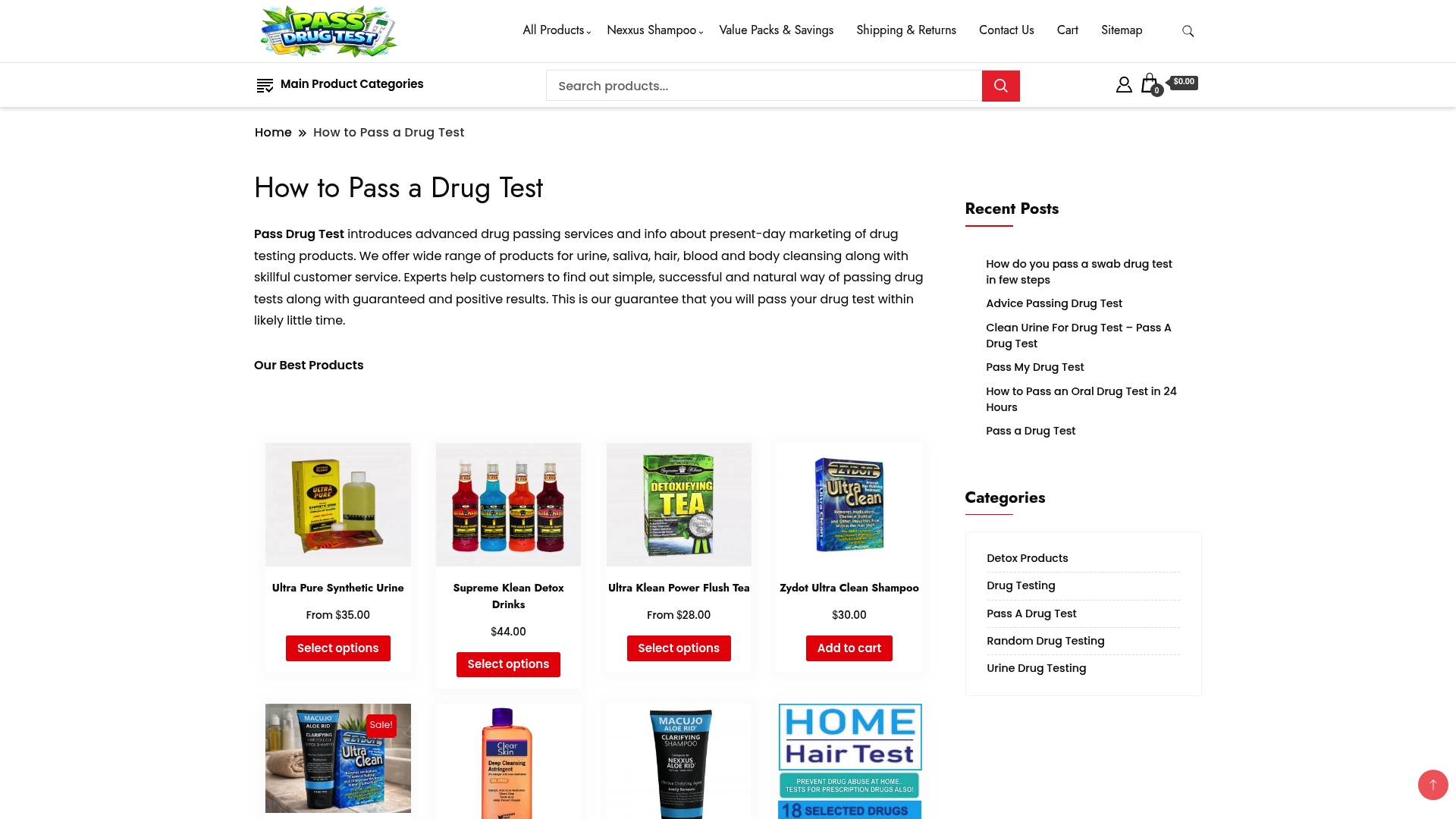
Our hair follicle drug test solutions page brings together everything you need in one place, including our flagship Macujo Aloe Rid Shampoo, which is specifically formulated to penetrate the hair cortex and target embedded drug metabolites. It’s the most trusted product in its class for a reason: it’s built for this exact situation, not repurposed from a standard salon formula. Whether you have seven days or fourteen, starting with the right product gives every treatment session the best possible chance to count.
Frequently asked questions
How long does THC stay detectable in hair for a drug test?
THC can be detected in the 1.5 inches of hair closest to the scalp, representing about 90 days of use history.
Do detox shampoos guarantee a negative result on a hair test?
No. Detox shampoos reduce THC by 36 to 73 percent with repeated use, but results cannot be guaranteed to fall below lab cutoffs, especially for heavy users.
What happens if I bleach or dye my hair before a test?
Bleaching lowers THC levels by 40 to 80 percent but risks having your sample rejected or forcing the lab to collect body hair, which has a much longer detection window.
Is it easier to pass a hair test as an occasional THC user?
Yes. Hair tests are less reliable for single or infrequent use and are most accurate for detecting chronic, regular patterns of consumption.
Are some people at higher risk of a positive hair test because of genetics?
Yes. Individuals with more melanin in their hair may retain more THC metabolites per strand, which can increase the likelihood of a positive result independent of usage frequency.