

If you have a hair drug test coming up, you have probably heard the term “initial screen” and wondered what it actually means for you. Understanding what is an initial screen in hair testing could be the difference between panic and preparation. The initial screen is not a final verdict. It is a rapid, sensitive filter designed to flag specimens that may contain drug metabolites. If the screen comes back negative, the process ends there. If it does not, a second, more precise test follows. Knowing this process puts you in control.
Table of Contents
- Key Takeaways
- What is an initial screen in hair testing: the full process
- What the initial screen detects and why cut-off levels matter
- What happens if the initial screen is non-negative
- Practical advice and pitfalls to avoid
- My honest take on what test-takers get wrong
- Prepare with the right tools from Passdrugtest
- FAQ
Key Takeaways
| Point | Details |
|---|---|
| Initial screen is not final | The hair drug test initial screening is a preliminary filter, not a confirmed result. |
| ELISA method is used | Initial screens use an immunoassay to detect drug metabolites rapidly in collected hair. |
| Cut-off levels matter | Specific thresholds prevent environmental exposure from triggering a false positive result. |
| Confirmation testing follows | Non-negative screens proceed to GC-MS or LC/MS/MS testing for forensic-level accuracy. |
| Preparation makes a difference | Understanding the initial hair test procedure helps you take meaningful steps before your test. |
What is an initial screen in hair testing: the full process
The initial screen in a hair drug test is a structured, multi-step procedure. Understanding each stage removes the mystery and helps you know exactly what happens to your sample from the moment it leaves your head.
Step 1: Sample collection
A trained collector cuts hair as close to the scalp as possible, typically from the crown of your head. 100 to 120 strands are gathered, representing roughly 1.5 inches of hair growth. That 1.5 inches corresponds to approximately 90 days of your history, which is why hair tests detect substances used over the prior 90 days rather than just recent use.
Step 2: Decontamination wash
Before any analysis begins, the lab puts your sample through a mandatory decontamination wash using organic solvents and buffered solutions. This step is designed to strip away external contaminants like secondhand smoke residue, sweat, and environmental oils without disturbing drug metabolites that have been incorporated into the hair shaft itself. It is an important safeguard against false positives caused by passive exposure, and you can read more about how environmental factors affect results in hair testing.
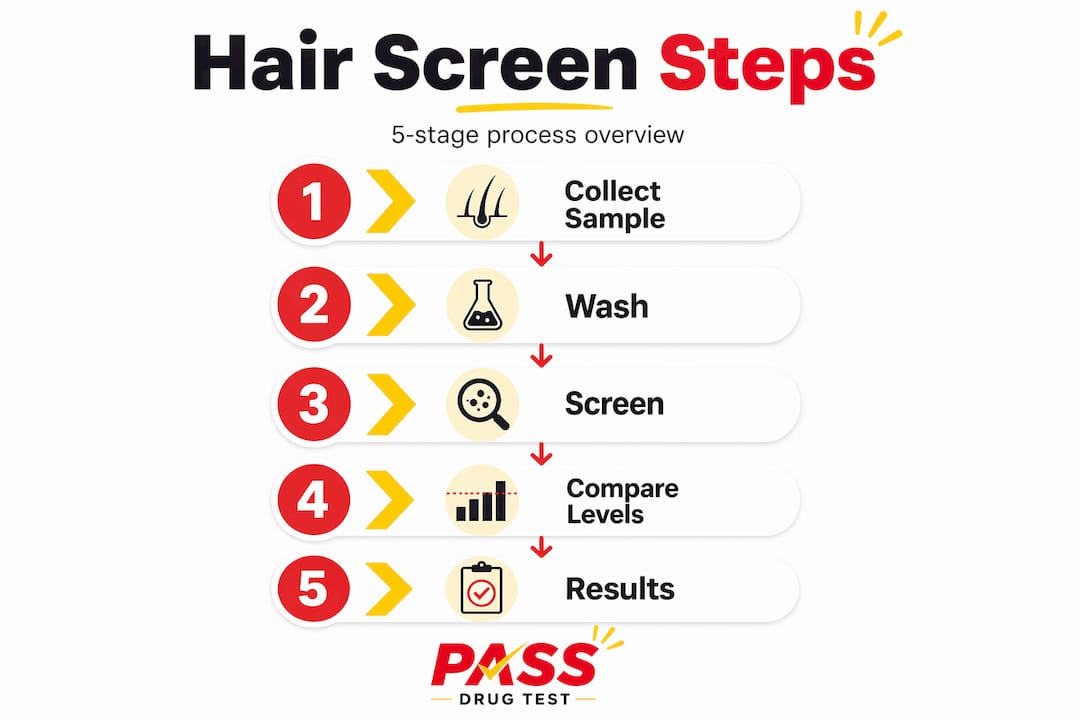
Step 3: ELISA immunoassay screening
Once the sample is prepared, the lab runs an enzyme-linked immunosorbent assay, commonly called ELISA. This method uses antibodies to detect drug molecules rapidly and with high sensitivity. Think of ELISA as a precise biological detector. It does not identify a drug with 100% certainty, but it flags anything that looks suspicious with speed and accuracy.
Step 4: Comparison against cut-off levels
Every substance has a specific concentration threshold. If the detected level falls below that threshold, the result is negative and testing stops. If it meets or exceeds the threshold, the result is labeled non-negative and moves to the next stage.
Step 5: Results timeline
A negative screen concludes within 2 to 3 days. If the sample is non-negative, confirmation testing adds another 3 to 5 days to the process.

Pro Tip: If you are waiting on results and the timeline stretches past five business days, it often signals that your sample moved to confirmation testing. This does not mean you have a confirmed positive. It means the lab is doing its job thoroughly.
What the initial screen detects and why cut-off levels matter
The initial screen targets a specific panel of drug metabolites that reflect what your body processed, not just surface contact. Here are the most common substances detected and their standard cut-off thresholds:
| Substance | Screening Cut-Off Level |
|---|---|
| Cocaine | ~500 pg/mg |
| Methamphetamine | ~500 pg/mg |
| THC (marijuana) | ~1.0 pg/mg |
| Opiates | ~200 pg/mg |
| Phencyclidine (PCP) | ~300 pg/mg |
The dramatic difference between THC and cocaine cut-offs is intentional. THC is lipophilic, meaning it binds to fatty tissue and can be deposited in hair through touch, smoke, and oils at very low concentrations. A THC cut-off as low as 1.0 pg/mg exists specifically to avoid flagging someone for passive environmental exposure while still catching meaningful use.
Here is why cut-off levels matter for you specifically:
- A result below the cut-off is reported as negative, even if trace amounts are technically present.
- A result at or above the cut-off moves to confirmation, where the forensic standard applies.
- Results that fall close to the threshold are the most ambiguous. This is why requesting numeric concentration results in pg/mg gives you far more information than a simple positive or negative label.
- Environmental exposure to secondhand marijuana smoke, for example, is extremely unlikely to push THC levels above the 1.0 pg/mg cut-off under normal conditions.
Understanding THC cut-off levels in hair testing is particularly relevant if marijuana is your primary concern. The threshold is set low enough to catch real use, but the decontamination wash and the confirmation process provide important layers of protection against unfair results.
What happens if the initial screen is non-negative
A non-negative result from the initial screen does not mean you have a confirmed positive on record. Many people do not realize this, and the confusion causes unnecessary panic.
Here is what actually happens next:
- The sample is relabeled as “presumptive positive” and sent for confirmatory analysis.
- Laboratories use gas chromatography-mass spectrometry (GC-MS) or liquid chromatography-tandem mass spectrometry (LC/MS/MS) for confirmation. These methods are far more specific than ELISA and carry forensic-level accuracy.
- Confirmation testing takes an additional 3 to 5 business days beyond the initial screen.
- Only after the confirmatory test returns a positive result does a Medical Review Officer (MRO) report a verified positive to the requesting organization.
- If the initial screen is negative, the process ends immediately and a negative result is reported.
The distinction between a presumptive positive and a confirmed positive is legally and professionally significant. Courts, employers, and licensing boards rely on confirmed results, not screening results. A single ELISA screen alone never produces a final, reportable result according to professional testing standards.
Pro Tip: If you receive notice that your result is under review or pending additional testing, ask specifically whether the sample is in confirmatory testing. You have a right to that information, and understanding where you are in the process helps you prepare your next steps.
Practical advice and pitfalls to avoid
Knowing the importance of initial screening in hair tests is one thing. Knowing how to navigate the process without making costly mistakes is another.
- Do not shave your head right before the test. Attempting to evade collection by shaving shortly before testing raises an immediate red flag. Collectors are trained to document this. In many testing protocols, an inability to collect a hair sample is treated as a refusal, which carries the same consequence as a positive result.
- Be transparent about prescription medications. Some prescription drugs share molecular structures with controlled substances. Disclosing your medications to the MRO before results are finalized gives you the opportunity to provide documentation that explains any flagged substances.
- Do not assume external contact will protect you. The decontamination wash removes surface contamination, but it will not remove metabolites that were incorporated into the hair shaft from your bloodstream. External exposure arguments have very limited success at the confirmation stage.
- Understand your privacy rights. Hair drug test results are handled with confidentiality protocols. Your results should not be shared beyond the requesting party without your consent. Learn more about protecting your privacy in the context of hair drug testing.
- Start preparation early. Hair grows approximately half an inch per month. The substances in your hair today represent use from weeks or months ago. The sooner you begin a structured preparation approach, the more options you have before your test date.
My honest take on what test-takers get wrong
I have spent years watching people approach hair drug tests with the wrong information. The single most damaging mistake I see is treating the initial screen result as though it were final. It is not. It is a filter, not a verdict.
What I have learned is that most stress around hair testing comes from a lack of clear information. People hear “non-negative” and assume the worst. In reality, that result simply means the lab has more work to do. The confirmation process is where accuracy happens, and it takes time for a reason.
My honest advice: focus on what you can actually control. Understand your detection window and take preparation seriously rather than hoping the results work in your favor without any action on your part. And if you receive a result you do not understand, request the numeric concentration figures. A number tells you far more than a label does.
People who know the process tend to make better decisions before and after their test. That is not a coincidence.
— Michael
Prepare with the right tools from Passdrugtest
Understanding the process is the first step. Taking action is the second.
At Passdrugtest, we have built our product line around one goal: giving you the best possible chance of a clean result on your hair drug test. Our flagship Macujo Aloe Rid shampoo is proven and trusted by thousands of users preparing for hair follicle testing. It works by targeting the inner cortex of the hair shaft where drug metabolites are stored. You can also browse our full range of hair follicle detox products to find the right solution for your situation. If marijuana is your primary concern, our dedicated marijuana hair test page walks you through exactly what detection looks like and what to do about it.
FAQ
What does the initial screen in a hair drug test actually test for?
The initial hair drug test screening uses an ELISA immunoassay to detect drug metabolites from substances including cocaine, methamphetamine, THC, opiates, and PCP. Each substance has a specific cut-off threshold that must be met or exceeded before the result is flagged as non-negative.
How long does the initial screening phase take?
A negative initial screen is typically reported within 2 to 3 days. If the screen is non-negative and moves to confirmation testing using GC-MS or LC/MS/MS, the full process takes an additional 3 to 5 business days.
Does a non-negative initial screen mean I failed my hair drug test?
No. A non-negative result from the initial screen is presumptive only. It must be confirmed by a second, more precise test before any official positive result is reported. The confirmation step exists to prevent false positives and meet forensic-level accuracy standards.
Can secondhand smoke cause a positive initial screen result?
The decontamination wash that labs perform before screening is specifically designed to remove external contaminants like secondhand smoke residue. While trace amounts may appear after washing, the cut-off levels for substances like THC are set to distinguish metabolized drug use from passive environmental exposure.
Can I request the actual concentration numbers from my hair test?
Yes. Requesting your results in numeric pg/mg values rather than a simple positive or negative label gives you far more transparency, especially if your levels fall near the cut-off threshold. This information helps you and your advisor understand the full picture of your result.