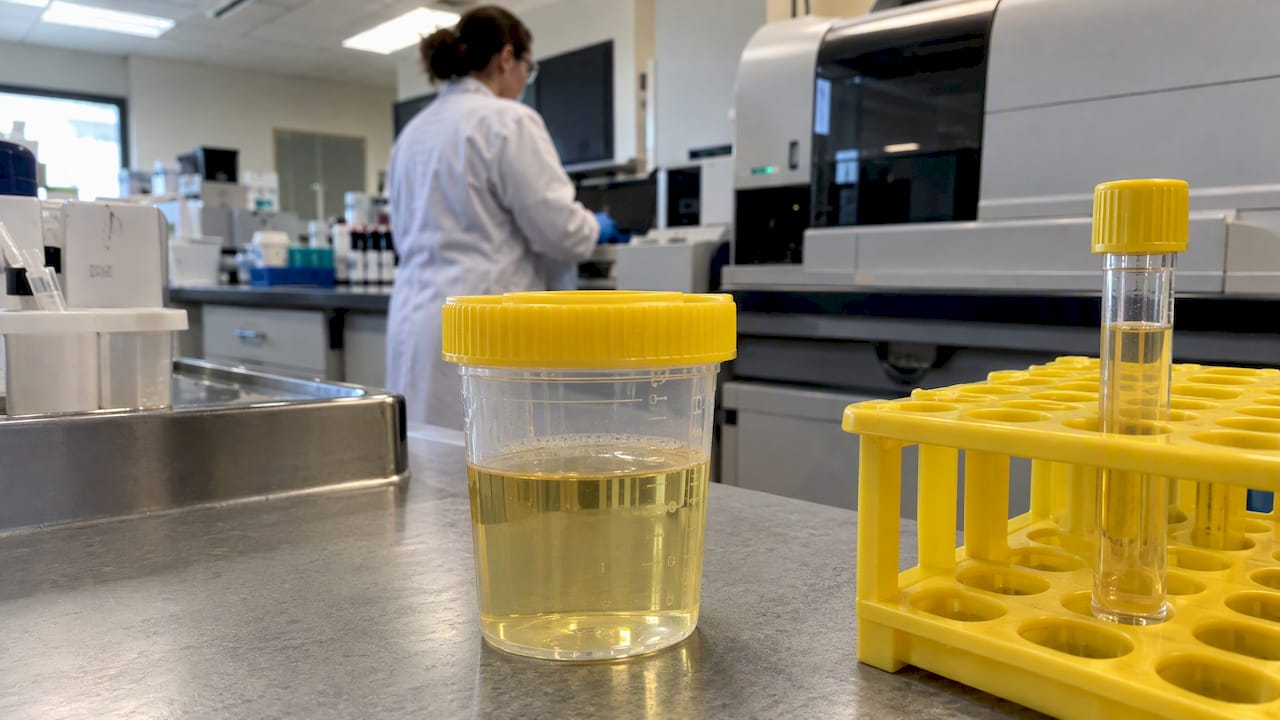

Yes, a vitamin B test can be run on urine. According to MedlinePlus, it can measure the amount of one or more B vitamins in a urine sample. Most people who search this phrase fall into one of two groups: those wondering whether their B levels can be checked at home or at a lab, and those who noticed bright yellow urine after taking a supplement and now wonder how that affects a urine drug test. This guide covers both, in plain terms.
TL;DR
- A vitamin B urine test can measure one or more B vitamins, and a random or 24-hour urine collection needs no special preparation, while some blood tests may require fasting.
- Bright yellow urine after a B-complex is usually extra riboflavin (B2) leaving your body through the kidneys.
- Riboflavin is not an adulterant, but historical research shows high doses can interfere with certain older drug-screening assays.
- Labs judge a urine specimen on creatinine, specific gravity, pH and oxidizers, not only on its color.
- Ask a clinician about B-vitamin testing if you have symptoms such as fatigue, tingling or numbness in your hands and feet.
Table of Contents
- Is there a urine test for vitamin B levels?
- Why vitamin B turns urine bright yellow
- Is a daily B-complex safe?
- Can vitamin B affect a urine drug test?
- How to prepare a urine sample the right way
- Where hair and saliva tests fit in
- Perspective
- Our urine testing options
- FAQ
- Sources
Is there a urine test for vitamin B levels?
There is. A vitamin B test measures how much of a particular B vitamin is in your body, and MedlinePlus lists urine as one of the samples that can be used. The family is larger than most people think: B1 (thiamine), B2 (riboflavin), B3 (niacin), B5, B6, B7 (biotin), B9 (folate) and B12 (cobalamin). A provider chooses which of them to measure based on your symptoms and history.
The result depends on what the lab is looking for. A blood draw is the most common route for B12 and folate, which is why many of the pages that rank for this topic describe blood tests. Urine testing exists alongside it and is used for certain vitamins and related markers.
Urine versus blood: how they differ
| Urine sample | Blood sample | |
|---|---|---|
| What it shows | Amount of one or more B vitamins in the sample | Circulating level of the vitamin |
| Preparation | A random or 24-hour collection needs no special preparation | Some tests may require fasting for several hours |
| Collection | Cup at a clinic, or a container for a full day at home | Needle draw by a phlebotomist |
| Ordered by | A clinician or a lab panel | A clinician or a lab panel |
The preparation details come from MedlinePlus. Fasting instructions vary by lab, so follow the sheet your provider gives you.
Who should get tested
Testing makes sense when something points to a shortage. MedlinePlus says to talk to a clinician if you have symptoms like fatigue, tingling or numbness in the hands and feet, mood or mental changes, weakness, or unexplained weight loss. The same page lists risk factors for low B levels: celiac or Crohn’s disease, malabsorption, diets low in foods rich in B vitamins such as animal products, and certain medicines that affect how your body uses some B vitamins.
If any of that sounds like you, see your doctor or a nurse practitioner. A supplement bought off a shelf will not tell you what your levels actually are.
Why vitamin B turns urine bright yellow
This is the question behind most casual searches. The answer is riboflavin. The University of Rochester Medical Center explains that excess riboflavin is excreted through the kidneys and makes urine bright yellow. B vitamins are water soluble, so your body takes what it needs and sends the rest out. A review in the journal literature on B vitamins makes the same point: excess is generally excreted in urine.
A few practical notes:
- The color often shows up within hours of a dose and fades as the supplement clears.
- Multivitamins, energy drinks and B-complex capsules can all carry enough B2 to do it.
- Healthgrades notes that yellow urine from B2 supplementation typically needs no treatment, but you should contact a doctor if bright yellow urine persists or worries you.
Color tells you very little about hydration or about what is in your sample. A pale urine and a neon one can both be perfectly normal for the person producing them.
Is a daily B-complex safe?
For most healthy adults, a standard-dose B-complex is considered reasonable, but three of the eight B vitamins have an official upper limit. According to a published review of B vitamins and dose, those are folic acid (generally 1,000 µg per day), niacin (35 mg in the US and Canada) and vitamin B6 (100 mg per day in the US). Very high B6 intake over long periods has been linked to reversible sensory nerve problems, and extra folate can mask the symptoms of B12 deficiency.
The practical rule: read the label, avoid stacking several products that all contain B6 or niacin, and tell your doctor which supplements you take, especially if you are pregnant, on prescription medicine or have a kidney condition.
Can vitamin B affect a urine drug test?
This is where the two topics meet. Many people take a B-complex during the days before a screening so their urine looks like normal urine. Here is what the evidence says, and what it does not.
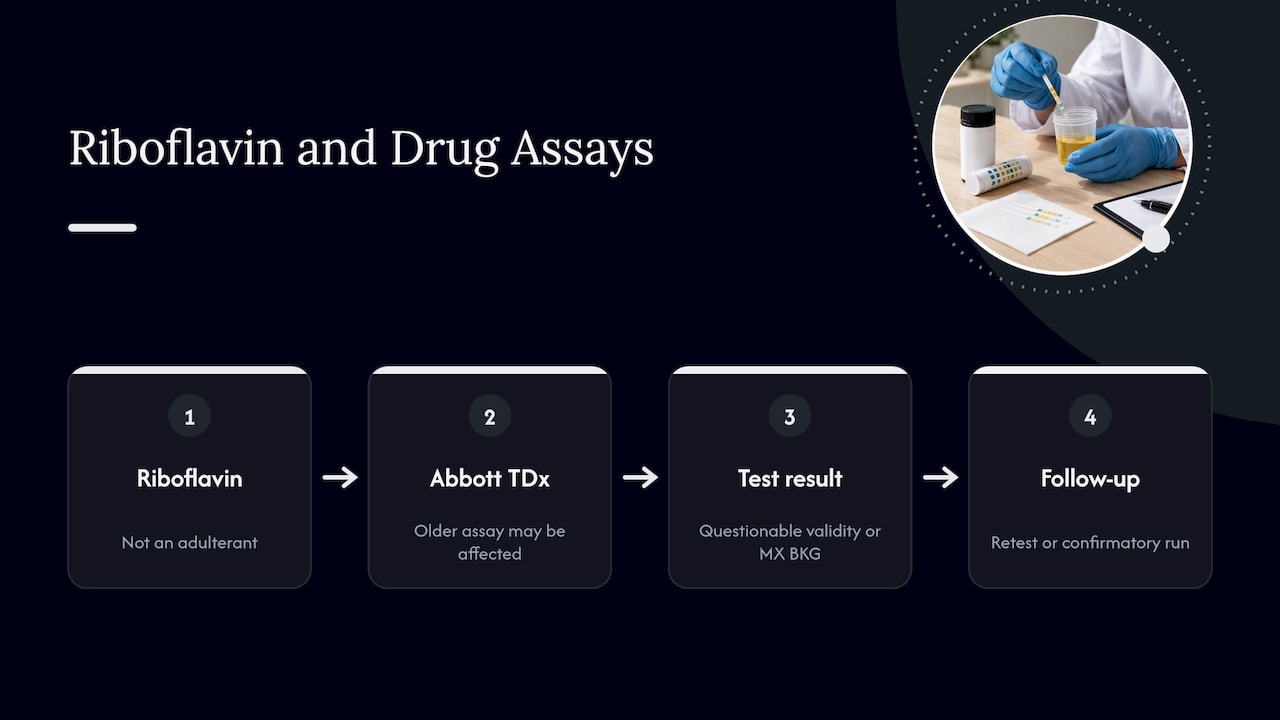
A 1998 study on vitamin B2 and TDx drug assays found that riboflavin is not an adulterant. It also found that it can interfere with Abbott TDx drugs-of-abuse assays and produce a result of questionable validity or an MX BKG error. Those are older immunoassay systems, and a questionable result is not a pass. It usually leads to a re-test or a confirmatory run, which is the opposite of what a nervous test-taker wants.
In short: vitamin B does not mask a drug, it does not change what a lab is looking for, and at high doses it can add a complication. If a lab flags your sample, the question becomes whether it was valid at all.
What labs actually check in a urine specimen
A lab does not judge your urine by its color. It runs validity tests. Under 10 CFR 26.161, a federal rule used as a reference point for validity testing, labs:
- Test creatinine.
- Test specific gravity when creatinine is below 20 mg/dL.
- Determine pH.
- Test for oxidizing adulterants.
The same rule defines a dilute specimen. Under 10 CFR § 26.161, a specimen is dilute when creatinine is at least 2 but below 20 mg/dL and specific gravity is above 1.0010 but below 1.0030. Employers outside federally regulated programs may use their own lab policies, so the rules you face depend on who orders the test.
This matters because adding B vitamins and drinking a lot of water can restore color while pushing creatinine down. A pale yellow, vitamin-colored sample can still read as dilute. For a deeper look, see our guide on the 20 mg/dL creatinine cutoff and dilute urine.
How to prepare a urine sample the right way
If you have a screening coming up, the aim is a sample that is valid and reads like a normal specimen. These are the habits that help:
- Keep your routine steady. Drink water the way you normally do. Our test day plan to avoid a dilute result lays out how much to drink and when, so you do not overshoot.
- Eat normally. A real meal helps more than a gimmick. We cover what to eat before a drug test and what does not matter.
- Skip heavy B-complex doses right before the test. Your urine may glow, and high riboflavin intake has been tied to questionable assay results in older systems.
- Do not bank on juice. Our explanation of why cranberry juice will not reliably work shows what labs catch.
- Know your test type. Urine, hair and saliva screens behave very differently. Our urine test preparation guide walks through the basics.
- Understand the validity checks. Labs use several markers to catch tampering; we list them in our piece on six SVT markers.
If your test is supervised or tied to probation, a dilute result can carry weight. See why in our article on probation urine tests and dilute samples.
A worked example
Say you take a B-complex in the morning and drink three large bottles of water before an afternoon collection. Your urine comes out almost clear with a yellow tint. The tint looks like a normal sample, but the water has pulled your creatinine down. A lab measuring creatinine and specific gravity sees a dilute specimen, and depending on the program, that may mean a re-collect or be treated as a failed attempt.
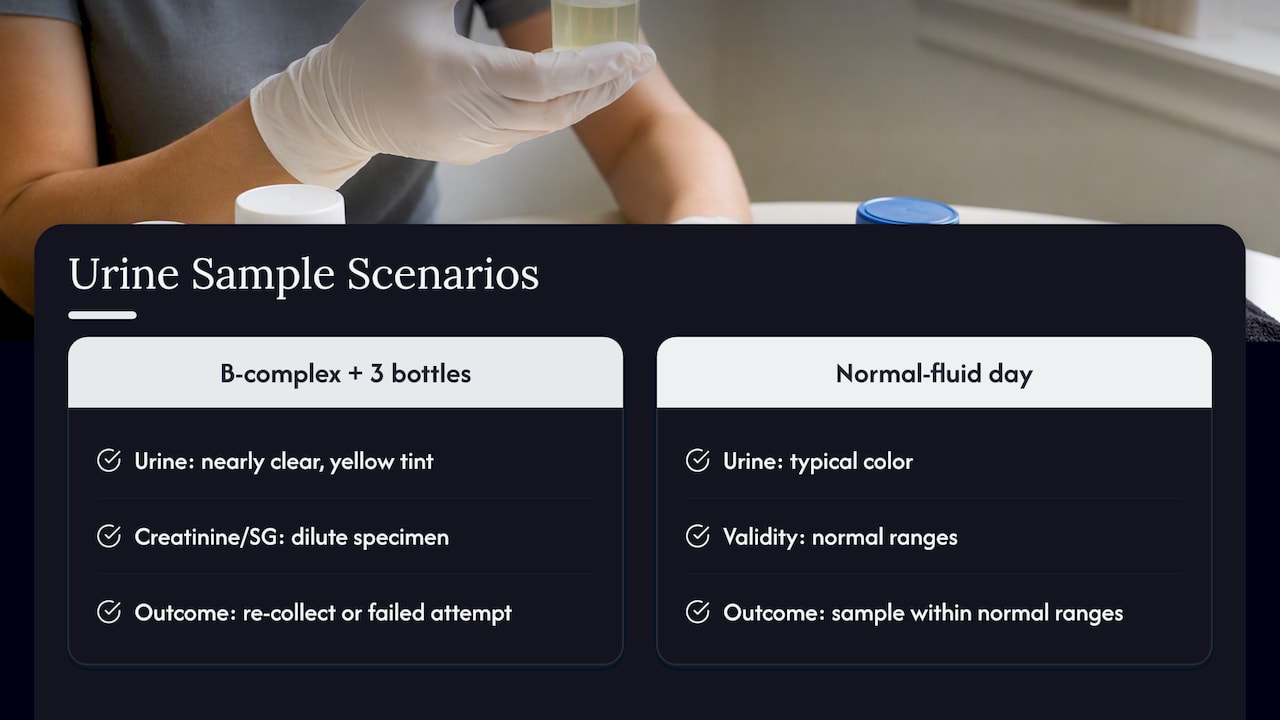
Now take the same person on a normal day: regular fluids, a meal, no megadose of B vitamins. The sample has a typical color and falls within normal validity ranges. The difference is not magic, it is just a specimen that looks like what a body produces.
Where hair and saliva tests fit in
Urine is only one route. Hair tests look at a longer window and respond to different preparation; saliva tests look at a short recent window. B vitamins have no meaningful role in either. If your employer or court uses hair testing, start with our hair drug test information page. For oral swabs, see our saliva drug test information.
The same applies to blood: a vitamin blood test checks nutrition, while a drug screen checks for specific substances. They are different tests ordered for different reasons.
Perspective
We hear from people every week who took a handful of B vitamins the night before a test because someone online told them it would make their sample look right. We understand the instinct. A test is stressful, and a pale yellow cup looks like safety.
Here is what we have learned from talking with customers. A lab does not read your sample like a person does. It runs measurements, and those measurements care about creatinine and specific gravity far more than color. That is why we encourage test-takers to match the preparation to the test type, and to plan around how the specimen will be evaluated.
This is the reason our catalog is organized by test: hair, saliva and urine. Each category has its own products and its own guidance, and our support team is available daily from 9am to 12am to help you pick what fits your situation. Orders ship with a focus on confidentiality and secure delivery.
If you came here because of a bright yellow sample, take the pressure off. Learn what the lab checks, prepare calmly, and choose tools made for the kind of test you face.
MIchael
Our urine testing options
If you want tools built for the test you are facing rather than guesswork, browse our urine drug testing collection. For people who need a backup plan, we also offer an ultra pure synthetic urine kit. If your screening is a hair test, our hair drug test shampoo page explains what we carry and how it is used. Always check the rules and laws that apply where you live and for your program before choosing a product.
Our team can point you to the right category if you are not sure whether your employer uses urine, hair or saliva. Start at passdrugtest.net and use the categories to narrow it down.
FAQ
Is there a test for vitamin B levels?
Yes. Vitamin B levels can be measured in blood or urine, depending on which vitamin your provider wants to check. MedlinePlus notes that a random or 24-hour urine test needs no special preparation, while some blood tests may require fasting. A clinician decides which version fits your symptoms.
Why does vitamin B make urine so yellow?
The cause is riboflavin, vitamin B2. When you take more than your body needs, the extra leaves through the kidneys, and it turns urine bright yellow. It is usually harmless, but contact a doctor if the color persists or concerns you.
Is it safe to take a super B-complex every day?
For most healthy adults a standard-dose B-complex is generally fine, but B6, niacin and folic acid have upper limits. A published review lists them as 100 mg per day for B6 in the US, 35 mg for niacin and 1,000 µg for folic acid. Check labels, avoid doubling up on products, and ask your doctor if you take medicine or are pregnant.
What depletes your body of B vitamins?
MedlinePlus names celiac or Crohn’s disease, malabsorption, diets low in foods like animal products, and certain medicines that affect how the body uses some B vitamins. If you have symptoms, a blood or urine test can show where you stand.
Can vitamin B cause a failed urine drug test?
Riboflavin is not an adulterant, and it does not create a positive for a drug. A 1998 study found that it can interfere with some older TDx assays and produce a questionable-validity result. A dilute sample can also cause problems, so prepare for the whole specimen, not its color.
Sources
- Vitamin B Test: MedlinePlus Medical Test
- Vitamin B2 health encyclopedia, University of Rochester Medical Center
- Bright Yellow Urine: Causes, Treatments, and More, Healthgrades
- Vitamin B2 interference with TDx drugs-of-abuse assays, PubMed
- 10 CFR 26.161, Cutoff levels for validity testing (eCFR)
- 10 CFR § 26.161, Legal Information Institute
- B Vitamins and the Brain: Mechanisms, Dose and Efficacy, PMC