
There is no single federal law that governs hair drug testing. Private employers can generally choose to test, states set their own limits, and federal transportation rules do not currently authorize hair testing at all. If you know a hair test is coming, the smart move is to understand which rules apply to your job and then prepare your hair properly. We built our Macujo Aloe Rid Shampoo for exactly that second step.
TL;DR
- Federal law generally does not require private employers to drug test, and it does not set rules for those who choose to do so, according to a 50-state employment survey.
- DOT-regulated testing authorizes only urine and oral fluid, not hair, under 49 CFR 40.210.
- States differ. Maryland, for example, allows hair testing only for job applicants, with hair no longer than 1.5 inches.
- Some states bar employers from making you pay for a required drug test.
- A hair test reaches back much further than urine, so preparing early with a proper wash routine matters.
Table of Contents
- Can an employer require a hair drug test?
- What federal and DOT rules say
- State laws: the rules depend on where you work
- Are hair test results reliable in court?
- How far back a hair test looks
- Preparing when a hair test is legal for your employer
- Our shampoo for hair test prep
- FAQ
- Sources
Can an employer require a hair drug test?
In most of the country, yes, if the employer applies the policy consistently and follows its state’s rules. The federal Drug-Free Workplace Act applies to organizations holding a federal contract of at least $100,000 or any federal grant, and it requires a drug-free workplace policy. It does not mandate hair testing specifically. Agencies such as DOT, the Department of Defense and the Nuclear Regulatory Commission can impose their own testing requirements in public-safety and national-security fields.
In practice, a private employer picks the specimen: urine, oral fluid or hair. Hair is popular for pre-employment screening because it covers a long period. Our guide on which drug test employers use explains how that choice is usually made.
Can you refuse?
You can always say no to a workplace test. The catch, per Nolo’s employee rights guide, is that if you are fired or not hired for refusing, you may have little recourse, and in some states you may lose unemployment benefits. The strongest challenge to an unfair action usually rests on whether the testing followed your state’s strict rules on form and procedure.
What federal and DOT rules say
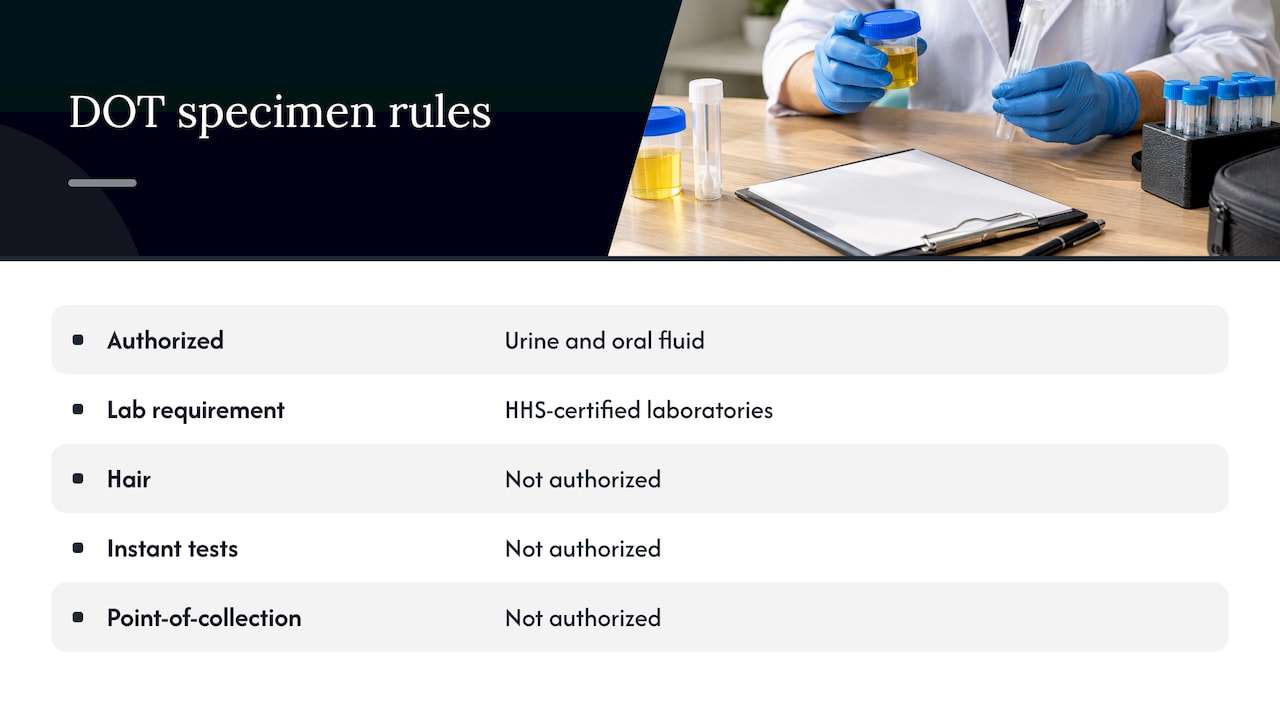
If you drive a commercial vehicle or hold another DOT safety-sensitive job, hair testing is not part of your program. Under 49 CFR 40.210, only urine and oral fluid specimens analyzed at HHS-certified laboratories are authorized. Hair testing, instant tests and point-of-collection tests are not.
The rules keep moving. DOT’s final rule of May 11, 2026, effective June 10, 2026, allows observed urine collections when oral fluid testing is unavailable, and employers can continue that for up to 18 months after HHS notice that two oral-fluid laboratories are certified. The direction of travel in transportation is oral fluid, not hair. If you work in that field, read our DOT hair test guide to see where hair can still come up, such as employer-specific policies outside DOT-mandated tests.
The federal hair guidelines
HHS published proposed Mandatory Guidelines for hair testing on September 10, 2020. They would let federal executive branch agencies test hair only for pre-employment and random testing. An agency using hair would also have to authorize a second specimen type, such as urine or oral fluid, for people who cannot provide enough hair for faith-based or medical reasons or because of length.
As of the June 2024 SAMHSA advisory board meeting, the proposed hair guidelines were still under review at the Office of Management and Budget. The same document confirms that the urine guidelines took effect February 1, 2024 and the oral fluid guidelines October 10, 2023. Check SAMHSA’s workplace program pages for any later change, since final hair rules would change how federal agencies test.
State laws: the rules depend on where you work
This is where hair testing law becomes real for most people. States set limits on who can be tested, how, and who pays. Our overview of marijuana legalization and drug testing covers what state cannabis laws do and do not change for employees.
Maryland: applicants only, 1.5 inches
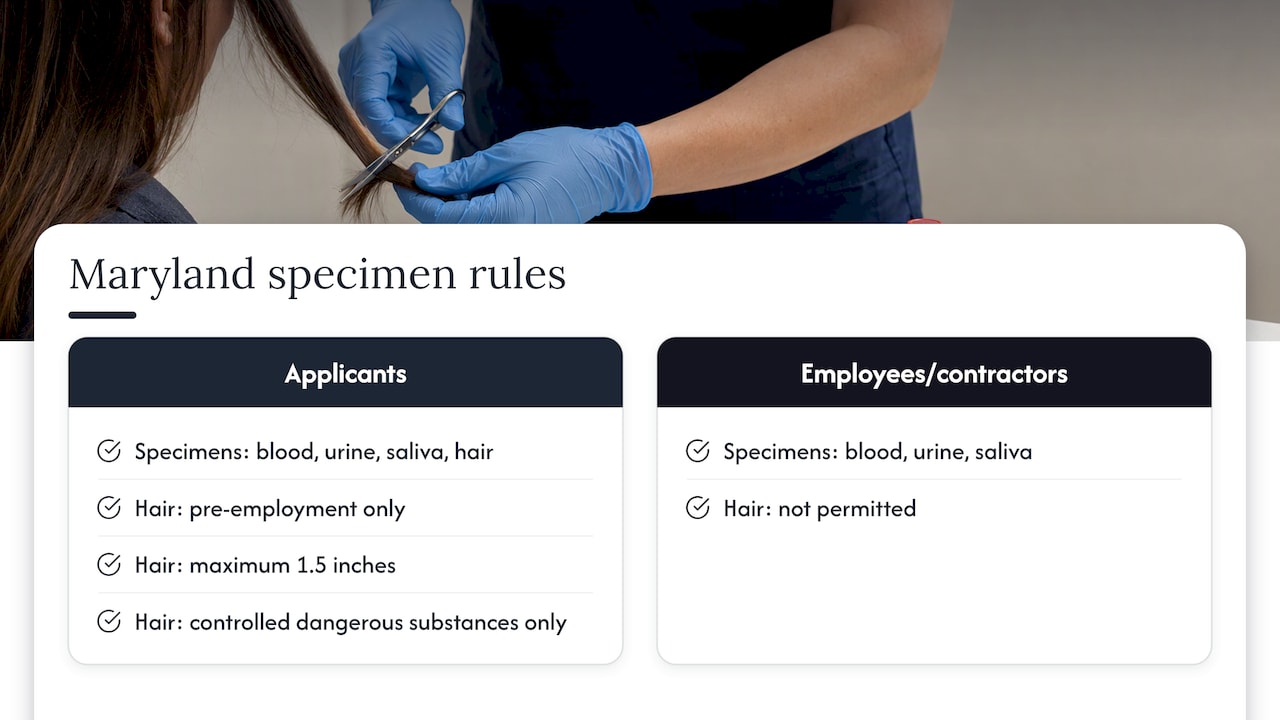
Maryland is the clearest example. Under Health-General § 17-214, an employer may use hair as a job-related specimen only for pre-employment purposes. The hair can be no longer than one and one-half inches measured from the body, and the specimen cannot be used for anything except testing for controlled dangerous substances. The state’s regulation COMAR 10.10.10.06 says the same thing differently: applicants may be asked for blood, urine, saliva or hair, while current employees and contractors may be asked only for blood, saliva or urine.
After a confirmed positive, Maryland law requires the employer to give you, in person or by certified mail within 30 days of the test, the lab result, the written drug policy, written notice of any intended discipline, and a statement of your right to request independent testing of the same sample.
Other states with hair limits or retest rights
A state-by-state report from BLR notes that in some states, such as Iowa, employees can rebut a positive finding and ask for confirmation through retesting, and employers may hair test prospective employees only. Because these laws vary and change, look up your own state’s labor department page before you assume what your employer can do.
Who pays for the test?
Several states stop employers from billing you:
| State | Rule in brief |
|---|---|
| North Carolina | Employers with 25 or more employees cannot charge applicants for a medical exam, which the state labor department says includes drug screening. |
| Wisconsin | An employer may not make a worker or applicant pay for a drug test required as a condition of employment. |
| Louisiana | R.S. 23:897 bars charging an employee or applicant for a required drug test, with limited exceptions. |
| Arkansas | A required drug test must be at no cost to the person, though an employer may charge for a requested re-test of a positive sample. |
| Tennessee | Employers in the voluntary Drug-Free Workplace Program must pay for all testing they require. |
These rules have exceptions, such as federally required tests in North Carolina, so confirm the details with your state agency.
Are hair test results reliable in court?
Hair results are not treated as automatic proof. In the Boston police hair-testing appeals, the Massachusetts Civil Service Commission found that a positive result was not necessarily conclusive of ingestion, and that there are no uniform national standards for hair testing. The HHS notice behind the proposed federal guidelines cites two Massachusetts cases, Jones v. City of Boston and Thompson v. Civil Service Commission, to explain why it wants a second specimen type alongside hair.
External contamination is the other recurring issue. Montana drug court training materials state that a drug found in hair is not enough on its own to conclude use, since hair can pick up substances from smoke in the air or powder residue on surfaces. We go deeper in our pages on external contamination and what causes false positives.
How far back a hair test looks
The Massachusetts commission explains that blood and urine windows are hours or days, while drugs and metabolites are stored in the hair as it grows. Labs commonly use a 90-day segment of hair close to the scalp. Details are in our hair drug test detection window guide.
That is why the law matters less than the calendar. If an employer is legally entitled to test your hair, your preparation is what you control.
Preparing when a hair test is legal for your employer
Once you know your employer can test hair, plan the timeline. A routine that works needs time, so start as early as you can. Our hair detox checklist lays out the steps, and the job applicant 90-day THC guide covers longer lead times.
Many readers choose the Macujo method, the well-known multi-day hair wash routine created by Mike Macujo, and we consider it the best method for a hair follicle drug test. You can read what the Macujo method is and follow the 10 to 14 day Macujo Aloe Rid instructions for timing and safety. If you are budgeting, see the Macujo cost breakdown.
Our shampoo for hair test prep
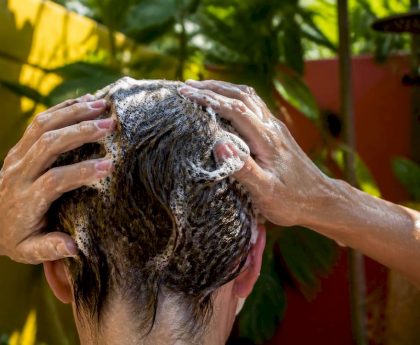
Macujo Aloe Rid Shampoo is our flagship product and the one we recommend for the Macujo method. Our formula is designed to cleanse the hair shaft of toxins and drug metabolites, and it is the centerpiece of our hair kits. Customers can also pair it with the Zydot Ultra Clean treatment bundle. Orders are handled with high confidentiality and secure delivery, and our customer service is available 9am to 12am daily if you have questions before your test date.
Our perspective
We talk with people every day who learn about a hair test with little notice and feel stuck. The law rarely helps in that window: employers in most states can choose hair, and the rules on retesting and cost vary. What you control is your preparation.
That is why we put our effort into the Macujo method and Macujo Aloe Rid Shampoo. A clear routine, started early and followed carefully, gives you the best chance of walking into the collection with confidence. We built our service around discretion, secure delivery and being reachable late in the evening, because test notices rarely arrive at convenient hours.
MIchael
FAQ
Is a hair drug test legal in every state?
Private employers can generally use hair testing, but states add limits. Maryland, for example, allows it only for applicants and caps hair length at 1.5 inches. Check your state labor department for the rule that applies to you.
Does DOT allow hair testing?
No. Under 49 CFR 40.210, DOT-regulated testing authorizes only urine and oral fluid specimens. An employer may still have its own non-DOT policy, so ask HR which program your test falls under.
Can my employer make me pay for a hair test?
In some states, no. North Carolina, Wisconsin, Louisiana and Arkansas all restrict charging applicants or employees for required drug tests, with exceptions. Your state labor agency can confirm the current rule.
Can a hair test result be challenged?
Often yes. Some states, such as Maryland, give you a right to independent testing of the same sample, and tribunals have treated a positive hair result as not automatically conclusive. Ask for your lab report and the employer’s written policy right away.
Sources
- Drug Testing Laws in Employment: 50-State Survey
- Laws on Employee Drug Testing, Nolo
- eCFR, 49 CFR 40.210
- Federal Register, DOT final rule, May 11, 2026
- Federal Register, proposed HHS hair guidelines, September 10, 2020
- SAMHSA Drug Testing Advisory Board summary, June 2024
- Maryland Health-General § 17-214
- COMAR 10.10.10.06
- Maryland Health-General § 17-214 (Justia)
- BLR drug and alcohol testing laws by state
- North Carolina DOL, Medical Payment Law
- Wisconsin DWD, Medical Exams Required by the Employer
- Louisiana R.S. 23:897
- Arkansas DOL rule 010.14-400
- Tennessee Drug-Free Workplace Program rules
- Massachusetts Civil Service Commission, BPD drug testing appeals
- Montana courts, Understanding Abused Drugs Testing Results