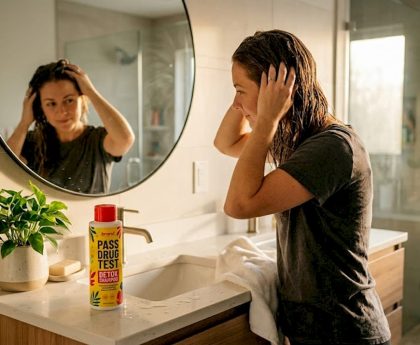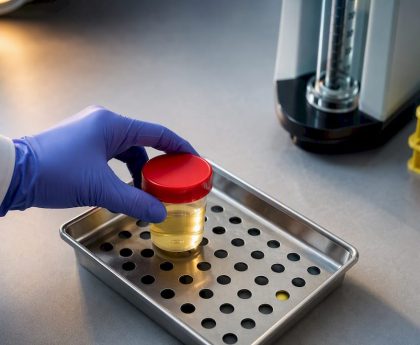
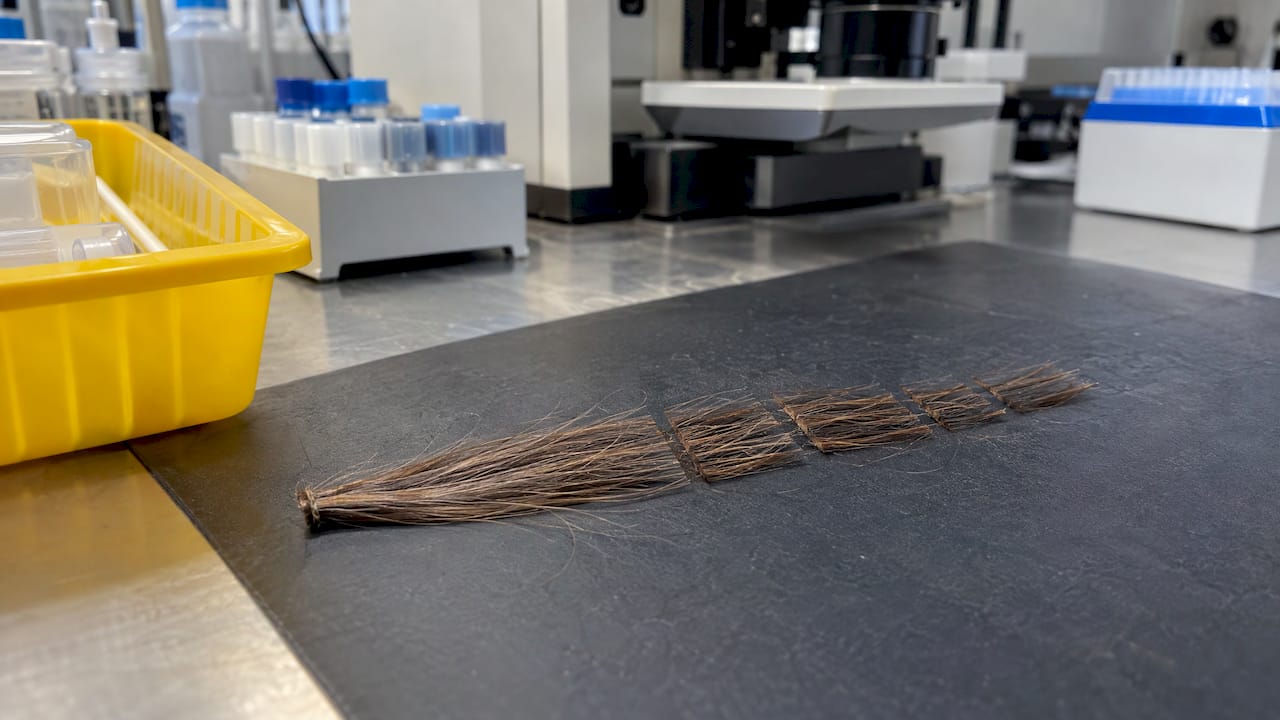

A hair test can pick up benzodiazepines for roughly three months, because each centimeter of scalp hair holds about one month of your history. That window is long, but it is not fixed: hair color, hair treatments, the specific drug and how the lab handles the sample all shift the result. If you are preparing for a hair follicle test in the United States, knowing how the test works tells you what you can and cannot control, and where a hair cleansing routine fits in.
TL;DR
- Scalp hair grows about 1 cm a month, so a standard 1.5-inch sample covers roughly 90 days of exposure.
- A drug can take days, and sometimes up to 10 days, to show up in hair above the scalp after you take it.
- Benzodiazepines appear at lower concentrations in hair than many other drugs, and labs have no single agreed cut-off for them.
- Hair color, bleaching, coloring and outside contamination all affect what a lab finds.
- If a doctor prescribes your benzodiazepine, say so before the test. Our own hair cleansing products are built around THC and hair follicle tests.
Table of Contents
- How benzodiazepines end up in hair
- How long benzodiazepines can be detected in hair
- What happens to your hair sample in the lab
- What changes a hair test result
- What research says about hair treatments
- If you take a prescribed benzodiazepine
- Preparing for a hair test the sensible way
- Where our products fit
- Our perspective
- FAQ
- Sources
How benzodiazepines end up in hair
When you take a drug, it travels through your blood. Small amounts reach the growing hair root and are locked into the hair shaft as it forms. Once inside, the drug stays in that segment of hair as it grows out of your scalp. That is why a hair sample works like a calendar: the part closest to your scalp is the most recent, and the tip is the oldest.
A 2025 review of toxicology testing in hair in the Journal of Applied Laboratory Medicine explains that 1 cm of scalp hair represents about one month of growth. The same review notes that drugs may take at least several days, and in some cases up to 10 days, to appear in the hair above the scalp after you take them. So a dose from last week will usually not be in the part of the hair a lab cuts, while a dose from two months ago will be.
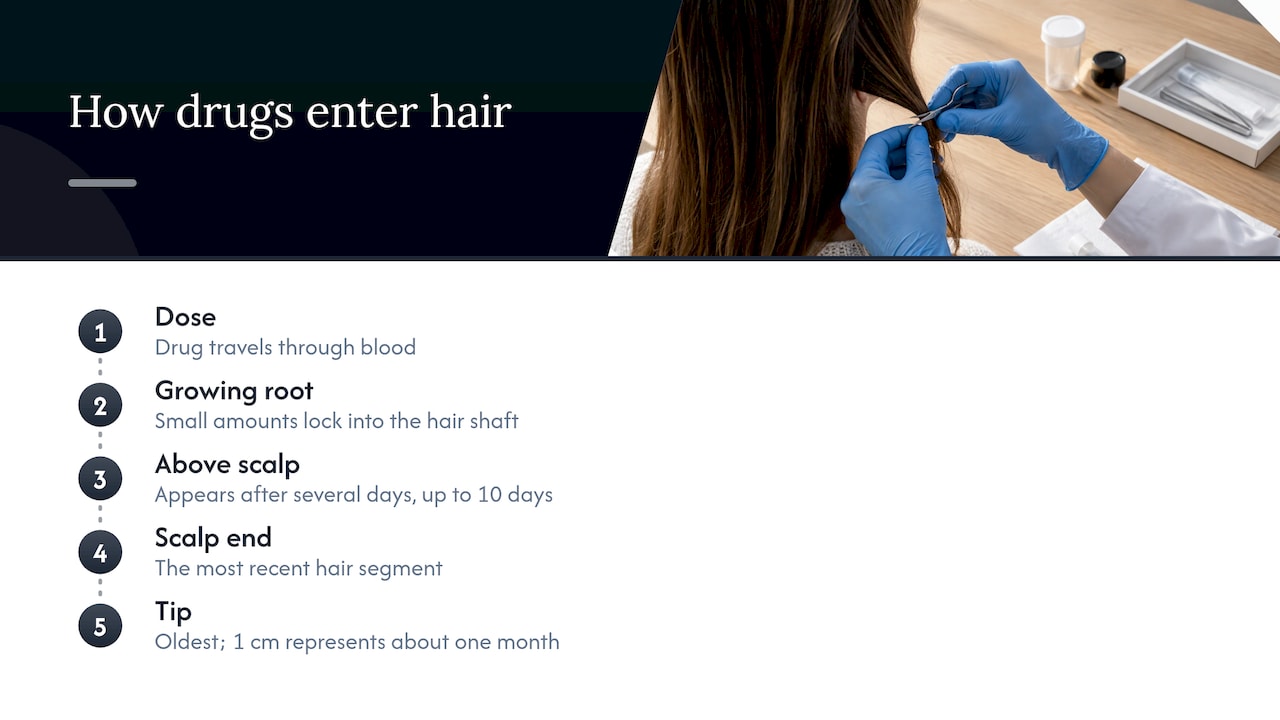
A 2021 systematic review confirms the average growth rate of about 1 cm per month and adds that hair color, age, metabolism, cosmetic treatment and individual variation all affect how a result is interpreted.
How long benzodiazepines can be detected in hair
The practical answer is up to about 90 days for a standard sample. Most workplace and legal hair tests use roughly 1.5 inches of hair cut close to the scalp, which is where the 90-day figure comes from. If your hair is shorter, the window is shorter. If a lab uses a longer segment, it looks further back.
Three details matter for benzodiazepines specifically:
- They are present at low levels. The 2025 Japanese review of hair testing points out that benzodiazepines are found at lower concentrations than basic drugs, and that concentrations vary from one compound to another.
- The compound matters. An early U.S. study of patients’ hair, published in 1992, detected diazepam but did not detect alprazolam or lorazepam. Methods have improved a great deal since then, but the point stands: not every benzodiazepine shows up equally.
- There is no single agreed cut-off. A large Swiss monitoring report states that neither SAMHSA (the federal Substance Abuse and Mental Health Services Administration) nor the Society of Hair Testing had recommended cut-off values for benzodiazepines in hair. Different labs can therefore set different thresholds.
Also keep in mind that a benzodiazepine window is not the same as a THC window. THC gets into hair from the bloodstream only in very small amounts, which is why cannabis testing in hair works differently and why THC cleansing is its own topic. We cover that in our guide to THC cleansing and how to remove it from your hair.
What happens to your hair sample in the lab
Knowing the process helps you understand why results come out the way they do.
Collection
The Society of Hair Testing consensus guidelines recommend cutting hair as close to the skin as possible, preferably from the back of the head (the posterior vertex). The collector should note the root end, the hair’s characteristics and any cosmetic treatment, and the sample is stored dry, dark and at room temperature. If you have little head hair, body hair can be used, but it follows different growth cycles and does not give the same time window.
Washing and analysis
According to the same consensus, the lab washes the hair, then homogenizes or cuts it, extracts the compounds and identifies and measures them with chromatography combined with mass spectrometry. This is a confirmation-grade method, far more specific than a quick screening kit.
What a result can and cannot show
The U.S. National Institute of Justice stated in June 2024 that hair testing can show drug exposure over months but cannot establish how much was consumed, and that labs must address possible environmental contamination. Looking at metabolites, the by-products your body makes, helps tell ingestion from outside exposure. For benzodiazepines this is tricky: the 2021 review explains that some metabolites are themselves prescription drugs, or can come from more than one parent drug, which complicates interpretation.
In plain terms, a hair result tells a reviewer that a substance was likely in your system during a period. It does not tell them the dose, the day or the pattern.
What changes a hair test result
Several things influence what a lab finds, and most of them have nothing to do with a product you buy.
| Factor | What it does |
|---|---|
| Hair length and growth rate | Sets how many weeks the sample covers. Growth varies between people and between hair cycles. |
| Hair color and pigment | Darker hair tends to bind some drugs more strongly, which shifts concentrations. |
| Drug properties | Different benzodiazepines enter hair at different rates. |
| Cosmetic treatment | Permanent coloring and bleaching can degrade or leach drugs out of hair. |
| Outside contamination | Drug residue from the environment can sit on the hair surface, which is why labs wash samples. |
| Body versus scalp hair | Body hair grows more slowly and cycles differently. |
The 2025 Japanese review says permanent coloring and bleaching can degrade or leach drugs from hair and that treatment history should be considered before a result is interpreted. The Society of Hair Testing consensus lists the same family of factors: natural hair color and type, cosmetic and physical treatment, contamination and hair-growth cycles.
A practical consequence: if you have colored or bleached your hair, tell the collector. Treatment history is part of what a lab is asked to document, and hiding it does not help you.
What research says about hair treatments
Research on hair treatments is mostly about cannabis, because that is where most of the market interest is. A 2022 German study, Manipulation of THC Hair Concentrations by Commercially Available Products, found that several products lowered THC concentrations in hair by average amounts between 52% and 65%, and that in some samples concentrations fell to non-detectable levels. That study did not examine benzodiazepines, so it says nothing about them.
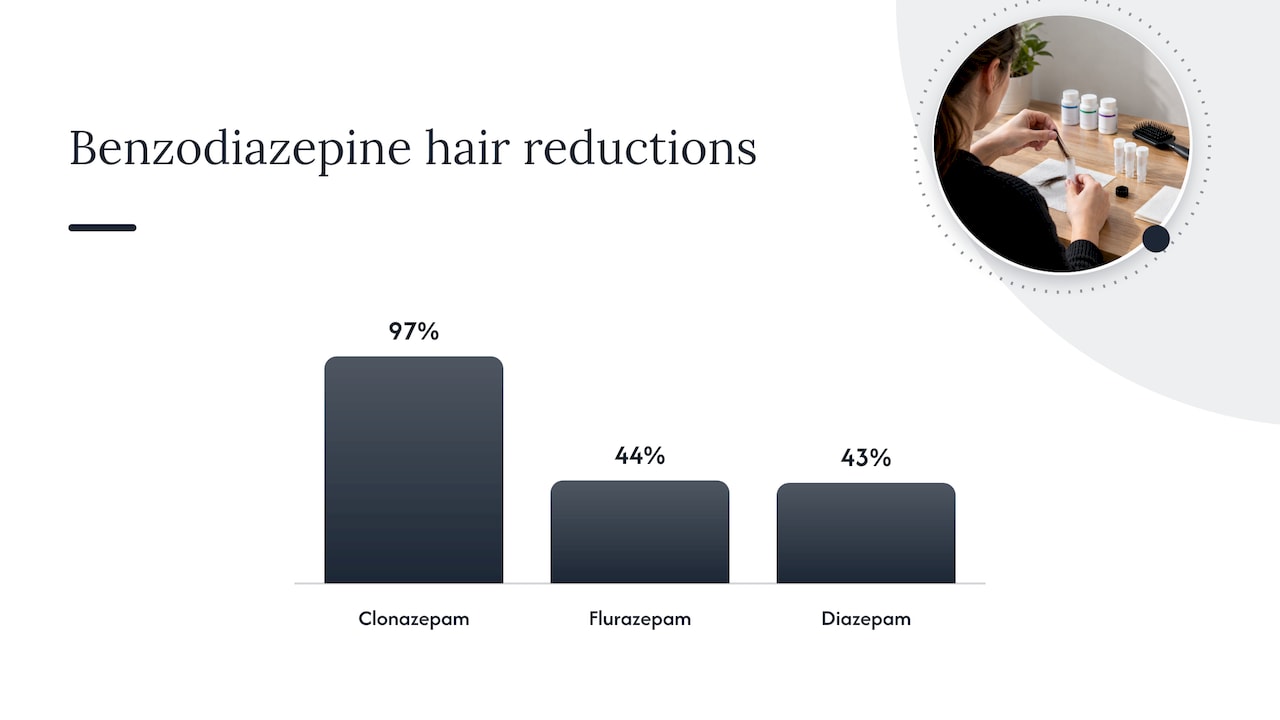
For benzodiazepines, one small laboratory study from Italy, published in 2024, tested a homemade treatment of baking soda, salicylic acid and bleach on hair samples. It reduced clonazepam by 97%, flurazepam by 44% and diazepam by 43%, while alprazolam was not reduced. The authors noted that the work used very few positive samples. Bleach is harsh on hair, and as the research above shows, damaged hair can itself change how a lab reads a sample, so we do not recommend this kind of home mixture. Our own take on that trade-off is in detox shampoo vs home remedies for hair drug tests.
If your concern is a hair test for THC, the type of product matters more than any single claim. Our guides on what actually works for hair detox and hair detox products compared walk through it.
If you take a prescribed benzodiazepine
This is the situation where the right move is not a product at all. A hair test cannot tell the difference between a prescription and unprescribed use, but a reviewer can.
- Keep your prescription records. The prescription label, pharmacy printout or a letter from your doctor gives a reviewer what they need.
- Disclose before you are asked to. In many workplace programs, a medical review officer, a physician who reviews positive results, contacts you after a lab positive and weighs your explanation against your prescription. Having documents ready makes that conversation quick.
- Do not change your dose to prepare for a test. Stopping a benzodiazepine suddenly or altering a dose can be dangerous. Any change in how you take it is a decision for the doctor who prescribed it.
- Ask about your options if you disagree with a result. If you believe a result is wrong, ask the testing program how to request a re-test of the original sample, and talk to your doctor or a lawyer about your rights, since these depend on the employer, the program and the state.
If you are worried about your own benzodiazepine use rather than a test, SAMHSA’s National Helpline is a free, confidential service open 24 hours a day, every day of the year, in English and Spanish.
Preparing for a hair test the sensible way
Whatever substance is involved, a few habits help you walk into a test with fewer surprises:
- Know your window. Count back about 90 days from your test date for a standard 1.5-inch head hair sample.
- Know what is on your hair. Dyes, bleach and relaxers change how a lab reads a sample and are noted at collection.
- Avoid products with harsh or unknown ingredients. Our list of detox products to avoid for hair drug testing explains why, and our do’s and don’ts for drug test prep gives a simple routine.
- Read the instructions fully. A routine only helps if you can follow it for the whole period. Our Macujo Aloe Rid instructions cover timing and safety for a 10 to 14 day program.
- Understand how drugs sit in the hair. Our page on hair shaft drug incorporation explains what a cleansing routine is aimed at.
Where our products fit
Our focus is hair cleansing for people facing a hair follicle test in the United States, and our flagship product is the Macujo Aloe Rid Shampoo. It is built for the THC hair test, which is where most of our customers come to us. You can see the product and its details on the Macujo Aloe Rid Shampoo page, or look at the Macujo Aloe Rid Shampoo with Zydot Ultra Clean Treatment if you want both together.
Our customer service is available from 9am to 12am every day, so you can ask questions about your routine when you need to, and we deliver with confidentiality and secure delivery in mind. If you are still choosing, start with our shampoo for hair follicle tests guide, or go straight to the Passdrugtest store.
Our perspective
Most people who write to us are under pressure. A test date is coming, hair feels like something you cannot hide, and the internet gives you ten different answers.
What we tell them is simple. Start from how the test works: hair is a record of about three months, labs wash and confirm samples, and what you put on your hair matters. Pick a routine designed for hair follicle tests, follow it exactly, and give it enough time.
That is why we built our range around the Macujo Aloe Rid Shampoo and the cleansing routine that goes with it. We would rather you have a clear plan and a person to ask than a pile of guesses. If you take a prescribed medication, keep your documents and talk to your doctor first. If you are preparing for a THC hair test, we are here every day until midnight.
MIchael
FAQ
How long do benzos stay in hair follicles?
A standard sample of about 1.5 inches of scalp hair covers roughly 90 days, since hair grows about 1 cm a month. Drugs can take several days, and in some cases up to 10, to appear above the scalp, so the most recent week or so is usually not in the cut sample. Shorter hair covers a shorter period.
Can you trick a hair follicle drug test?
Labs wash the hair and confirm results with mass spectrometry, so a sample is examined closely. What does change results is hair treatment, such as bleaching or coloring, which can reduce the drug in the hair but is also documented at collection. For THC, a routine designed for hair cleansing, followed fully, is the approach we recommend.
What is the best detox shampoo to use before a hair follicle test?
Our flagship is the Macujo Aloe Rid Shampoo, made for hair follicle test preparation and used over a 10 to 14 day routine. You can also read our comparison of the best hair follicle drug test shampoo to see how the options differ.
What throws off a hair follicle test?
Hair color, growth rate, the drug itself, cosmetic treatment and outside contamination all affect what a lab finds. Coloring and bleaching can degrade or leach drugs from hair, and labs record treatment history when they collect the sample. Tell the collector about any treatment you have had.
Sources
- Review on Toxicology Testing in Hair, Journal of Applied Laboratory Medicine (2025)
- A Systematic Review of Metabolite-to-Drug Ratios (2021)
- Hair testing for investigating intake and use history (2025)
- Detection of benzodiazepines in human hair by radioimmunoassay (1992)
- Large scale consumption monitoring of benzodiazepines
- Society of Hair Testing consensus (2022)
- National Institute of Justice: Detecting Drugs in Hair (2024)
- Manipulation of THC Hair Concentrations by Commercially Available Products (2022)
- Hair analysis: Assessment of homemade hair treatment effects (2024)