

Exercise before a drug test can temporarily raise THC levels in your blood, but it rarely changes the outcome of a urine test, which is what most people take. The safest rule of thumb is to skip vigorous aerobic exercise for 24 to 48 hours before a urine screen. This guidance rests on human trials, including Gunasekaran et al. and Westin et al., and applies mainly to THC because it’s stored in fat, not to water-soluble drugs that clear the body differently.
TL;DR:
- Vigorous exercise temporarily increases blood THC levels but rarely alters urine test results, especially if you wait 24 to 48 hours before testing.
- Studies show plasma THC spikes by about 15% during exercise, but levels return to normal within two hours, without significantly affecting urine metabolite levels.
- The main factor influencing THC mobilization is body fat percentage, with higher adiposity leading to larger blood THC spikes during exercise.
- For urine tests, the safest approach is to avoid intense workouts and maintain normal hydration and diet in the days before testing.
- Exercise has little to no impact on hair or saliva tests, which reflect long-term or recent use, respectively, and are unaffected by fat mobilization.
Table of Contents
- How Exercise Mobilizes Fat-Stored THC
- What the Research Actually Shows
- Which Drug Tests Does Exercise Actually Affect?
- Your 72-Hour Pre-Test Checklist
- When Exercise Actually Matters: Lab Confirmation and Edge Cases
- Why Timing Beats Panic on Test Day
- Where to Go From Here With Passdrugtest
- Key Studies and Guidance Referenced
- Sources
- FAQ
How Exercise Mobilizes Fat-Stored THC
THC is fat-soluble. Once it enters your bloodstream, a share of it gets tucked away in adipose tissue instead of clearing out through urine and feces right away. That’s the whole reason THC lingers in regular users’ systems far longer than something like cocaine or opioids.
Aerobic exercise burns fat for fuel through a process called lipolysis, where fat cells release stored fatty acids, and along with them, the THC molecules riding along in that fat. This is the physiological basis behind every “sweat it out” theory circulating on forums. The mechanism is real. The practical impact on a drug test is much smaller than the theory suggests.
Here’s the sequence that actually happens in the body:
- Sustained aerobic effort triggers lipolysis and fat cells release stored THC into circulation.
- Blood THC concentration rises temporarily, sometimes noticeably.
- The liver and kidneys process the released THC into metabolites, primarily THC-COOH.
- Blood THC returns to baseline within a couple of hours as the spike clears.
- Urine THC-COOH levels, which reflect metabolism over days, show little to no meaningful shift from a single workout.
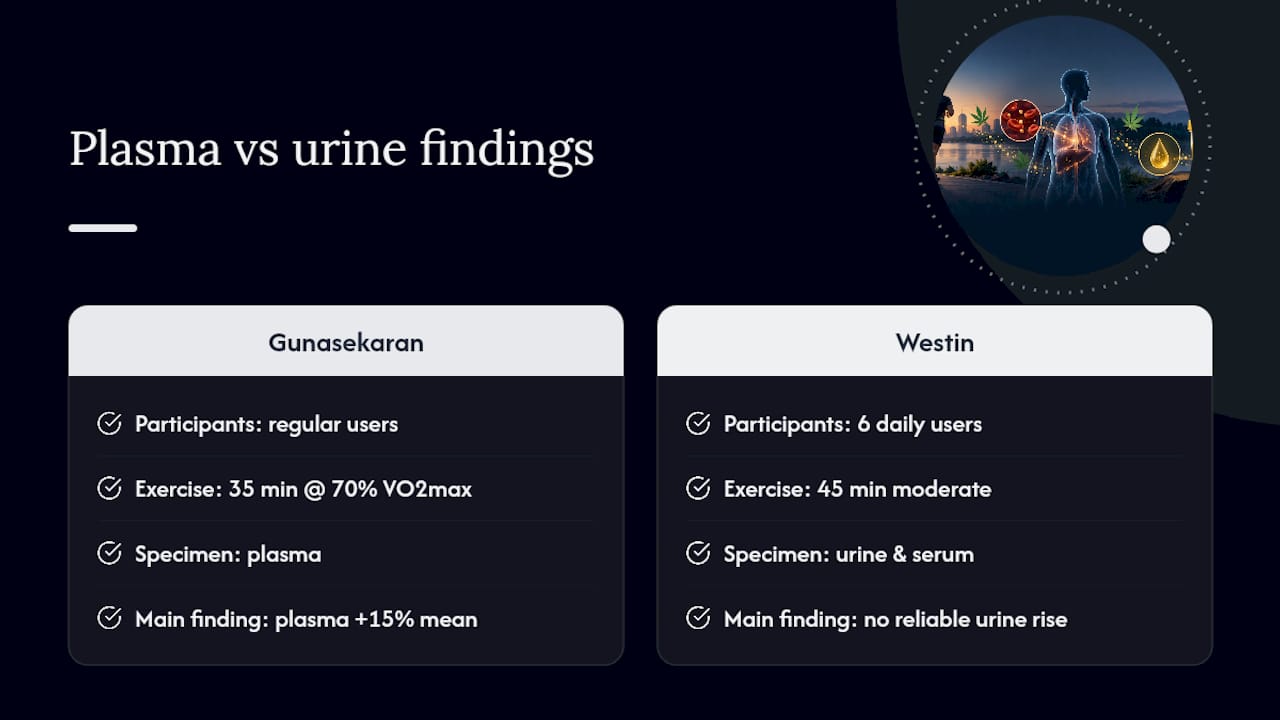
Statistic Callout: In a controlled trial, cycling at roughly 70% of VO2max for 35 minutes produced a mean 15% increase in plasma THC in regular users, with the spike fading back to baseline about two hours after exercise, according to Gunasekaran et al.
Not everyone mobilizes THC the same way. Several factors change how much a workout might move the needle:
- Body fat percentage. Higher adipose stores mean more THC available to release during lipolysis, and the same study noted larger plasma increases in higher-BMI participants.
- Use pattern. Chronic, heavy users build up a bigger adipose reservoir than occasional users, so they have more THC available to mobilize.
- Fasting state. Exercising on an empty stomach can push the body toward fat metabolism faster, amplifying the release.
- Intensity and duration. Short, light activity barely touches fat stores. Long, sustained cardio does more of the work lipolysis depends on.
None of these factors change the bigger picture: the spike happens in blood, not urine, and it’s short-lived.
What the Research Actually Shows
Two human trials anchor most of what’s known about exercise and THC testing, and they point in slightly different directions depending on which specimen you’re looking at.
Gunasekaran and colleagues (2013) had regular cannabis users cycle at about 70% of VO2max for 35 minutes. Plasma THC rose by a mean of 15%, with the increase more pronounced in participants carrying more body fat. The spike wasn’t permanent. THC levels normalized roughly two hours after the session ended, consistent with a transient mobilization event rather than a lasting change in total drug burden.
Westin and colleagues (2014) looked at the question from the urine side. Six daily cannabis users completed a 45-minute moderate workout, along with a 24 hour food deprivation condition, and researchers measured both serum and urine cannabinoid levels before and after. The result: no significant, reliable increase in urine THC-COOH concentrations. Some participants showed small, transient serum changes, but nothing that would meaningfully shift a urine test result.
Both studies share real limitations. Sample sizes are small, participants were already chronic users with substantial adipose THC stores, and the exercise sessions happened in controlled lab settings rather than a gym parking lot the morning of a test. That means the findings are a solid signal, not a guarantee, especially for someone whose body fat, use history, or workout intensity falls outside what these trials measured.
Which Drug Tests Does Exercise Actually Affect?
The specimen type matters more than the workout itself. Detection windows vary widely by specimen: urine reflects days to weeks of exposure, blood reflects hours to about 48 hours, and hair reflects months. That difference in timing is exactly why exercise hits some tests and leaves others untouched.
- Urine. Labs measure THC-COOH, and this metabolite pool changes slowly, so a single workout rarely moves the number enough to matter. Our urine THC detection guide covers typical cutoffs and timeframes in more detail. Exercise could theoretically nudge a borderline result, but it doesn’t produce wholesale shifts.
- Blood. This is the specimen most sensitive to exercise, since it measures the actual THC spike lipolysis produces, and that window closes fast. Our blood test guide breaks down what a 24 to 72 hour window looks like.
- Saliva. Detection here tracks recent use, not fat stores, so fat mobilization has little expected effect on saliva results.
- Hair. Hair testing reflects drug exposure incorporated into the hair shaft over months, and nothing about a pre-test workout changes analyte levels already locked into hair. Our hair follicle detection window guide explains why this specimen type works so differently from the others.
Your 72-Hour Pre-Test Checklist
If you have a urine test coming up, the smartest move is boring discipline, not last-minute heroics. Here’s the order of operations that actually reduces risk:
- Skip vigorous aerobic exercise for 24 to 48 hours before the test. This is the single highest-leverage step, since it avoids the plasma spike lipolysis can trigger and gives your body time to settle back to baseline.
- Keep hydration normal. Drink what you’d normally drink. Don’t chug water in a panic. Overdrinking creates a dilute specimen, and dilute results trigger their own problems, including possible retesting under observed collection.
- Sleep and eat like it’s a regular day. Extreme fasting paired with exercise can accelerate fat mobilization, which works against you if a test is imminent.
- Test yourself early with a home kit if you can. Giving yourself a few days of lead time to check a home urine test result beats guessing right before a scheduled screen.
- Know what happens if your sample comes back dilute. Most labs and employers have a defined process for retesting rather than an automatic pass or fail, so understand that before test day arrives.
Pro Tip: If you’re a heavier or more frequent user sitting close to a cutoff, the real fix isn’t a workout the night before. It’s weeks of sustained fat loss and abstinence, which steadily lowers the adipose THC reservoir your body has to draw from.
Frantic last-minute cardio or extreme fluid loading tends to backfire. A sudden burst of intense exercise mobilizes THC into blood right when you don’t want it there, and aggressive overhydration produces a specimen that looks suspicious on its face. Neither move buys you the shortcut it promises, and both can create the exact scrutiny you were trying to avoid. For readers managing hydration specifically, our guide on avoiding a dilute result walks through safer timing.
When Exercise Actually Matters: Lab Confirmation and Edge Cases
Labs don’t rely on a single screening number. Positive screens go through confirmatory testing with GC-MS or LC-MS/MS, and a Medical Review Officer evaluates unexpected or borderline results before anything becomes final.
Exercise-driven elevation matters most in rare combinations: someone carrying a high adipose THC load who suddenly undergoes rapid fat loss, extreme fasting, or unusually intense training. That stacking of factors is uncommon. For the vast majority of people, rest and normal hydration on test day remain the safer bet.
Why Timing Beats Panic on Test Day
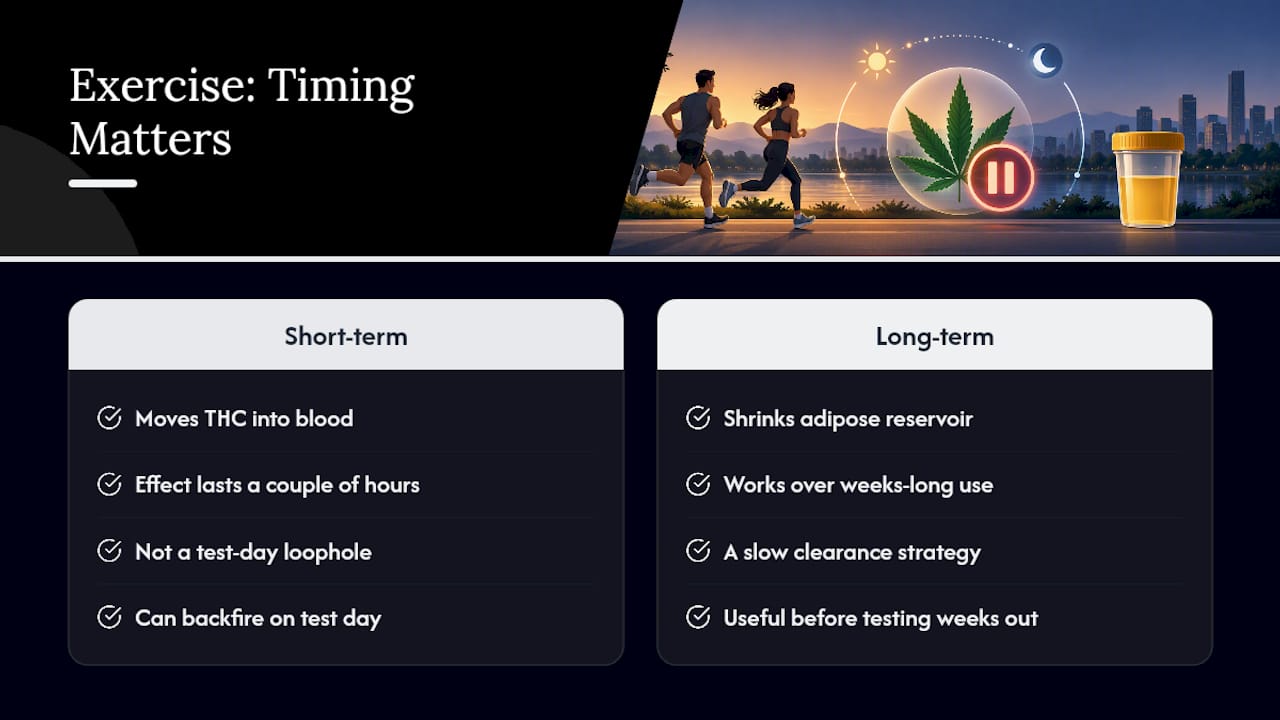
Most of what circulates online about “sweating out” THC treats exercise like a faucet you can turn on the morning of a test. It isn’t. The research shows a real but narrow effect: exercise moves THC into blood for a couple of hours, then the body settles back down. Treating that narrow window as a loophole is where people get into trouble.
I’d rather see someone use exercise the way it actually works for THC clearance: as a slow, weeks-long strategy that shrinks the adipose reservoir over time, not a 20-minute fix attempted the night before a test. That’s a different conversation than test-day tactics, and conflating the two is where most of the bad advice online comes from. If you’re looking at home testing tools or detox products to sort out where you actually stand, treat that as a next step worth taking seriously rather than a last resort.
— MIchael
Where to Go From Here With Passdrugtest
You can check where you actually stand with a home test kit before the real one shows up. That distinction matters when a scheduled or random screening is on the calendar and you have days, not weeks, to prepare.
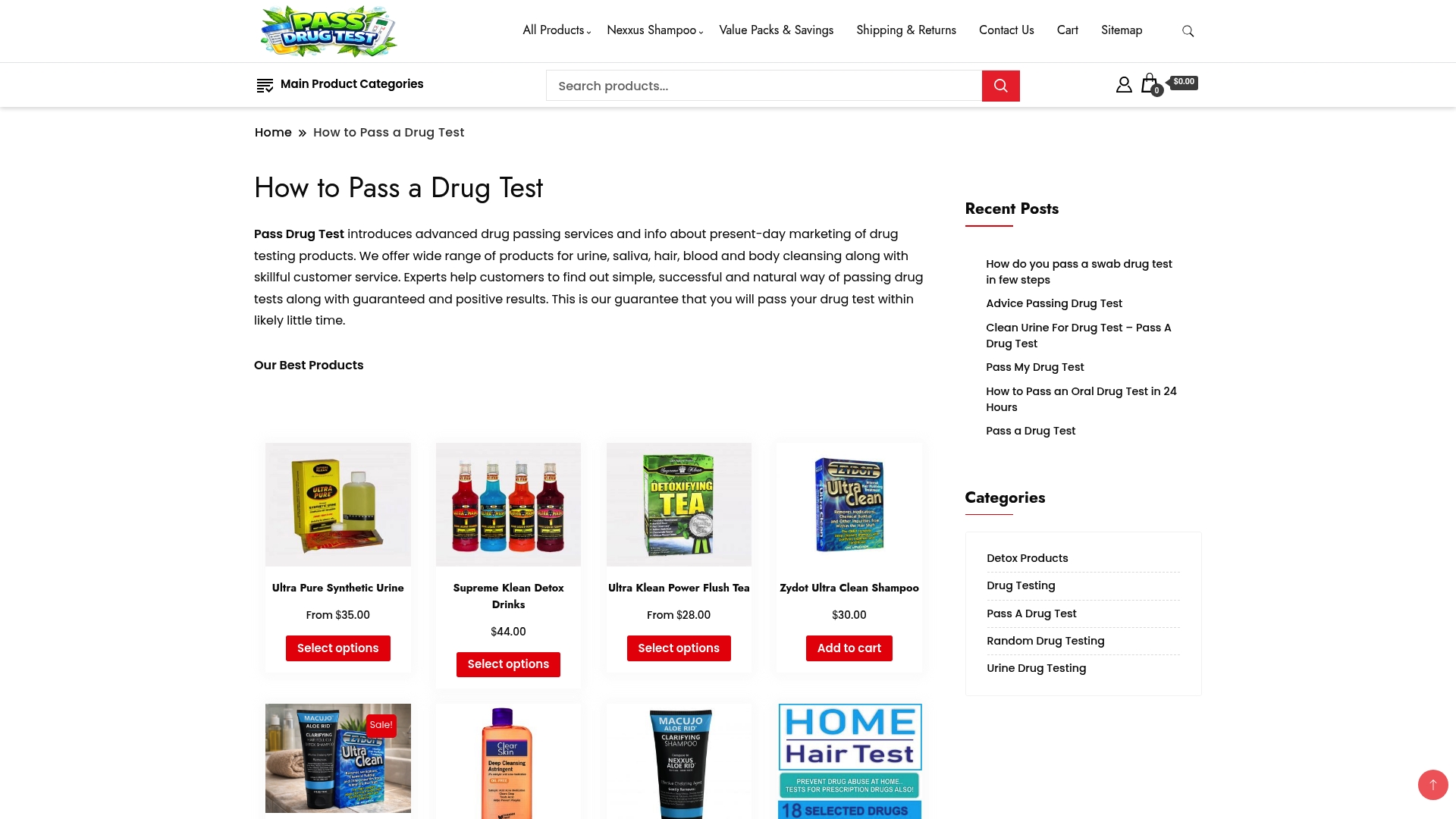
Our urine drug testing kits let you see your result days ahead of the real test, so you’re not relying on theory about plasma spikes and hoping it works out. If your situation involves a hair follicle test instead, that’s a different specimen with a different playbook entirely, since hair holds a much longer record of exposure that no workout will touch. For that scenario, there are specific detox approaches built around Aloe Rid Shampoo. The shampoo is featured in our hair follicle drug test shampoo guide. Readers dealing with a saliva swab test can look at our saliva detox mouthwash for a specimen type where timing works differently again. Start by figuring out which test you’re actually facing, then pick the resource that matches it at Passdrugtest.
Key Studies and Guidance Referenced
- Gunasekaran et al. (2013), PubMed — cycling and plasma THC spikes.
- Westin et al. (2014), PMC — exercise and urine THC-COOH in daily users.
- Detection windows by specimen type, PMC — urine, blood, and hair comparisons.
- SAMHSA MRO case studies — how unexpected results and dilute samples get handled.
Sources
- PubMed: Gunasekaran et al. (2013) — exercise and plasma THC
- Can physical exercise or food deprivation cause release of fat-stored cannabinoids? (Westin et al., 2014) — PMC
- Review: Drug detection windows by specimen type — PMC
- SAMHSA MRO case studies (2024)
FAQ
Does Exercise Get Drugs Out of Your System Quicker?
Not meaningfully for THC. Exercise mobilizes fat-stored THC into blood temporarily, but it doesn’t accelerate the metabolism and elimination process your liver and kidneys handle over days and weeks.
What Should You Avoid Before a Urine Drug Test?
Avoid vigorous aerobic exercise for 24 to 48 hours beforehand, since it can temporarily raise blood THC through fat mobilization. Also avoid extreme overhydration, which can produce a dilute specimen and trigger a retest under observed collection.
Will Pre-Workout Affect a Drug Test?
Pre-workout supplements themselves generally aren’t screened for on standard drug panels, but the intense exercise they fuel can still trigger the same transient THC mobilization described in the Gunasekaran study. The bigger risk is the workout, not the supplement.
Does Exercise Metabolize Drugs Faster?
Exercise speeds up fat mobilization, not liver metabolism, so it doesn’t accelerate how fast THC-COOH forms or clears from urine. The research on daily users found no significant change in urine metabolite levels after a moderate 45-minute workout.
Can Exercising Right Before a Hair Follicle Test Help?
No. Hair testing measures drug exposure already incorporated into the hair shaft over months, and nothing about a workout changes that record. If you’re facing a hair follicle test, the Macujo Method paired with Aloe Rid Shampoo addresses the hair itself rather than blood or fat stores, which is the actual variable that matters for that specimen type.