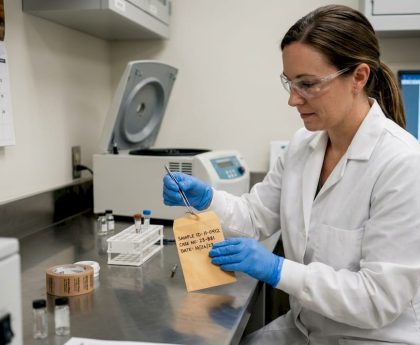
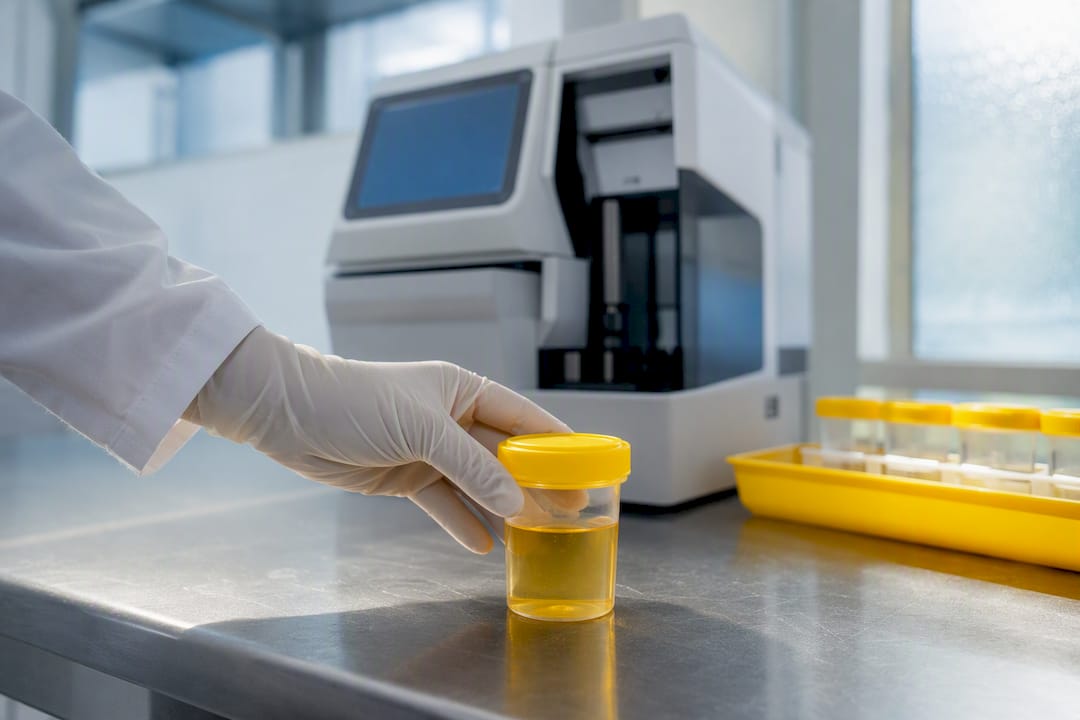

Urine adulterants are household chemicals, commercial masking agents, or substitute liquids added to a urine sample to hide drug metabolites from a screening test. Some, like nitrite or vinegar, can genuinely suppress cannabinoid results on quick immunoassay strips. But specimen validity testing and confirmatory lab methods like GC-MS catch the overwhelming majority of tampered samples, which is why supervised collection and lab-side SVT remain the real line of defense, not the chemical itself.
TL;DR:
- Household adulterants like bleach, vinegar, and eye drops are commonly used, but modern testing methods often detect these through specimen validity tests.
- Chemical adulterants such as oxidizers and pH manipulators either degrade drugs, block test reactions, or dilute metabolites, making labs’ confirmatory tests necessary for detection.
- Specimen validity testing measures physiologic markers like temperature, creatinine, specific gravity, and pH to identify tampering attempts, with lab protocols designed to catch most adulteration.
- Synthetic urine is increasingly sophisticated but can usually be identified through biomarker panels and temperature checks, making sample substitution harder to evade.
- Tampering with urine tests carries serious legal and health risks, including criminal charges, employment consequences, and exposure to caustic household chemicals.
Table of Contents
- Common Urine Adulterants: Household Chemicals vs. Commercial Products
- How Adulterants Work: Chemical and Analytical Mechanisms
- Specimen Validity Testing: The Markers Labs Check First
- Synthetic Urine and Sample Substitution: How Labs Catch a Swap
- What Happens at Collection and When a Sample Gets Flagged
- Publisher Note: What Detox Products Can and Cannot Promise
- Why People Adulterate Urine: Workplace, Sports, and Clinical Settings
- Legal and Regulatory Risk of Tampering with a Drug Test
- Health Risks of Common Urine Adulterants
- An Honest Note on Risk vs. Reward
- Where Passdrugtest Fits If You’re Preparing for a Test
- Sources
- FAQ
Common Urine Adulterants: Household Chemicals vs. Commercial Products
People reach for what’s under the sink before they research what actually works. That instinct explains why clinical labs see the same handful of household and commercial adulterants over and over, according to reviews cataloged in the NCBI Bookshelf’s clinical reference on drug test adulterants.
The list breaks into three practical categories: things people already own, things they buy specifically to beat a test, and full sample replacement.
- Household chemicals: bleach (sodium hypochlorite), white distilled vinegar (acetic acid), lemon or citric acid, table salt, laundry detergent, hydrogen peroxide, lye (sodium hydroxide), hand soap, and Visine or similar tetrahydrozoline-containing eye drops.
- Commercial masking products: glutaraldehyde-based formulas, potassium or sodium nitrite powders, peroxide or peroxidase compounds, and products built around pyridinium chlorochromate (PCC).
- Substitution products: synthetic urine formulated to mimic human chemistry, and in rarer cases, donor urine from someone else.
Not every adulterant hits every drug class the same way. A controlled experiment on point-of-care screening strips found that vinegar and other acids could push cannabinoid tests into a false negative, while the same acids often invalidated the strip outright rather than sneaking past it, according to research on urine adulterants and commercial screening test strips. Cannabinoids sit at the fragile end of the spectrum because THC-COOH is present in tiny concentrations to begin with. Cocaine metabolites, by contrast, tend to survive chemical interference far better simply because the assay’s cutoff margins are more forgiving.
Glutaraldehyde deserves its own mention because it was, for years, the most feared name in this category. It works differently than an acid or oxidizer. Rather than degrading the drug metabolite, it interferes with the antibody reaction the immunoassay depends on. That made it briefly effective against older test formats, which is exactly why most labs added a dedicated glutaraldehyde screen to their standard adulterant panels once its use became common.
How Adulterants Work: Chemical and Analytical Mechanisms
Every adulterant strategy falls into one of three buckets: degrade the drug, block the test from seeing it, or dilute it below the radar. Reviews of manipulation tactics in forensic toxicology group tampering this way, whether the sample is chemically altered, physically interfered with, or swapped entirely, according to research on sample manipulation detection.
Oxidizers do the heaviest chemical lifting. Nitrite, iodate, bleach, and peroxide all attack drug metabolites directly, and inter-laboratory testing has shown that nitrite and iodate specifically reduce measured concentrations of certain metabolites in submitted samples, per research on synthetic urine and adulterant performance. The metabolite doesn’t vanish. It gets chemically converted into something the immunoassay antibody no longer recognizes.
pH manipulation works on a different lever. Strong acids like vinegar or strong bases like lye shift the sample’s pH far outside the 4.5 to 8.0 range human urine normally occupies. That shift can distort antibody binding in an immunoassay, but it also degrades the sample itself, which is precisely the kind of red flag a pH strip is built to catch.
Surfactants and detergents take a third approach: physical interference. Soap, laundry detergent, and pectin-based commercial products coat or bind to antibody sites on the test strip, effectively blocking the reaction rather than destroying the drug. Dilution, whether added directly to the cup or achieved by drinking large volumes of water before testing, simply pushes the metabolite concentration under the assay’s cutoff threshold.
This is also the core reason immunoassays are the weak link and chromatographic confirmation is not. A screening immunoassay reacts to a chemical signature. Change that signature even slightly and the test can misfire. GC-MS and LC-MS/MS instead identify and quantify the actual molecule, which makes them far harder to fool with the same tricks.
Specimen Validity Testing: The Markers Labs Check First
Specimen validity testing is the first checkpoint every urine sample passes through, often before a single drug panel result is generated. It measures a handful of physiologic markers that are nearly impossible to fake all at once.
Pro Tip: If you’re ever curious why a lab asks for a temperature reading within four minutes of collection, it’s because that single 90 to 100 degree Fahrenheit window is one of the hardest adulteration signs to fabricate on the spot.
The core SVT panel typically includes:
- Creatinine, which should fall within a normal physiologic range; values below roughly 20 mg/dL suggest dilution, a threshold explained in detail in Passdrugtest’s breakdown of urine creatinine cutoffs.
- Specific gravity, a density measurement that flags samples diluted with water or swapped for a liquid that doesn’t match human urine’s concentration.
- pH, normally between 4.5 and 8.0; readings outside that band point to an acid or base additive.
- Temperature, checked at collection and expected between 90 and 100 degrees Fahrenheit.
- Oxidant and nitrite screens, which catch bleach, peroxide, and nitrite-based products directly.
- Ascorbic acid, checked because high concentrations can mask oxidant activity.
Clinical reference guides used by testing labs lay out specific cutoffs for each of these markers, and a value that falls outside physiologic range on more than one parameter typically triggers an automatic invalid or “requires follow-up” flag rather than a simple pass or fail, according to the Aegis Labs clinical reference guide on specimen validity testing. Many diagnostic labs, including academic medical centers, run dedicated adulterant screens checking for bleach, soap, vinegar, and other oxidants as a standard add-on panel, confirmed in Michigan Medicine’s adulterant screen test listing.
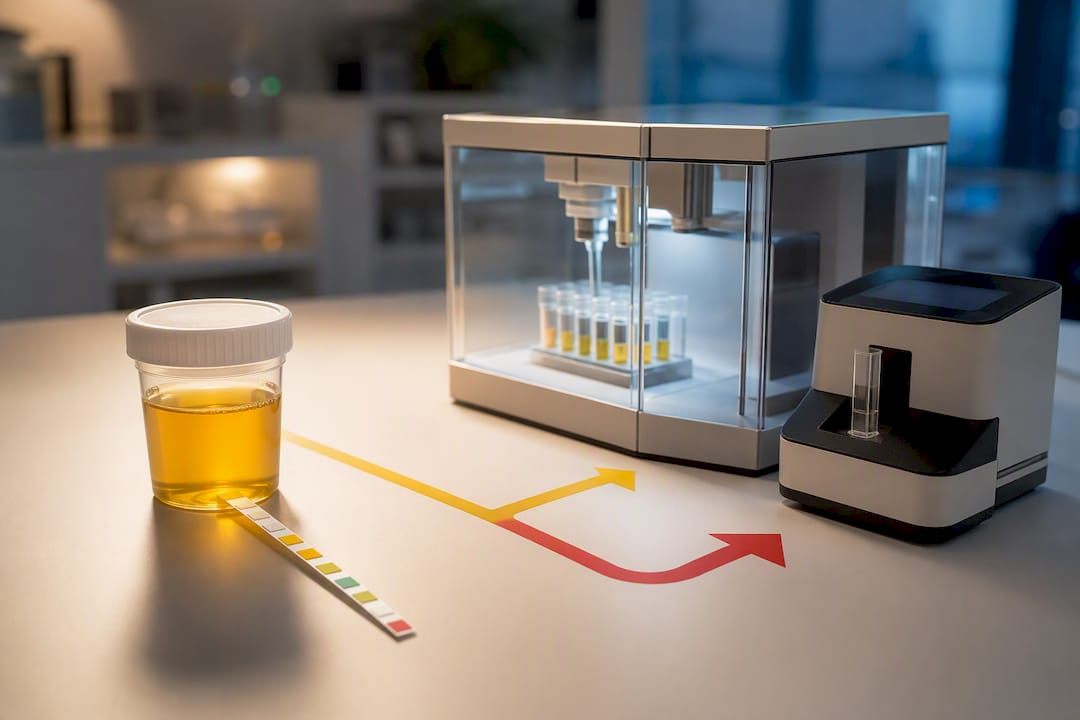
Commercial multi-parameter dipsticks used at collection sites can flag most of these markers within seconds, giving the collector an immediate signal before the sample ever leaves the building. Once a sample reaches the lab, oxidant tests and immunoassay signal-suppression patterns add a second layer, and any positive or suspicious result then moves to chromatographic confirmation. That two-tier approach, quick screening at the point of collection followed by instrument-based confirmation for anything questionable, is standard practice across most accredited labs today.
Synthetic Urine and Sample Substitution: How Labs Catch a Swap
Synthetic urine tries to replicate human urine at the chemical level: uric acid, creatinine, matching pH, and yellow coloring to pass a visual check. Older formulations skipped several of these markers entirely, which is why early synthetic products failed the moment a lab ran even a basic SVT panel.
Modern versions are considerably more sophisticated, and some can pass a simple dipstick test. That’s exactly why labs stopped relying on dipsticks alone. Biomarker panels that search for endogenous compounds, substances only present in genuine human metabolism, are becoming the standard countermeasure, since a well-formulated fake can match pH and creatinine but still lack the natural biological signature that comes from an actual human system, per emerging biomarker detection research.
Temperature remains the first and fastest tell, since keeping a synthetic sample within the 90 to 100 degree window during transport and handoff is harder than it sounds. Combine that with creatinine, full SVT, and a biomarker panel. Labs now have a layered system that’s considerably harder to beat than it was even a few years ago. If Passdrugtest’s own overview of synthetic urine products makes anything clear, it’s that formulation quality varies enormously between products, and older or poorly made kits are the ones most likely to get flagged.
When substitution is confirmed, the consequences escalate fast: a mandatory retest under direct observation, a documented chain-of-custody report, and in workplace settings, disciplinary action or termination depending on employer policy.
What Happens at Collection and When a Sample Gets Flagged
Most drug testing programs still use unobserved collection as the default, with direct visual observation reserved for situations involving a prior failed or invalid test, a specific policy requirement, or reasonable suspicion. It’s a privacy tradeoff every collection site has to manage, and it’s the main reason SVT technology carries so much weight. It does the verification work that a collector standing in the room would otherwise have to do.
When a sample flags on temperature, pH, creatinine, or an oxidant screen, the standard response follows a fairly consistent sequence:
- The original specimen is marked invalid or dilute rather than automatically failed.
- A second collection is requested, sometimes under direct observation depending on program policy.
- If a confirmatory result is contested, a split-sample retest can be run from the original specimen where one was collected.
- Chain-of-custody documentation is updated at each step to preserve the sample’s legal standing.
Not every flagged sample means tampering. Low creatinine shows up naturally in people who are well hydrated or who drink large volumes of water before a scheduled test, and some supplements and medical conditions can shift pH or specific gravity without any intent to deceive. Most lab policies account for this by allowing a retest rather than an automatic failure.
Pro Tip: If a legitimate medical condition or prescription might affect your results, disclosing it to your medical review officer before testing is almost always a better outcome than letting a flagged sample trigger an investigation.
The straightforward advice holds regardless of the setting: don’t attempt to tamper with a sample. If a positive result is a real concern, talk to HR about disclosure policies, or look into treatment and detox timelines that work with your body’s own clearance process rather than against a lab’s detection systems.
Publisher Note: What Detox Products Can and Cannot Promise
Detox shampoos, synthetic urine kits, and saliva and urine detox solutions are popular categories among people facing scheduled and random testing.
The peer-reviewed picture is clear on one point: modern SVT and confirmatory testing catch most tampering attempts, and no product on the market can promise otherwise against a properly administered panel. Detox and masking products can help in specific, narrower scenarios, particularly around natural clearance support, but they are not a substitute for understanding how a test is actually structured. Readers deserve that honesty before they buy anything.
Why People Adulterate Urine: Workplace, Sports, and Clinical Settings
Motivation shapes method, and the setting almost always predicts which adulterant shows up. Workplace testing programs see the highest volume of attempted tampering simply because employment consequences are immediate and personal: a failed test can mean a lost job offer or termination, which pushes people toward whatever is fastest and cheapest, usually a household chemical grabbed the morning of the test.
Competitive sports testing operates under a different pressure entirely. Athletes face scheduled and unannounced testing under strict chain-of-custody protocols, so simple household adulterants rarely make it past collection staff trained specifically to watch for tampering behavior. That’s part of why sports testing bodies were early adopters of direct observation and stringent SVT panels.
Clinical and treatment-program testing carries the most complicated motivations. Patients in pain management or substance use treatment may adulterate a sample out of fear of losing access to medication or being removed from a program, rather than to hide recreational use. Clinical settings tend to respond with more supportive follow-up, since the goal is usually treatment continuity rather than punishment, but a confirmed adulteration attempt can still trigger a change in care plan or provider mistrust that’s hard to rebuild.
Across all three settings, the pattern holds: adulteration attempts spike whenever the perceived cost of a positive result is high and the tester believes detection is unlikely. Better SVT technology has been steadily narrowing that second assumption.
Legal and Regulatory Risk of Tampering with a Drug Test
Adulterating a urine sample carries legal weight that goes beyond a failed test. A number of states have passed laws specifically criminalizing the sale, possession, or use of urine adulterants and substitution products, and roughly 18 states currently treat synthetic urine possession or use as a criminal offense, a landscape detailed in Passdrugtest’s guide to synthetic urine’s legal status by state.
Federal workplace testing under Department of Transportation rules treats a confirmed adulterated or substituted specimen as equivalent to a verified positive, often carrying harsher consequences than a straightforward positive result because it demonstrates intent to deceive. That distinction matters in employment law: many companies treat tampering as grounds for immediate termination rather than a disciplinary step, regardless of what the underlying drug test would have shown.
Court-ordered and probation testing programs go further still. An adulterated sample submitted during court-supervised testing can constitute a violation of probation terms independent of the drug result itself, sometimes resulting in additional charges. Regulatory bodies overseeing federally mandated testing programs, including transportation and safety-sensitive industries, maintain specific adulterant and substitution detection requirements precisely because the legal stakes of a false negative in those fields extend well past the individual being tested.
Health Risks of Common Urine Adulterants
Several of the most common household adulterants carry direct health risks that have nothing to do with whether they beat a drug test. Bleach and hydrogen peroxide are corrosive when ingested or when contact occurs with skin and mucous membranes during handling, and accidental exposure has sent people to emergency rooms.
Sodium hydroxide (lye) is significantly more dangerous. It’s a strong caustic capable of causing severe chemical burns on contact, and it has no business being handled without protective equipment, let alone introduced into a sample someone then has to transport and handle repeatedly.
Nitrite-based commercial products pose a different kind of risk. Nitrites can be toxic in concentrated form, and cases of nitrite poisoning tied to adulterant products have been documented in emergency medicine literature, with symptoms ranging from headache and dizziness to more serious methemoglobinemia in severe exposures. Glutaraldehyde is a recognized skin and respiratory irritant, which is part of why occupational safety guidelines restrict its handling even in industrial contexts, let alone informal use.
Even something as ordinary as excessive water intake to dilute a sample carries a real, if less discussed, risk: water intoxication and dangerous electrolyte imbalance in extreme cases. None of these risks depend on whether the adulteration attempt actually works. The exposure happens either way.
An Honest Note on Risk vs. Reward
Readers researching this topic usually want one of two things: to understand how detection actually works, or to figure out if a specific substance will get them past a test. The uncomfortable truth is that the second goal has gotten measurably harder to achieve every year, while the legal and health risks tied to trying have stayed exactly as serious as they’ve always been.
What gets underestimated is how much detection technology has shifted the odds. A decade ago, a well-chosen household chemical had a real shot at slipping past a basic dipstick. Today’s layered approach, combining SVT, oxidant screens, and chromatographic confirmation, means a chemical shortcut is more likely to produce an invalid flag and a mandatory retest than a clean pass. That outcome is often worse than a straightforward positive, since it signals intent and invites closer scrutiny going forward.
If there’s a lawful, low-risk path worth pursuing instead, it starts with understanding your own body’s clearance timeline and disclosing anything relevant through the proper channels rather than reaching for a bottle from under the sink.
— MIchael
Where Passdrugtest Fits If You’re Preparing for a Test
Everything above explains why chemical shortcuts and improvised adulterants are a losing bet against modern lab detection. Some providers offer products based on the Macujo Method developed by Mike Macujo, which targets the hair shaft directly rather than relying on masking chemistry that labs can detect; this approach is considered effective by some for passing a hair follicle drug test.

Various sellers offer hair, saliva, and urine testing kits and detox solutions for people who want to understand where they stand before test day rather than guess.
If a hair follicle test is on your calendar, start with the Macujo Aloe Rid Shampoo product page to see exactly how the method works and whether it fits your timeline. For urine or saliva testing needs, browse the full range of drug testing and detox products to find the option that matches your situation.
Sources
- Update on Urine Adulterants and Synthetic Urine Samples to Subvert Urine Drug Testing
- Adulterants and related substances used to beat urine drug tests (NCBI Bookshelf)
- Effect of urine adulterants on commercial drug abuse screening test strip results
- Specimen Validity Testing and Specimen Tampering (Aegis Labs clinical reference guide)
- Adulterant Screen, Urine — Michigan Medicine
FAQ
What Are the Most Common Adulterants Found in Urine Drug Testing?
The most common adulterants include household items like bleach, vinegar, table salt, hydrogen peroxide, and Visine eye drops, plus commercial products containing glutaraldehyde, nitrite, or peroxide compounds. Reviews of clinical testing data list these as the substances labs screen for most often, detailed in the NCBI Bookshelf’s adulterant overview.
Can a Lab Tell if Urine Is Synthetic?
Yes, modern labs increasingly use biomarker panels that check for endogenous compounds only present in genuine human urine, catching synthetic samples that pass basic dipstick checks. This approach is described in research on synthetic urine detection methods, and it’s a major reason older synthetic formulas no longer reliably work.
Can a Lab Tell if Urine Is From a Different Person?
Labs don’t run DNA matching on standard drug screens, but specimen validity testing checks temperature, creatinine, specific gravity, and pH, all of which can flag a substituted sample if it doesn’t match expected physiologic ranges. Combined with observed collection in high-risk cases, substitution is difficult to pull off undetected.
What Are the Three Types of Adulteration?
Toxicology literature groups adulteration into three strategies: diluting the sample to push metabolite levels below detection cutoffs, chemically interfering with the assay itself through oxidizers or pH shifts, and substituting the sample entirely with synthetic or donor urine. This framework comes from research on sample manipulation detection in forensic toxicology.
Does Passdrugtest Sell Products That Guarantee a Passed Test?
Passdrugtest sells detox shampoos, synthetic urine, and detox solutions designed to support specific testing scenarios, with the Macujo Aloe Rid Shampoo as the flagship hair test product. No legitimate product can guarantee passing a properly administered test with full specimen validity checks, and current pricing is available directly on the Passdrugtest product pages.