
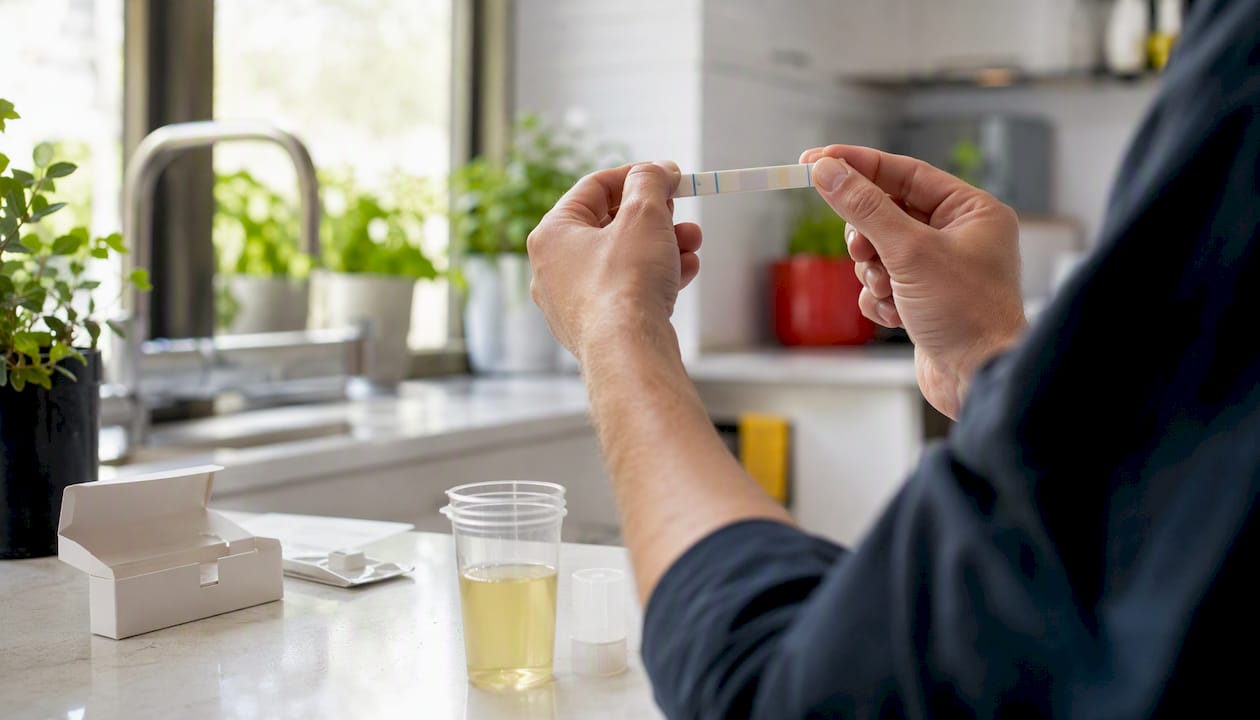

You can sometimes get a negative result on an at-home urine test, but you cannot reliably guarantee passing a formal lab screening. That’s the honest answer, and it matters more than most guides admit. At-home kits use immunoassay screening, a technology that detects drug metabolites above a set concentration threshold. They are not the same as the confirmatory tests used by employers, courts, or clinical labs. SAMHSA sets the standards for workplace drug testing programs, and those programs require confirmatory analysis using GC-MS or LC-MS/MS before any positive result is considered legally defensible. The FDA also maintains guidance on home-use devices and is explicit that consumer kits are screening tools, not diagnostic instruments.
Three reasons a home negative isn’t a guarantee:
- Different cutoff concentrations. Home kits often use a 50 ng/mL THC cutoff; some labs screen at 20 ng/mL.
- No chain of custody. Without observed collection and documented handling, a home result carries zero legal weight.
- Confirmatory testing. A lab will run GC-MS or LC-MS/MS on any screen-positive sample, catching metabolites an immunoassay missed or misidentified.
Pro Tip: Use a reliable at-home kit from Passdrugtest for self-monitoring in the days before any scheduled test. If the stakes are high, treat a home negative as provisional and plan for lab confirmation.
Safety warning: household adulterants like bleach, drain cleaner, or vinegar are dangerous. Clinical evidence confirms they are ineffective and carry serious health risks. Never ingest or add them to a urine sample.
Table of Contents
- How do at-home urine drug tests actually work?
- What are the real detection windows for common drugs?
- What methods do people try, and why do they often fail?
- What are your safest, legal options before an at-home test?
- How do you buy, use, and read an at-home urine test correctly?
- Key Takeaways
- The honest truth about at-home drug tests
- Passdrugtest has the kits and prep products you need
- Useful sources
How do at-home urine drug tests actually work?
At-home urine drug tests are immunoassay-based screening devices. Each test strip or cassette contains antibodies that bind to specific drug metabolites. When metabolite concentration in the urine exceeds the kit’s cutoff threshold, the antibodies are saturated and a colored line does not appear on the test strip. A missing line in the drug zone means a presumptive positive. Two lines, including a faint one, typically mean a negative result.
The Mayo Clinic Laboratories confirms that home kits are screening immunoassays and that lab confirmation using GC-MS or LC-MS/MS is required for any definitive, legally defensible result. GC-MS (gas chromatography-mass spectrometry) and LC-MS/MS (liquid chromatography-tandem mass spectrometry) identify specific drug compounds by molecular weight and structure, not just antibody binding. They can distinguish between a true positive and a cross-reactive substance that triggered a false alarm on your home kit.
Chain of custody is the other critical difference. A certified lab collection involves:
- Observed or monitored sample collection
- Temperature verification at the time of collection
- Tamper-evident sealing and documented handling
- A split sample preserved for potential re-testing
None of that happens with a home test. Testing.com notes that at-home tests are useful for personal monitoring but lack the collection controls that make lab results legally defensible. Some home kits do offer a mail-in confirmation option, which adds a layer of certainty if you need it.
Common at-home sample types include urine and oral fluid (saliva). Urine is by far the most common for consumer kits because detection windows are longer and the technology is well-established.
Pro Tip: Read the kit’s instruction sheet before you open the foil pouch. Timing matters: most cassette tests require you to read results at exactly 5 minutes. Reading too early or too late produces unreliable lines.
What are the real detection windows for common drugs?
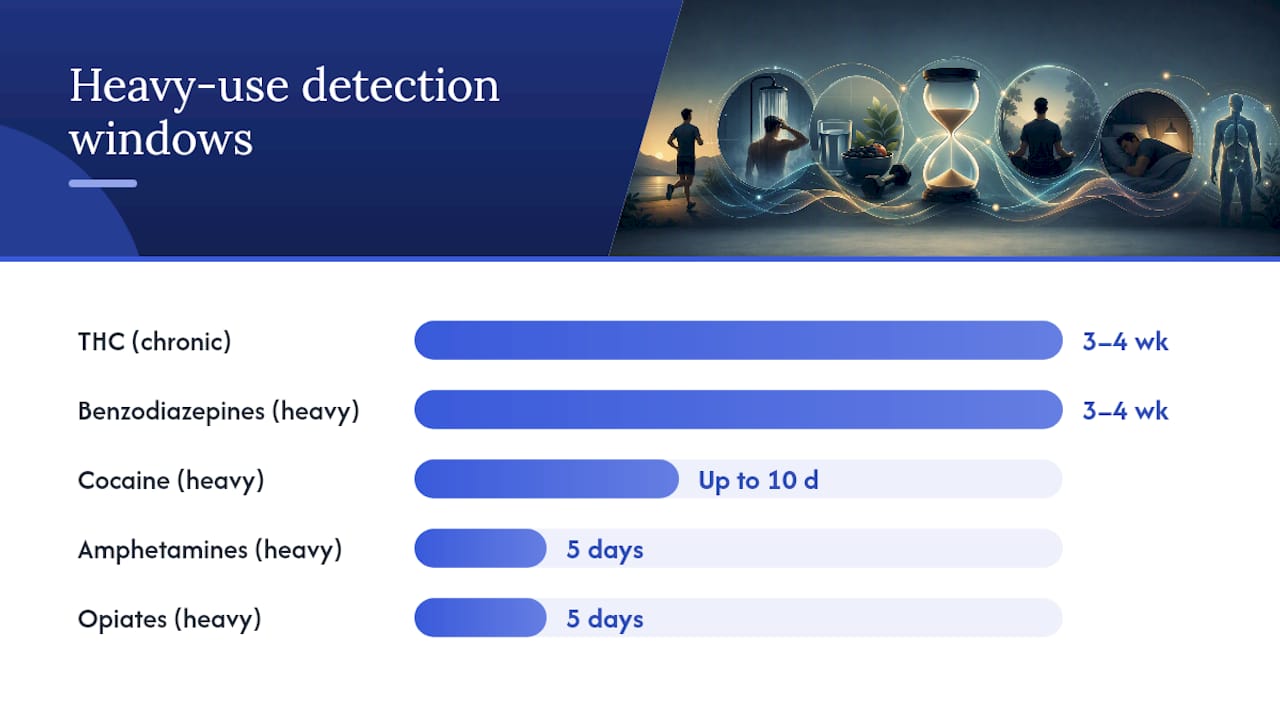
Detection windows vary by drug, frequency of use, and individual biology. The table below reflects typical urine detection ranges drawn from clinical reference data.
| Drug | Single Use | Occasional Use (2-3x/week) | Heavy/Chronic Use |
|---|---|---|---|
| THC (marijuana) | 1–3 days | 5 days | 10 days or longer |
| Cocaine | 2–4 days | 3–5 days | Up to 10 days |
| Amphetamines | 1–3 days | 3–5 days | 5 days |
| Opiates (heroin, morphine) | 1–3 days | 3–5 days | 5 days |
| Benzodiazepines | 1–3 days | 5 days | 3–4 weeks |
THC is the outlier. Because THC metabolites are fat-soluble, they accumulate in body fat and release slowly. A chronic daily user can test positive for three to four weeks after stopping, sometimes longer. Cocaine and amphetamines clear much faster because their metabolites are water-soluble.
Several factors shift these windows significantly:
- Body fat percentage — Higher body fat stores more THC metabolites and extends clearance time.
First morning urine is the most concentrated sample of the day. Metabolites that have accumulated overnight are at their highest concentration, making a positive result more likely. If you’re self-testing to track clearance, testing with first morning urine gives you the worst-case reading. Passing that sample is a stronger signal than passing a diluted afternoon sample.
Pro Tip: Test yourself every 48–72 hours using first morning urine to map your personal clearance timeline. For THC specifically, check out the urine drug test marijuana guide on Passdrugtest for timeline-specific prep advice.
What methods do people try, and why do they often fail?
People attempt four main categories of methods when trying to pass a urine drug screening test. Each has a detection mechanism that labs and even some home kits are designed to catch.
Dilution and flushing
Drinking large amounts of water before a test lowers the concentration of metabolites in urine. For an immunoassay set at 50 ng/mL, this can push a borderline sample below the threshold. Labs counter this with two checks: creatinine concentration (normal urine contains 20–300 mg/dL; diluted urine drops below 20 mg/dL) and specific gravity (normal range is 1.003–1.030; heavily diluted urine falls below 1.001). A sample flagged as diluted is often reported as invalid or inconclusive, not negative, which typically triggers a retest.
Household adulterants
Adding bleach, vinegar, salt, or other household chemicals to a urine sample is dangerous and largely ineffective. Clinical research warns that ingesting caustic substances carries serious health risks, and modern test strips detect pH abnormalities, oxidizing agents, and nitrites that common adulterants introduce. A sample with a pH outside the 4.5–8.5 range or a positive oxidant reading is flagged as adulterated, which is treated the same as a positive result in most employment contexts.
Synthetic urine and sample substitution
Synthetic urine products are formulated to mimic the chemical profile of real urine: creatinine, urea, pH, and specific gravity. The challenge is temperature. Real urine exits the body at 90°F–100°F. Collectors check temperature within four minutes of collection. A sample outside that range is immediately flagged as substituted. Modern lab panels also test for uric acid and other biomarkers not always present in older synthetic formulas. ADLM Clinical Lab News documents how labs have progressively added validity checks specifically to catch substitution attempts.
Detox drinks and supplements
Commercial detox drinks work by temporarily diluting urine and supplying B vitamins and creatine to restore normal color and creatinine levels. The window of effect is short, typically two to five hours, and varies by individual metabolism, body weight, and how recently the person used. There is no consistent clinical validation showing they reliably produce a negative result across all users. They are not a guaranteed solution; they are a dilution strategy with better optics.
Why would a method fail or trigger an invalid result?
Labs run validity checks on every sample: pH, creatinine, specific gravity, oxidants, and nitrites. Any reading outside the accepted range produces an invalid or adulterated result, which carries the same consequence as a positive in most workplace programs. A home test does not run validity checks, so a method that “works” at home may still fail at the lab.
For a detailed look at real-world failures, the real examples of failed drug tests page on Passdrugtest breaks down the most common mistakes and why they happen.
What are your safest, legal options before an at-home test?
The safest preparation strategy starts with stopping substance use as early as possible. Time and metabolism are the only mechanisms that reliably reduce metabolite concentration. Everything else is a modifier, not a solution.
Immediate steps to take:
- Stop all substance use immediately.
- Hydrate at a normal, steady rate (not excessive flushing, which triggers dilution flags).
- Exercise regularly to accelerate metabolism, but stop intense exercise 24–48 hours before the test because fat-burning releases stored THC metabolites into the bloodstream temporarily.
- Eat a fiber-rich diet to support metabolite excretion through the digestive tract.
- Use at-home test kits from Passdrugtest to track your clearance every 48–72 hours.
If you’re facing a supervised or employer-ordered test, you have the right to ask the collector about the cutoff concentrations used, whether the test is observed, and what the confirmatory testing policy is. That information helps you understand what threshold you actually need to clear.
When to seek medical review:
If you take prescription medications that are known to cause false positives (bupropion, certain antihistamines, rifampin, some NSAIDs), bring documentation to the collection site. A medical review officer (MRO) at the lab can factor in your prescription list before reporting a result to an employer. This is a legitimate, legal process and can prevent a false positive from being reported as a confirmed positive.
If you test positive on a critical screen, you can request a split-sample confirmation. Under SAMHSA guidelines for federally mandated testing programs, you have the right to have the “B” portion of your split sample sent to a second certified laboratory for independent GC-MS confirmation.
Pro Tip: Keep the packaging and lot number from any home kit you use. If you need to dispute a result later, documentation of your self-testing history, including the kit brand, cutoff level, and result date, supports your case. Check the warning signs before a drug test guide for a full pre-test checklist.
For readers with more time to prepare, the whole body cleansing section on Passdrugtest outlines longer-term detox routines that support natural metabolite clearance.
How do you buy, use, and read an at-home urine test correctly?
Choosing the right kit matters as much as using it correctly. Not all consumer strips are equivalent.
What to look for when buying:
- Documented cutoff concentrations (ideally matching the lab standard you’ll face)
- Multi-panel options if you need to screen for more than one substance
- Clear expiration date and intact foil packaging
- Included instructions with timing guidance
- A mail-in confirmation option for high-stakes situations
Passdrugtest’s home drug testing kits page lists validated options with documented cutoffs, which removes the guesswork about what threshold you’re actually testing against.
Step-by-step sampling:
- Collect a midstream urine sample, not the first or last portion of the stream.
- Test in the afternoon or evening rather than with first morning urine if you want a more favorable (less concentrated) reading. Use first morning urine if you want a worst-case baseline.
- Check the sample temperature immediately if your kit includes a temperature strip (90°F–100°F is the valid range).
- Dip the strip or fill the cassette well exactly as instructed.
- Read the result at the specified time window, typically 5 minutes. Do not read after 10 minutes; evaporation lines can appear and mimic a negative.
Reading your results:
- Two lines (including a faint one): Negative. Any visible line in the drug zone, no matter how faint, counts as a negative result.
- One line (control only): Presumptive positive. The drug zone line is absent, meaning metabolite concentration exceeded the cutoff.
- No lines at all: Invalid result. The control line failed, meaning the test did not work correctly. Retest with a new kit.
- Line in drug zone, no control line: Invalid. Discard and retest.
For THC clearance tracking, test every 48–72 hours while abstaining. You’ll typically see a gradual progression from positive to faint positive to negative over days or weeks, depending on your use history.
Pro Tip: If you’re hydrating heavily on test day to dilute your sample, take 50–100 mg of B2 or B12 to restore urine color and consider a creatine supplement (5 g with water) to bring creatinine levels back into the normal range. This reduces the chance of a dilution flag, but it does not guarantee a valid result if your metabolite levels are still above the cutoff.
Key Takeaways
Home drug tests are self-screening tools, not legal proof, and a negative result at home does not guarantee passing a certified lab test that uses lower cutoffs and GC-MS confirmation.
| Point | Details |
|---|---|
| Home tests are screening tools only | Immunoassay kits detect metabolites above a threshold; they cannot replace GC-MS lab confirmation. |
| Detection windows vary widely | THC can stay detectable for three to four weeks in chronic users; cocaine clears in 2–4 days for single use. |
| Cheating methods are detectable | Labs run validity checks for dilution, adulterants, and substitution alongside every drug screen. |
| Tampering carries legal and health risks | Adulterating a sample in an employment context can be a federal offense; household chemicals are dangerous. |
| Passdrugtest offers validated kits | Use Passdrugtest’s detox products and kits for self-screening and preparation with documented cutoffs. |
The honest truth about at-home drug tests
Most guides on this topic either oversell the reliability of home tests or undersell the risks of trying to beat them. After writing extensively about test preparation and reviewing the clinical literature, my view is that the biggest mistake people make is treating a home negative as a finish line.
A home test is a data point. It tells you your metabolite concentration is below a specific threshold at a specific moment. It says nothing about what a lab running at a lower cutoff will find 48 hours later, or what GC-MS will identify that the immunoassay missed. The gap between “passed my home test” and “passed the lab test” is where most people get caught.
The other underappreciated risk is the validity panel. People spend significant effort trying to dilute or adulterate a sample and never consider that the lab isn’t just testing for drugs. It’s testing whether the sample is real urine. Creatinine below 2 mg/dL doesn’t produce a negative result; it produces a specimen substitution finding, which is treated as a refusal in most federally regulated programs.
What actually works is time, abstinence, and honest self-monitoring with a quality home kit. The products Passdrugtest carries, including validated urine test kits and preparation support products, are tools for that process. They help you understand where you stand. They are not a workaround for a body that hasn’t cleared yet.
Passdrugtest has the kits and prep products you need
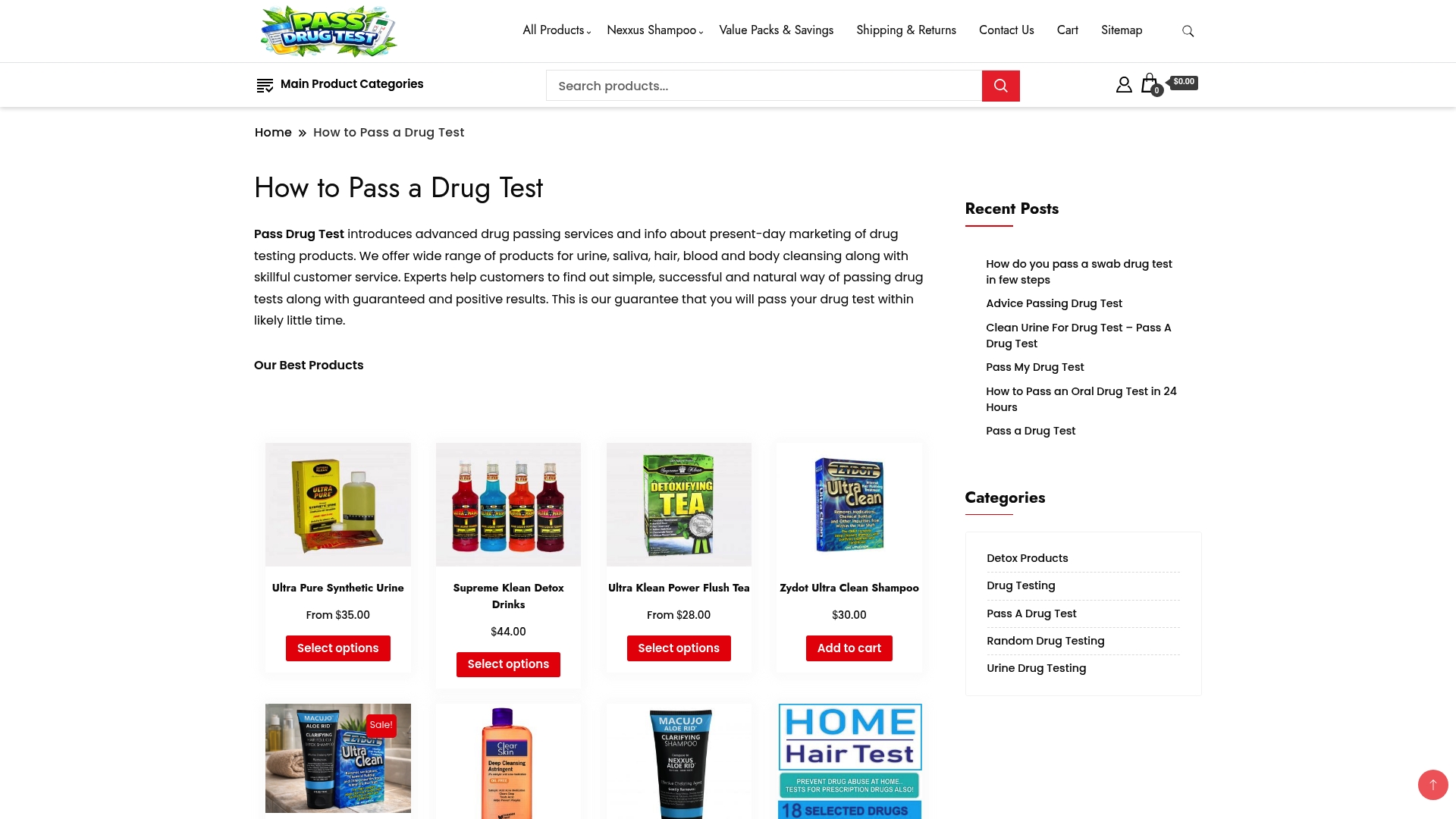
When you need to know where you stand before a scheduled test, the right starting point is a validated kit with documented cutoffs, not a gas station strip with no specifications on the label. Passdrugtest carries a full range of urine preparation products and detox support kits designed specifically for marijuana users and anyone facing a urine drug screen.
The difference between Passdrugtest and a generic pharmacy option is specificity. Every product in the catalog is selected for documented performance, clear instructions, and known cutoff levels. You get the information you need to make a real decision about your timeline, not a vague promise.
If your situation involves a hair follicle test rather than urine, Passdrugtest also carries the full range of hair detox solutions, including the Macujo Aloe Rid Shampoo. Browse the detox products catalog and find the right preparation path for your test type and timeline.
This article is general information, not medical or legal advice. Confirm current testing policies and cutoff standards with your employer, collector, or a qualified professional.
Useful sources
The following authoritative sources informed this article. Each covers a specific aspect of drug testing, detection, and preparation.
- Mayo Clinic Laboratories: Drugs of Abuse testing overview
- PubMed indexed clinical warning on dangerous adulterants and test circumvention attempts
- FDA — Drugs of abuse home-use tests
- SAMHSA (U.S. Substance Abuse and Mental Health Services Administration)
- NCBI Bookshelf: Drug testing and detection windows
- Testing.com — At‑Home Drug Tests: How they work and what to know
- How People Try to Beat Drug Testing — ADLM Clinical Lab News
- Therecoveryvillage — Is it possible to cheat a drug test?
- TestGuide — Comprehensive drug screen overview (UW Lab Medicine)