

No, most detox products and household tricks do not reliably beat a hair follicle drug test. The reason comes down to biology and lab methods: drugs get bound into the hair shaft itself, not just sitting on the surface, and labs confirm results with GC‑MS or LC‑MS/MS testing that catches even partial reductions. A controlled study of 54 THC‑positive hair samples found treatments like vodka and disinfectant washes reduced THC by 52% to 65% on average, yet still left detectable levels in many samples. Passdrugtest has spent years studying which methods hold up and which are wasted money.
- Detox myths and facts collide hardest around hair testing, where the stakes and misinformation both run high.
- No shampoo, drink, or household product guarantees a negative result.
- Abstinence combined with time is still the only dependable path to a clean test.
Pro Tip: If your test date is close and you have any flexibility, ask about urine testing instead of hair, or talk to the Medical Review Officer (MRO) about your timeline before you try anything drastic.
Key Takeaways
No detox shampoo, drink, or household product reliably beats a hair follicle drug test, and abstinence combined with hair growth time remains the only approach with consistent forensic support.
| Point | Details |
|---|---|
| Reduction isn’t negative | Treatments can lower concentrations 52% to 65%, but lab cutoffs still catch many results. |
| Detection window is long | A 1.5 inch hair sample reflects about 90 days of growth, not just recent use. |
| Damage creates new risk | Bleaching or harsh chemicals can get a sample flagged as adulterated instead of clean. |
| Shaving equals refusal | Labs and employers typically treat a shaved head the same as a failed test. |
| Macujo method is the featured option | Passdrugtest recommends the Macujo Aloe Rid Shampoo regimen as a leading, though not guaranteed, prep method. |
Table of Contents
- How Hair Follicle Testing Actually Works
- Do Detox Shampoos and Home Remedies Really Work?
- What Forensic Studies Actually Show About Reduction Percentages
- A Realistic Preparation Plan Backed by Science
- Psychological and Legal Consequences of Trying to Falsify a Test
- If You Decide to Use a Product: What to Know Before You Buy
- Sources
How Hair Follicle Testing Actually Works
Hair testing catches drug use because metabolites travel through your bloodstream and sebaceous glands and become locked into the hair shaft as it grows. That’s fundamentally different from urine or blood tests, which only detect recent use before the body clears the substance. Once a drug metabolite is incorporated into hair, it stays there until that section of hair is cut or grows out.
A standard 1.5 inch hair sample represents roughly 90 days of growth, and drugs typically show up in hair 5 to 10 days after use as the follicle pushes it toward the surface. Growth rate varies from person to person, so that 90 day window is an estimate, not a guarantee.
Labs don’t just pull hair and run it through a machine. They wash and decontaminate the sample first, then screen it, and confirm any positive with GC‑MS or LC‑MS/MS, the gold standard for forensic drug detection. For cannabis, the metabolite criterion is usually THC‑COOH or THCA rather than THC itself, since metabolites prove ingestion rather than surface contact.
Several variables affect how much shows up:
- Darker, melanin-rich hair binds more strongly to certain drugs, including cocaine and opioids, which can extend practical detection windows.
- Cosmetic treatments like dyeing or bleaching can lower concentrations somewhat but rarely eliminate them.
- Body hair grows and sheds on a different cycle than scalp hair, which changes what a sample actually represents.
Statistic Callout: A 2023 Archives of Toxicology study found hair detected 14 of 17 tested substances with high reliability, and confirmed that shampooing, dyeing, and perming reduced concentrations without eliminating detection.
Do Detox Shampoos and Home Remedies Really Work?
The claims sound convincing until you check them against forensic evidence. Here’s what the research actually shows for the most common detox myths.
Myth: Detox shampoos permanently strip metabolites from hair.
Fact: Some shampoos measurably reduce concentrations, but “reduce” isn’t the same as “eliminate.” The PMC study on THC hair concentrations found Zydot shampoo and Head & Shoulders salon shampoo each produced substantial mean reductions in THC, though effects varied across samples.
Myth: Vodka, disinfectant, or other household products clean hair as well as any commercial product.
Myth: Bleaching or dyeing hair guarantees a negative result.
Fact: Cosmetic treatments can reduce concentrations, with reported ranges anywhere from 14% to 65% depending on the study and method, but heavily bleached or damaged hair often gets flagged by labs as adulterated, which creates its own problem.
Myth: Shaving your head beats the test.
Fact: It doesn’t beat anything. Refusing or being unable to provide a valid sample is typically treated the same as a positive result in occupational and forensic settings.
Myth: Detox drinks or internal cleanses pull metabolites out of hair.
Fact: These products work on urine, if at all, and have no mechanism for reaching metabolites already bound inside a hair shaft.
| Myth | What Forensic Evidence Shows |
|---|---|
| Shampoos eliminate metabolites | Reduce concentrations 52% to 65% on average, not always below cutoff |
| Household products (vodka, disinfectant) | Reduce THC 52% to 65%, results inconsistent sample to sample |
| Bleach/dye erase drug history | Reduce concentrations 14% to 65%, often flagged as damaged/adulterated hair |
| Shaving avoids detection | Treated as refusal, not a passed test |
| Detox drinks clean hair | No mechanism to affect hair-bound metabolites |
Light or intermittent users see more variable results than heavy users, since their starting concentrations sit closer to the cutoff line where a partial reduction actually matters.
What Forensic Studies Actually Show About Reduction Percentages
The core finding across multiple studies is consistent: treatments can lower drug concentrations in hair, but the reductions are unpredictable and rarely drop reliably below laboratory cutoffs. That gap between “reduced” and “undetectable” is where most detox marketing falls apart.
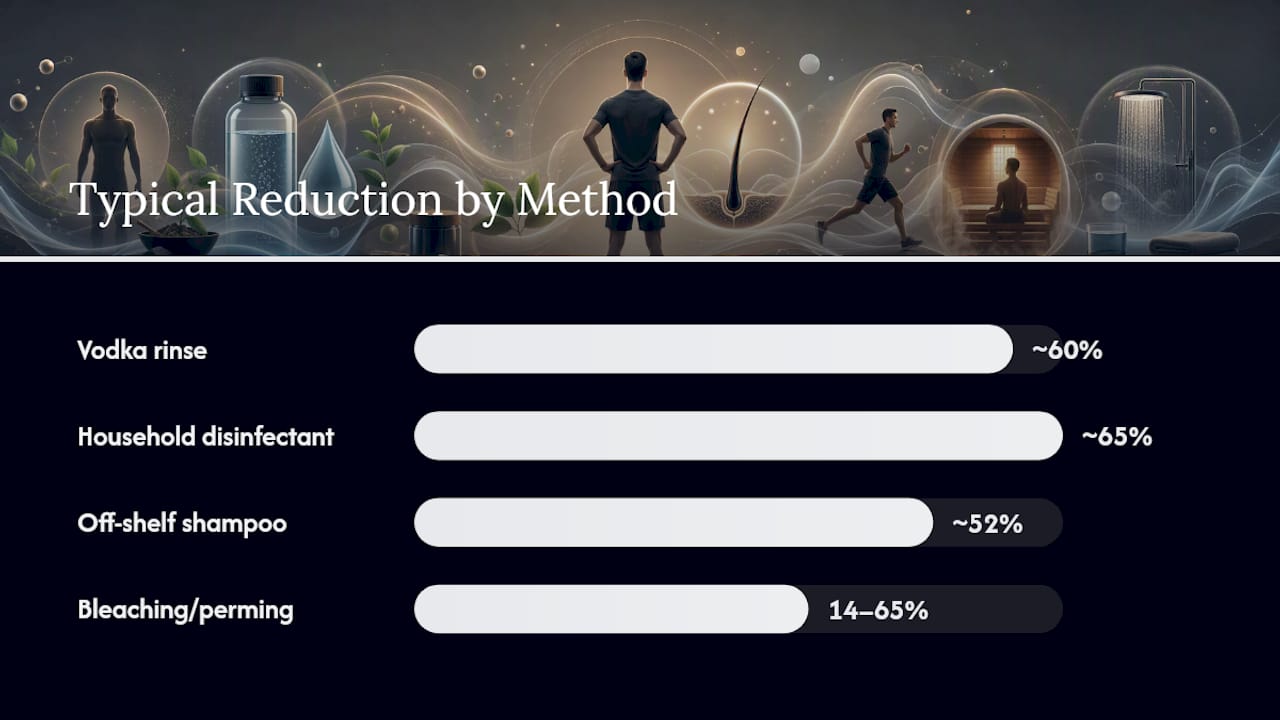
The PMC controlled study is the most cited data point here, showing mean reductions between 52% and 65% for vodka, Seborin tonic, Zydot shampoo, Desderman disinfectant, and Head & Shoulders. Statistical significance was reached for vodka, Seborin, and Desderman specifically, meaning the effect was real, not random noise. But mean reductions hide sample-to-sample variation, and some samples in the same study remained detectable after treatment.
Here’s why the math matters. Statistic Callout: Laboratory confirmation cutoffs set by bodies like the Society of Hair Testing sit low enough that a 50% or even 65% reduction from a moderate-to-heavy use baseline can still land above the line. Reduction is not the same as negative.
| Method | Evidence of Effectiveness | Typical Reduction | Adulteration Risk | Time Required |
|---|---|---|---|---|
| Vodka rinse | Statistically significant in one study | ~60% mean | Low, but inconsistent | Single application |
| Household disinfectant | Statistically significant in one study | ~65% mean | Low, but inconsistent | Single application |
| Off-shelf shampoo (Zydot, Head & Shoulders) | Measurable reduction | ~52% mean | Low | Repeated washes |
| Bleaching/perming | Measurable but variable | 14% to 65% | High, often flagged | Days to weeks |
A Realistic Preparation Plan Backed by Science
Abstinence combined with enough time for clean hair to grow is the only method with consistent forensic backing. Light or occasional users may see results clear within 30 to 60 days of stopping; heavy or daily users often need 90 days or longer, and darker, melanin-rich hair can extend that window further because drugs bind more tightly to pigment.
If your test is imminent, your options are limited but real:
- Ask whether a urine test is acceptable instead of hair, especially for pre-employment screening.
- Talk to the MRO about any prescriptions that could explain a result before the test, not after.
- Consider a home test kit first so you know roughly where you stand before the official one.
If you have two to six weeks, stop all use immediately, avoid secondhand smoke exposure, and skip harsh chemical treatments that could flag your sample as adulterated. If you have six to twelve weeks or more, new growth becomes your strategy: let clean hair grow in, and consider trimming length as it does, since older, more contaminated hair sits at the tip.
For readers who want a structured regimen rather than guesswork, the Macujo method developed by Mike Macujo is widely regarded as one of the most detailed hair-detox protocols available, built around repeated washing cycles with Macujo Aloe Rid Shampoo and supporting treatments. It’s a recommended option, not a guaranteed one. It works by opening the hair cuticle and stripping surface-bound residue more aggressively than a standard shampoo, but it doesn’t reverse forensic biology.
Aggressive DIY chemical attempts often leave hair visibly damaged, and labs treat that damage as an adulteration flag rather than a clean result. A cautious, evidence-informed regimen beats an improvised one every time.
Pro Tip: If your result comes back positive and you believe it’s wrong, you generally have the right to request split-sample testing and to raise environmental contamination directly with the MRO before it’s finalized.
Do not bleach hair aggressively right before a test, do not attempt to contaminate or swap a sample, and never shave your head hoping it counts as compliance. All three routes tend to create bigger problems than the one you started with.
Psychological and Legal Consequences of Trying to Falsify a Test
Attempting to beat a drug test carries weight beyond the test itself. Occupationally, a sample flagged as adulterated or substituted is frequently treated the same as a confirmed positive, sometimes worse, since it signals intent to deceive rather than simple use. That distinction can affect eligibility for rehire, professional licensing, or court-ordered testing programs where credibility matters as much as the result.
The psychological toll is real too. Waiting on results after trying an unproven method adds a layer of stress that abstinence-based prep simply avoids. People who go the DIY chemical route often describe a spiral: one failed attempt leads to a more aggressive attempt, which leads to visibly damaged hair, which leads to a rejected sample and a harder conversation with an employer or court officer than an honest positive would have caused.
Legally, falsifying a specimen, using synthetic substitutes, or tampering with a sample can carry consequences ranging from termination to criminal charges in regulated industries like transportation or federal employment. Chain-of-custody procedures exist specifically to catch this kind of interference, and once a sample is flagged, the burden shifts to the person tested to explain it. That’s a much harder position than simply being prepared ahead of time.
Publisher note: honest practitioner perspective on trade-offs and risks
Working closely with people preparing for hair tests, I’ve seen how much bad advice circulates online. The Macujo method stands out as the most consistently documented approach worth featuring, but it is not magic, and no responsible source should call it guaranteed. Transparent, evidence-based prep beats dangerous chemical extremes every time, and that’s the standard we hold products to.
If You Decide to Use a Product: What to Know Before You Buy
If abstinence timing isn’t fully on your side, the Macujo Aloe Rid Shampoo paired with the full Macujo method gives you a documented regimen instead of guesswork with random household products.
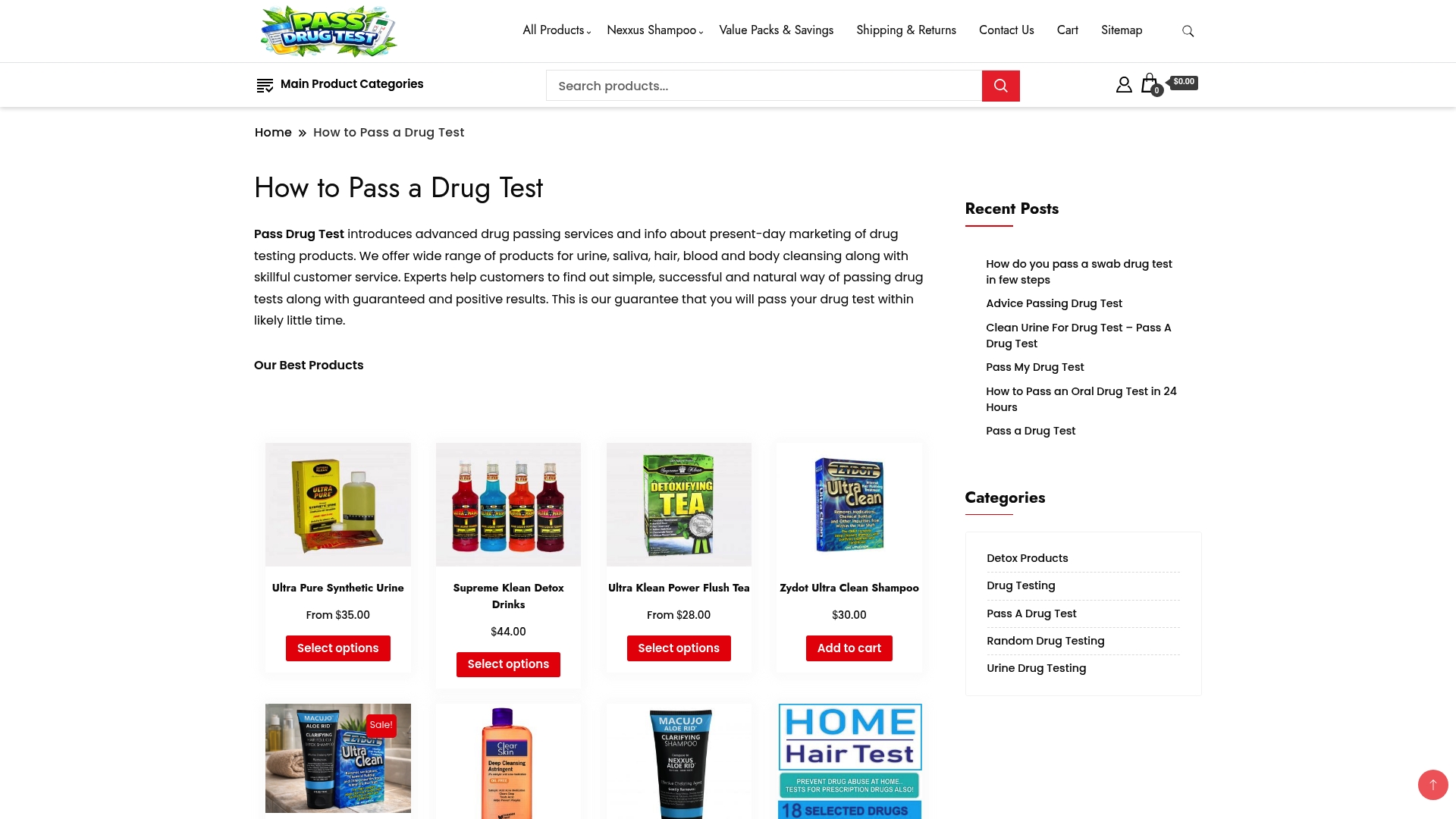
The kit works through repeated washing cycles designed to open the hair cuticle and strip surface residue more thoroughly than a single shampoo pass. Order with enough lead time, ideally 10 days before your test, since the method requires multiple sessions rather than a one-time fix. Follow the instructions as written: don’t over-bleach hair beforehand, don’t skip wash cycles to save time, and don’t assume more product means better results. If you can, pick up a home test kit and check your status a few days before the real one so you’re not walking in blind. For a bundled option that pairs the shampoo with additional treatment, the Macujo Aloe Rid Shampoo and Zydot Ultra Clean bundle covers both steps in one order.
Sources
- Manipulation of THC Hair Concentrations by Commercially Available Products – PMC
- Probing the hair detectability of prohibited substances in sports: an in vivo-in silico-clinical approach and analytical implications compared with plasma, urine, and faeces | Archives of Toxicology
- How to Pass Hair Drug Test: Complete Science-Backed Guide – Gary A. Cohen, M.D.
- Hair testing review — SAGE Journals
This article is general information, not a substitute for advice from a qualified lawyer. Consult a qualified legal professional about your own circumstances before acting on anything here.